

week 38 / 2026: condensers and collapses
In this instalment: the demise of the deodand; a history of the microphone; and a gloss on civilisational collapse. Plus: the more-than-human in Haraway! The set-pieces in Iain M Banks! And my seeming inability to say no to academic writing opportunities, despite no longer being an academic!

“I stare at the cracks in the wall / I think I’m unravelling / a silverfish slithering away / from everything, and everyone...”
Greetings from Malmö, where the shift of seasons is heralded by the return of the silverfish, who seem to surge in and out of the house around the autumn and spring equinoxes, respectively, and whose lust for paper and adhesives presents problems for anyone, like me, who owns a lot of dead-tree books.
This week, we’re looking at little legal oddities, the interface of a mass medium, and the minor matter of how civilisations come to an end.
plugwork
Just to let you know that I’ve got some public appearances in the pipeline.
- If you’re going to Bokmässan, otherwise known as Gothenburg Book Fair, you’ll be able to find me there on Thursday 24th September, hanging out at the Swedish games industry stand and talking about how we put together Over the riddle, the latest book collaborative foresight publication from Media Evolution. There’s a slot before lunch, and one later in the afternoon; if you’d like to meet up at some point in between, drop me a line.
- The book gets its home-town launch the following day, so if you’re anywhere near Malmö on the morning of Friday 25th September, please come hear me read from one of the stories while you slurp down a coffee! (Just don’t slurp too loudly, OK?)
- The week after next sees me over the water at Roskilde, where I’ll be giving a talk on speculative futures for urban planning at GRASP Festival on Thursday 1st October.
If you’re looking for someone to talk about futures and worldbuilding at your event or organisation, I’d love to help—so drop me a line and tell me what you need!
OK, back to the usual format. Are you ready? Then let’s get scrolling…
among the pixels
I’ve always been a sucker for stories that show things to have worked in weirder ways than one thought—stories that reveal human affairs to be less a simple structure than a palimpsest, with new layers laid down atop the faded remnants of older ones. This short bit at the JSTOR blog about the demise of the deodand is just such a story:
When an object killed a person, the owner of that object was on the hook for the value of the thing in question. That money was due to the king, and theoretically was to be used for charitable purposes. In practice, it was usually collected by the local coroner, and often (though not always) given to the family of the deceased.
In theory, a deodand was a moving object that caused someone’s death. But in the course of eight hundred years, there can be a lot of variation, and when it comes to deodands, it’s much easier to identify the exception than the rule.
The deodand is of double interest to yours truly due to its demise being tied up with the rise of the railroads; where weird medieval legal concepts meet the early explosive growth of concrete infrastructures, there will you find my happiest of happy places.
If the deodand has whetted your appetite for more histories of the obscure and overlooked, then this review-essay at the London Review of Books about the history of the microphone will bring you a good half hour of pleasure.
One of the more recondite claims made by Kanye West during a notorious December 2022 interview with the far-right radio show host and conspiracy theorist Alex Jones was that Hitler ‘invented the very microphone I use as a musician’. Well, no, obviously. But it is true both that Hitler’s reliance on the distinctively tubular Neumann CMV3 when speaking at rallies and other public events earned it the nickname the Hitlerflasche, or Hitler Bottle, and that the quality of the CMV3’s audio signal played as significant a part in postwar developments in sound engineering as it had in the dissemination of Nazi propaganda.
It goes far beyond the book which is its ostensible object, to discuss forgotten composers of the early C20th and sound artists of the present moment, and uses a classic movie as a clothesline reference to help keep the whole piece aloft—so even if you’re not particularly interested in the topic (what’s wrong with you?!), it’s worth reading just for the craft of the writing.
Lastly, here’s a fairly short and accessible overview by Matthew Butterick of the scientific literature on civilisational collapse. I’m tempted to say this was a timely stumble-upon for me for two reasons: firstly it is relevant to a piece of fiction I’m working on, and secondly it’s just relevant, full stop.
The latter is less due to my thinking we’re suddenly any more doomed than before, despite yet another week of escalating Clever Sand hype and hysteria, and more due to my having some time ago read Joseph Tainter’s seminal work on collapse (which Butterick glosses herein), which concludes that it’s essentially inevitable:
Tainter agrees with the [The Limits to Growth] authors that we can’t simply grow our way out of the problem through, say, increased research investment, because such research cannot produce substitutes for all forms of social complexity. For instance, research can produce better software that can perform certain tasks more cheaply and thereby reduce organizational costs. But we can’t easily invent entire substitutes for the complex, socially valuable organizations that use the software, e.g.—the military, the judicial system, etc. Furthermore, increasing these research investments would require allocating an escalating proportion of our social wealth, which is already being spent on current goodies we’d rather not relinquish.
Butterick’s gloss reminds me, in the paragraph following the quote above, that Tainter didn’t think degrowth was a viable exit strategy, because it would leave a nation or bloc open to being trampled by those who elected to keep their foot on the gas. This is a very game-theoretical way of looking at it—which is not to say it’s necessarily wrong, but that it does make certain assumptions about how human beings and their societies behave, and those assumptions have been shown to be something of a self-fulfilling prophecy.
If that all sounds a bit bleak, it’s worth noting that to theorists like Tainter, “collapse” is not quite the devastating apocalypse that the word tends to conjure in the vernacular:
His definition of collapse is similar to that of [The Limits to Growth reports]: “a rapid, significant loss of an established level of sociopolitical complexity.” It doesn’t mean the end of a society, necessarily. Rather, it marks a point after which quality of life tends to get ever worse for ever more people.
Indeed, more recent scholarship in the field tends to emphasise the archaeological evidence that, for those at the bottom of any civilisational pyramid that “collapses”, things may actually improve in many ways, albeit after a period of messy turmoil… which may give you a hint of what I’m thinking about with regard to this piece of fiction I’m working on.
This is a reminder for me to add Tainter to my list of books for future semesters of Deep Reads here at Worldbuilding Agency, along with Graeber and Wengrow’s The Dawn of Everything… though I think I’ll have to give myself rather more than two weeks to re-read the latter, which is bloody huge.
between the pages
Speaking of Deep Reads, if you somehow managed to miss my essay on the more-than-human in Donna Haraway’s Staying With the Trouble, it’s still there for you to catch up on! Zero apologies for that shameless segue; the stats suggest it’s had quite a lot of readers, and I’ve received some very gratifying comments and emails about it, so I’m going to go out on my own limb and say it’s well worth your while.
 Paul Graham Raven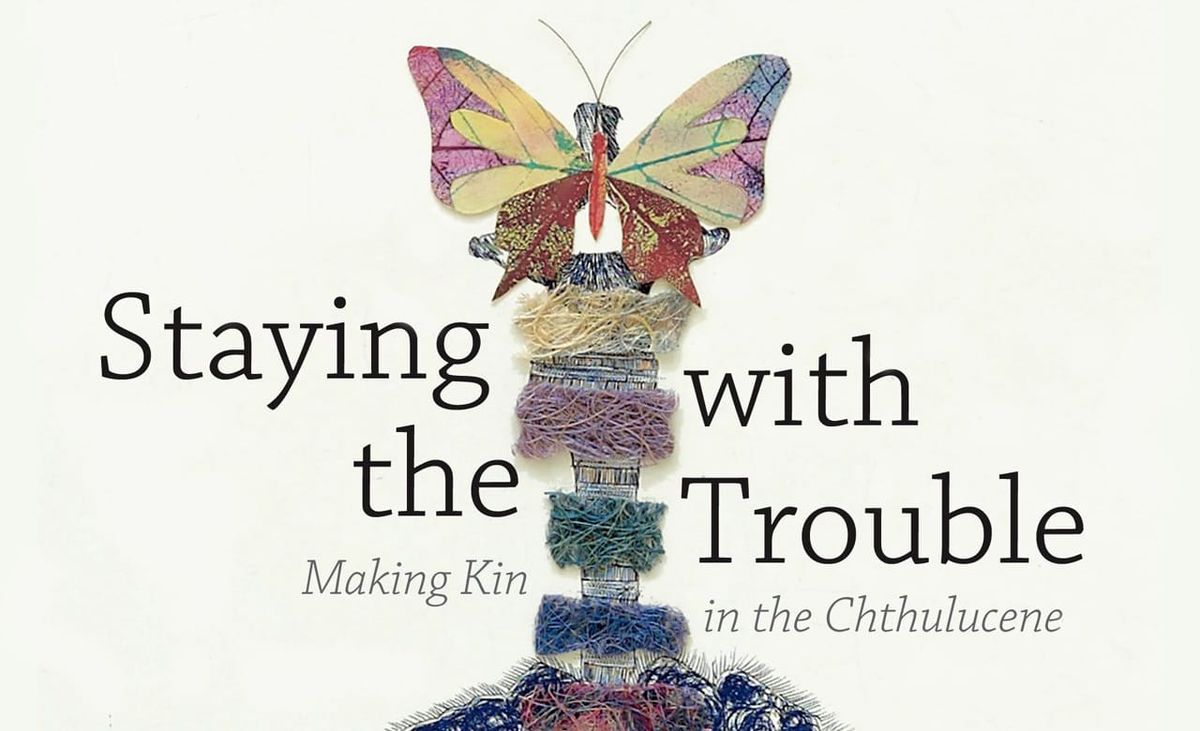
Next in the queue is David Edgerton’s The Shock of the Old, which should be mandatory reading for anyone thinking about futures, and particularly futures of “technology”. It’s a much easier book than the Haraway, and more obviously relevant to The Present Circumstances™—so if you found yourself struggling to stay with the trouble (and if you’ve ever wondered what I’m doing, beyond being a cranky pedant, when I put scare quotes around the word “technology”) then this should be a rather less daunting and more immediately applicable adventure on which to join me.
This week I also finished my re-read of Iain M Banks’s Consider Phlebas, which I mentioned last week. I had forgotten how much of this book comprises long and detailed action scenes and set-pieces, many of which I remembered with great clarity once I was nudged by the overall arc of the story. Much is made (and rightly so) of the sheer fecundity of Banks’s imagination, in the sense that he routinely came up with settings and set-ups that mashed hard on the old sensawunda buttons; I don’t recall so much attention being paid to his command of pace and detail at the sentence level within those set-pieces, but I’m finding it pretty impressive.
I mean, it’s one thing to write a scene in which your protagonist and his enemy end up having a fatal fist-fight underneath the skirt of a giant hovercraft, but it’s quite another thing to convey the disorientation of the characters without passing that disorientation wholesale to your reader…
lookback
This has been one of those “where did the week go?” sort of weeks. And, well—they’re all that sort of week, aren’t they? But this one in particular seems to have been marked mostly by my not giving anywhere near the amount of focussed time I had planned for certain projects.
There are a number of factors in play behind that outcome, but for the sake of honesty and my own learning, I should note that the most important factor was the Haraway essay eating up two full day’s-worth of focussed writing-time; that’s not a sustainable workload for what is essentially a give-away, no matter how much pleasure it may give me to do it.
However, as noted above, the Haraway was a seriously tough topic, and this was my first run with a new format; I’m hoping that it will get easier with practice, and with lighter subject matter! I feel like academia kinda robbed me of a certain developmental momentum as regards the essay, as much of my effort went into writing for that very particular audience—which is ironic, because now I’m outside of the sacred grove, most of that writing is unlikely to ever be read properly, or indeed to be read at all.
It probably wouldn’t have been read properly even if I had managed to make it past the postdoctoral bottleneck... but at least then it would have formed the functional spine of my CV. That’s exactly why I made a point of doing so much of it, against the well-intentioned advice of my supervisors: the curse of doing genuinely inter- or trans-disciplinary work is that you’re effectively illegible to both the disciplinary system and the major journals that serve and support it, so you have to try to make up for it by publishing anywhere that will let you say what you actually want to say, and hoping that you’ll get a decent citation score to make up for it. And I actually did quite well on that latter front… but it was not enough to make up for my other shortcomings, sadly, nor for the circumstances. Selah: I’ve mostly made my peace with it. I had a good run.
That said: the first and most painful thing you learn on leaving academia is that—unless you’re a very particular sort of specialist or already something of a rock star in your field—no one is ever going to ask you about your chapters and articles ever again. So it’s a mark of how much my academic work still matters to me that I’m currently on the hook for writing two academic publications, having already finished a third earlier in the year…
…yeah, yeah: my own worst enemy, I know. But when you believe in the work for its own sake, it’s hard to say no—because if you don’t do it, it goes undone forever.
ticked off
- Eight hours of essaywork (see above).
- Seven hours of admyn.
- Six hours of research.
- Four hours on PROJECT RADBURN. (One of those academic writing projects.)
- Three hours on PROJECT PILDAMM.
- Three hours on these here weeknotes.
- Two hours of blogging.
- Two hours of art practice.
- And ten hours of undirected writing and reading, as always, because the soul’s gotta eat if you’re gonna ask it to work.
There we go, then—time to put this in the out-tray, and then squeeze in an hour or two of monoprinting before I go home to my Sunday chores. In the meantime, thanks for your attention, which is always appreciated. I hope all is well with you, wherever you may be.
This has been the Worldbuilding Agency weeknotes for Week 38 of 2026. Thanks for reading! If you've enjoyed them, it's free to subscribe. If you are already subscribed, please send to a friend!


Comments ()