

week 42 / 2026: rooms and readings
A rare essay from Superflux’s Jon Adern offers us some amazing insights into how and why their speculative practice works to open up questions of futurity in a way that can’t be done with words alone. Also: some reasons you should see the movie Digger while it’s still in cinemas.

“Johnny’s in America, Johnny looks up at the stars / Johnny combs his hair, and Johnny wants pussy and cars...”
Greetings from Malmö, where the skies are steel grey one day and baby’s-eye blue the next, and the overnight temperatures are descending steadily. This week, we’re taking a long look at a rare reflection from one of the best speculative designers in the business.
OK, then—grab your washing and check you’ve got enough coins for the dryer, it’s time to get started…
among the pixels
I want to keep most of this week’s focus on this essay by Jon Adern. Jon is surely the quieter, more retiring half of the binary star system that is Superflux, but he has a powerful gravity of his own. This essay demonstrates why that should be the case, though that’s a side-effect of the core intention, which is to try to explain what it is that Superflux does (and why it matters) from the inside perspective.
In Jon’s case, that perspective is shaped by his dyslexia, which he suspects is a more general condition than the formal diagnostic criteria might allow, and which is particularly prevalent among (or perhaps even characteristic of) folk with an artistic temperament—though this is very much not one of those “my diagnosis is my superpower” routines. To the contrary, it’s an attempt to understand why understanding can be so hard to come by in systems of education and communication as currently constituted, and how adaptive strategies in some people for whom that system is a particularly difficult fit might end up looking like some sort of superpower.
Or, more succinctly, in the man’s own words:
I’m not better at using context than anyone else. I’m just worse at coping without it.
But it’s also about how the provision of context is the secret sauce that makes a Superflux project do that thing they do. In order to achieve that end, Jon explains a psychology experiment from the 1970s that illustrates the underlying problem:
Two psychologists, John Bransford and Marcia Johnson, played people a series of instructions. Every sentence is ordinary English. The procedure is quite simple and involves arranging things into different piles. If you don’t know what it’s about, it’s fog. The words go past and nothing sticks to anything, which by now might sound familiar.
Around fifty people took part, split into three groups. One group was told nothing. One was told beforehand that the passage was about washing clothes. One heard the passage first and got the context afterwards.
Out of nearly twenty instructions in the passage, the told-nothing group remembered about three. The context-first group remembered about six. The group told afterwards remembered about three, no better than the people who were never told at all.
It’s that third number that has stayed with me. Context has to be there while the information is arriving. Handed over afterwards, it did nothing. The same words, the only difference was having somewhere to put them.
The paper is called Contextual Prerequisites for Understanding. I’ve thought of it as the washing-clothes experiment ever since.
Later, he describes the Superflux approach as the building of “rooms”. Sometimes the rooms are literally rooms, as in the justly famed Mitigation of Shock, but some “are films. Some are an object with a poem beside it. A room [...] is a built context: enough of a world around you, in enough senses, that new things landing in it make sense on arrival.”
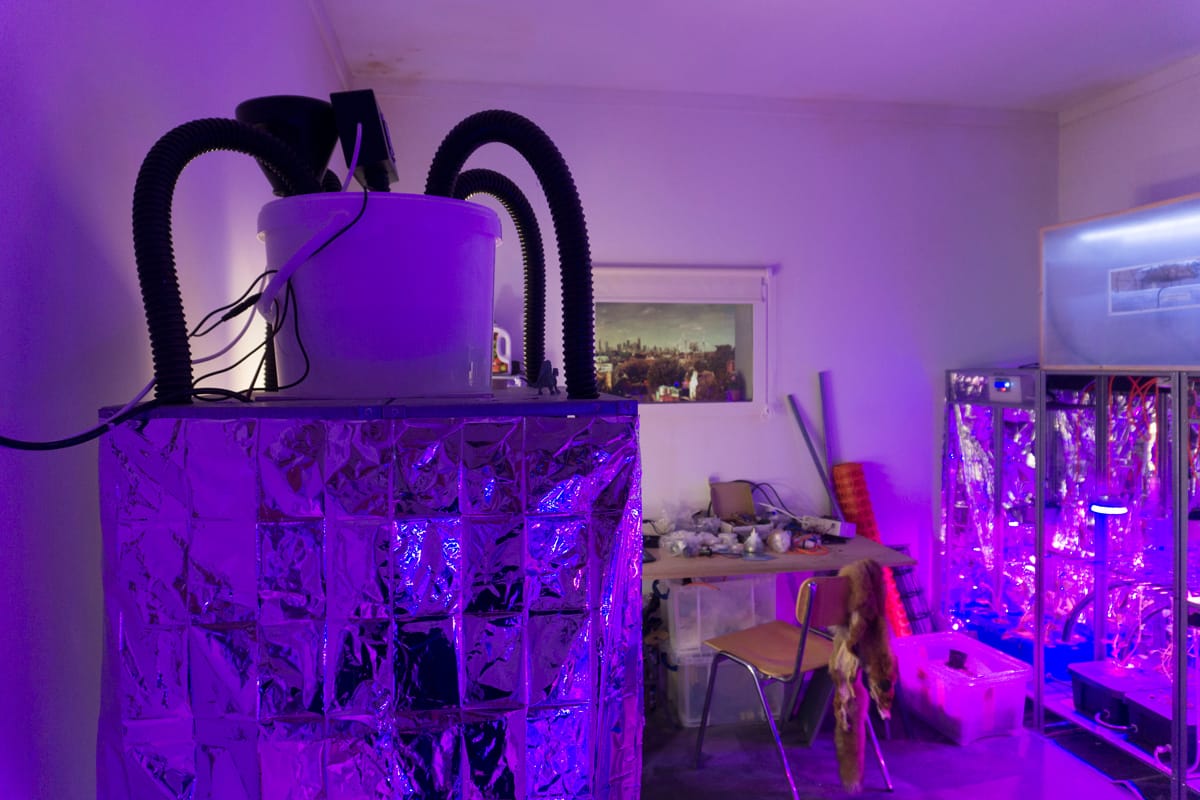
And what this gets us to is an explanation of what the very various practices that go under such names as “speculative design” and “design fiction” and “experiential futures” are doing that more traditional, “straight” forms of research and communication cannot:
Too many reports about the future are the topic-afterwards condition: here are the facts, assemble the world yourself, in your head, from a standing start, while reading. It’s about the hardest thing you can ask of a reader, and it gets handed out in forty-page documents, and then people wonder why nothing changes. A room reverses the order. You’re inside the context before you’re given a single fact to hold, and everything that arrives after that has somewhere to go. A good report can do the same. But a well-designed room can go further.
A room gives you the basket: the smell of the laundry, the damp weight of it, the other jobs waiting while you do this one. The context comes in through every sense you have, and the feeling is the part of it arriving on the channels that don’t carry words. That’s what the cottage was doing when it held a whole week together, and what the clay did in my hands. That’s what we’ve found works. Why it works as well as it does, we’re still finding out.
At the risk of seeming to take a strongly personal piece of writing by a major figure in the field and make it all about me, I found this piece particularly fascinating because it feels like the first time I’ve seen someone else really trying to theorise how and why these practices work from the perspective of the audience rather than the perspective of the creator. It is, in other words, a project somewhat related to my own attempts to think worldbuilding as a broader category of speculative practice, in order that we might consider it as a sort of meta-medium—but it takes a radically different route, even if I would argue that we end up describing a similar destination using very different words.
It would be a fine piece of work even if that were all it did, but I would argue that this is a particularly good essay in a more general sense because one of the core features of that otherwise incredibly loosely defined category is that an essay should feel like a journey made in the company of its author. (The parasociality of social media began, in other words, with Montaigne—or, more accurately, with the relationships that writers like Montaigne felt they had with the thinkers of previous generations.)
I’ve been lucky enough to know Jon for well over a decade, and to have worked with Superflux a number of times over the years, but I wouldn’t presume to say I know him well. I feel I know him better now—but, more importantly, I feel I know how who he is shows up in the work. If I ever manage to make people feel that way about my own efforts, I will count myself as having really achieved something.
between the pages
This section is somewhat inaccurately named this week, as while I have been doing some reading after last week’s fast—indeed, I have quite possibly been doing too much reading, and thus confirming that the boomerang effect of diets applies beyond the context of food—I’m actually going to mention a movie instead.
(Perhaps I should come up with a different subheader for such circumstances? Like, instead of between the pages, maybe it should be before the screen? Or something like that, at least… if you’ve got a suggestion, by all means hit reply and mail it in, our operators are waiting for your call &c &c.)

The movie in question is Digger, and I’m actually going to say very little about it here, because while I am in most circumstances pretty scathing about Spoilers Discourse, I think you really do have to see this film with minimal preconceptions. For those who’ve seen it already, or are cavalier enough not to care, you can read what I wrote about it on my personal blog.
I strongly recommend seeing it, and seeing it on a big screen rather than at home—though apparently the scale of its flopping means it may already be rather hard to find anywhere showing it? I guess it’s more than possible that you’ll end up on the side of the folk who thought it was confusing or grandiose or whatever else, but hey, look at it this way: in that case, you’ll have an informed personal opinion about a work of art that clearly has the capacity to provoke wildly different interpretations and emotional responses from its audiences.
(Which is the sort of thing that used to count for discourse, in the days before “discourse” came to mean getting together on the internet and baying for the blood of this week’s Main Character… and that shift might just be one of the things that this film is talking about. Eh, just go and see it—you can always email and tell me how much you thought it sucked!)
lookback
As hinted above, this week has been partly characterised by something of a backlash to last week’s reading fast. Looking at my ledger, I believe I spent no more than the usual amount of time reading this week, and maybe even a little less? But the effect of the fast is to have made myself suddenly hyper-aware of how much I’m reading: the decision to open up a tab or pick up a book has been made more conscious a thing than it was before, which means it feels… larger, somehow.
It’s also given me a sense of contrasting affect, which could be most simply summed up by saying that I felt so much more clear-headed and focussed while I was on the fast, but also less grumpy and negative. Adam Mastroianni (of Experimental History fame) wrote some years back about nixing his news habit, and I have to say pretty much everything here tracks with my own experience. I don’t read a lot of news anyway, but clearing away most of what still comes through in my feeds—and pruning also the stuff that seems mostly to serve as a goad to my ire—would seem like a wise move. I don’t need to quit reading completely, but it’s become fairly obvious that it’s a habit which, as currently constituted, drains my energy and wastes more time that could be spent on doing things I actually enjoy.
On the productivity side of the equation, this has been a decent week, though I am about a week behind on my general schedule, and have been for a few weeks now. PILDAMM took a lot longer than it was meant to: worldbuilding is perhaps the best job in the world, but it’s dangerously enjoyable, and as such it can be very hard to estimate how long it’s going to take to finish. (There’s no quantitative measure for the thickness of an imagined city, it turns out!) As such, I’m now catching up on commissions which should already have been subbed… but I’m not wildly late, and should be able to catch up over the next week or so.
(The commissioners of both outstanding projects are occasional readers of these here weeknotes, so, uh—sorry, I’m on it! Your patience is greatly appreciated.)
Finally, this week saw the start of the latest collaborative foresight cycle with my good friends at Media Evolution. The core group is all set and will start work next week, but I think there’s still spaces for the community critique session on Wednesday 11th November. It’s a great way to get a feel for how the process works, and to shape the work-in-progress… so if you’re in or around Malmö on that date, and you have opinions and/or feels on the topic of how artificially intelligent systems might (re)shape human-to-human collaboration in the workplace, then come along and join us!
ticked off
- Ten hours on PROJECT PILDAMM.
- Seven hours on a commissioned essay.
- Six hours of admyn.
- Four hours on PROJECT GESTALT. (That’s the foresight cycle.)
- Three hours on a fiction commission.
- Three hours on these here weeknotes.
- Two hours of other essaywork.
- Two hours of art practice.
- And ten hours (or maybe more?) of undirected writing and reading, as usual.
OK then—there’s more admynistrative bits and bobs to do before heading home for Sunday chores and laundry, so I’m going to sign off. Thanks for your attention, which is always appreciated! I hope all is well with you, wherever you may be.
This has been the Worldbuilding Agency weeknotes for Week 42 of 2026. Thanks for reading! If you've enjoyed them, it's free to subscribe. If you are already subscribed, please send to a friend!



Comments ()