

week 41 / 2026: after the fast
This week I have been reading quite literally nothing. Now you can read about why that is the case, and what effects it had.
“Revisit to an empty hall / you can’t see I’ve been burned before / well they tear you down and they’ll bear your shame / longevity, hear my pain...”
Greetings from Malmö, where the temperature has taken a very decisive turn toward the autumnal, and I’m therefore reacquainting myself with my flannel shirt collection. This week’s reading notes are about the reading that I very deliberately didn’t do.
Care to join me? Well, come on, then!
on an experiment in abstinence
This week I have been fasting from words—or, at least, from other people’s.
I’m currently re-running Julia Cameron’s famous Artist’s Way programme, which I first did nearly nine years ago, during a difficult and very low period of my life at the start of 2018. The element of the programme that really stuck for me in that first run was the so-called “morning pages”: first thing in the morning, before doing anything else, you sit down and you write three pages in longhand.
Write what, exactly? Whatever’s in your head at the time. It’s that simple—and that challenging.
I’ve done my morning pages ever since, and have missed perhaps a couple of dozen days in all that time, mostly due to either illness or very early-morning travel schedules. I have done pretty much all the other routines and exercises in the book, too—though none of the routines have stuck like the pages stuck.
But there’s one directive that I’ve never before managed to follow through on, which is the Week Four injunction to stop reading.
Cameron calls out in advance every possible excuse for welching on this particular promise, and I’ve used all of them many times over, particularly the ones rooted in professional necessity: I’m a writer, a researcher, a foresight practitioner, and I must read in order to do my job! And that’s true enough, to some degree, for me as for many others—but the point of the exercise is first to show that you don’t actually need to read quite so much as you might have convinced yourself you should, and second to show you what you could be doing instead.
Cameron says that many creative people are essentially addicted to reading, and while I much prefer the framing of habituation to that of addiction (for reasons too complicated to go into in this context), I think she’s basically right. At any rate, she’s certainly right in my case! Reading is perhaps the earliest and oldest of my habits, going back to a fairly early stage of my childhood. I doubt I’ve gone a full week without reading since the age of five?
In case you’re wondering, the injunction not to read does not include, say, email, or the other sorts of functional reading that one might have to do to get through a day in the modern world. At least, that’s how I’ve interpreted it; The Artist’s Way was originally published in the Nineties, when most people didn’t have email, and in my edition at least it doesn’t get a mention. This is one of those cases where you have to determine the spirit of the law rather than follow the letter, and my determination is that the reading you have to drop is exactly the discretionary stuff: all the reading that you don’t literally have to do to get through the week.
In the book, Cameron calls out TV as a related habit, another weapon of mass distraction; I haven’t had a television since the very early Noughties—yes, I’m that guy, and I make no apologies for it—but in search of the spirit of the thing I chose to expand the concept to cover other more contemporary sources of long-form narrative distraction, and forbade myself podcasts and online video-essays as well. However, I gave myself a few safety valves: I went to see a movie one evening, for instance, and I played a few hours of Pentiment, which as video games go is fairly text-forward (and also excellent, FYI).
So: no novels, no journalism, no journal papers, no essays or articles or newsletters. The toughest nut to crack was not the fiction, but rather the news. I’ve been going through my RSS feeds every morning for over two decades, because that was part of the writerly routine required of someone who came up during the gilded age of blogging, and the instinct to fill that void of knowledge on waking is still a strong and savage thing. (It is, in essence, a slower, deeper version of social media’s monkey-mind dopamine loop, which took that urge and optimised it for a truly terrible degree of stickiness.)
And yes, I did it—and it’s been quite an experience in a number of ways. In general, it has given me a new perspective on the way I use my time, in that I now realise that I’m probably putting in two or three hours of undirected reading each day, sometimes even more, rather than the one-per-weekday that I actually enter in the ledger. And that’s not even counting leisure/pleasure reading before bed, nor the aforementioned podcasts and so forth.
Without that habitual intake of other people’s words, you get instead an outflow of your own. Though it was unplanned, the timing has actually been quite fortuitous, because I had a lot of head-down worldbuilding work to do this week—and I found I was able to write more in an hour than usual, and to do a greater number of focussed writing hours than usual across the week as a whole. This extended to my conceiving and writing a whole extra essay, and a bunch of notes and fragments toward other things, and writing in the evenings, which I almost never usually do.
Cameron says that blocked creatives read obsessively because it frees them from the responsibility implicit in creative work: there is no risk of failure when you read someone else’s work (though there is of course the very real risk of resenting their seeming success). But I think it’s also about quieting the inner voice, or perhaps just giving it something to react to. That may not be the case for everyone, I suppose—but I can tell you that I have been talking aloud to myself much more than usual this week, and I don’t think that’s incidental.
I’m very glad I did it, and I’m going to suggest that you should try it too. It’s a real revelation with regard to one’s daily habits, and to their surprising plasticity: it will seem impossible, but it is not.
(Indeed, I’d recommend the whole The Artist’s Way programme to pretty much anyone, whether they identify as an artist or not. That recommendation doesn’t come without caveats, to be sure, but I have to believe that any reasonably smart person—which is to say, any of you reading this right now—will be capable of taking from it what’s good and useful for them, and leaving what isn’t, just as I was.)
It’s also been clarifying with regard to current events more generally. Since quitting social media, it’s been a number of years since I was last really riding the bleeding edge of the news cycle, but it still moves pretty fast—and this past week, I’ve been almost completely unplugged from it. Opening up the feeds today, I can see that plenty has happened, but little has changed, and almost nothing has occurred to which I could have in any way usefully reacted or responded in the moment.
The lesson here is that the world does not require your attention in order to keep happening. I have always told myself I needed to stay on top of the news because my work involves thinking about futurity, but fasting from the news reveals the essential contradiction in this idea: rather than looking into the future, to read the news is to be more like Benjamin’s angel of history, perceiving the passing of time not as a chain of events, but rather as “one single catastrophe which keeps piling wreckage upon wreckage and hurls it in front of [your] feet”.
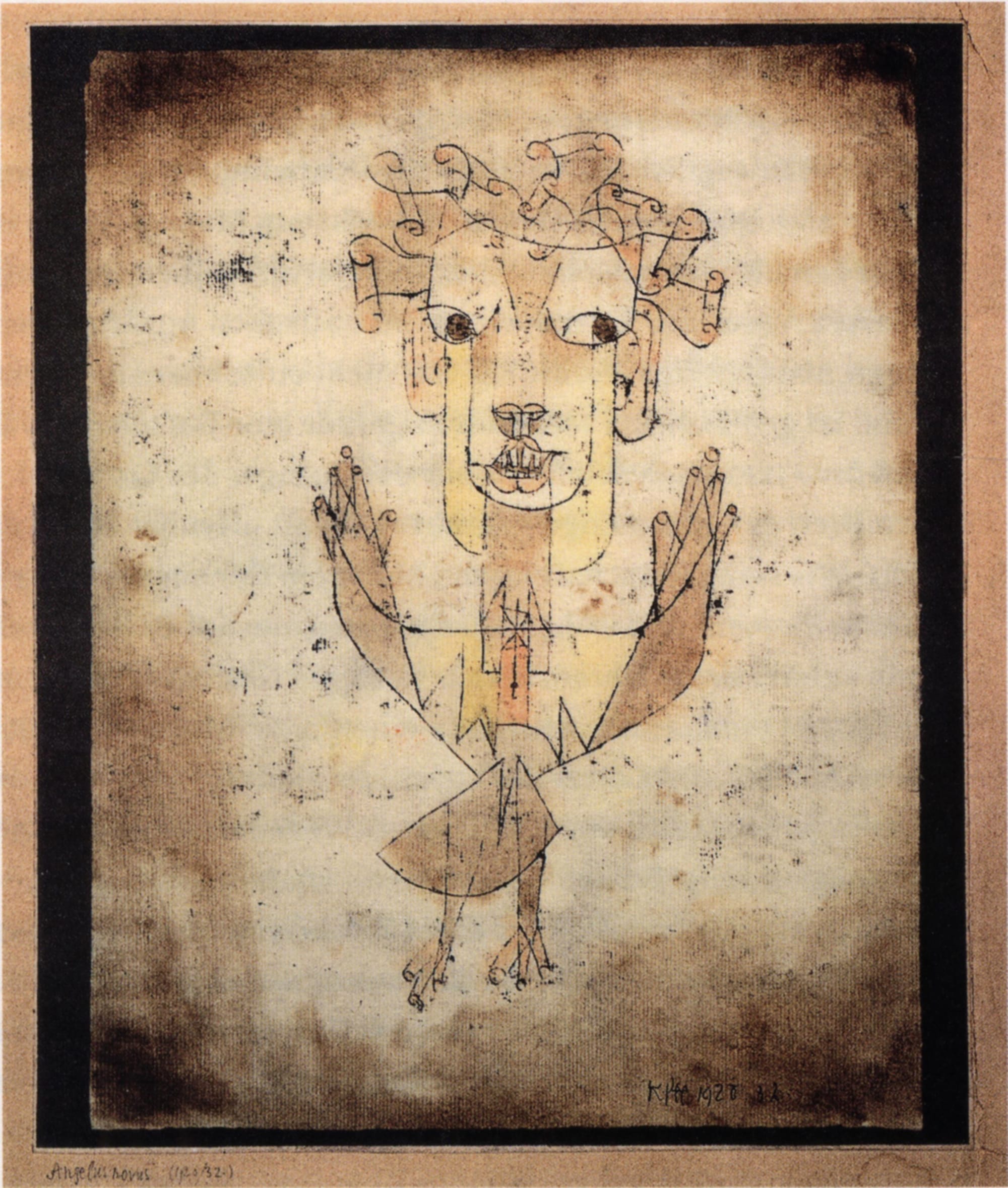
The storm that is blowing Angelus Novus into the future, says Benjamin, “is what we call progress”. As such, you cannot remove yourself from its winds, whether by reading less or any other change of habit. But you can perhaps stop torturing yourself with the desire to “make whole what has been smashed”, and choose instead to build something new.
ticked off
- Twenty hours on PROJECT PILDAMM. (Which translates to something like 12,000 words of gazetteer material for a worldbuilding gig—which is to say, not merely typing, but instead creating-through-typing, which is the very best of good times. Exhausting, though! You know when you’re done for the day, because suddenly you just can’t do any more, like someone threw a switch.)
- Seven hours of essaywork. (Some of the results of this can be found at my personal blog, if you’ve an interest in my opinions on the shifting dynamics of gender representation in the TOCs of genre fiction anthologies.)
- Five hours of art practice.
- Four hours of admyn.
- Three hours on these here weeknotes.
- And at least ten hours of undirected writing, because when deprived of its security blanket my mind apparently reverts to something approaching full graphomania.
Apologies to those of you who turned up expecting the usual clippings and reading notes; regular service, such as it ever is, will be resumed next week! (I may have to adjust my Deep Reads schedule a bit, though...)
In the meantime, thanks again for your attention, which is always appreciated! I hope all is well with you, wherever you may be.
This has been the Worldbuilding Agency weeknotes for Week 41 of 2026. Thanks for reading! If you've enjoyed them, it's free to subscribe. If you are already subscribed, please send to a friend!


Comments ()