

week 39 / 2026: utilities and utilitarianisms
Path dependency in infrastructure is not just a hardware issue, and Effective Altruism (for all its failings) fills a gap identified by its critics. Plus: form echoes function in the writing of Stephen Jay Gould! And the Gothenburg book fair is inimical to the authorial sensibility!

“We want to extend the earth / to the fringes of the cosmos...”
(The new album from The Ocean is a proper belter, folks. Get on it!)
Greetings from Malmö, where we are pointedly not discussing the passing of the autumn equinox. Instead, we’re taking a long look at the energy system of the British Isles, and trying to treat Effective Altruism as a philosophical argument made in good faith, in order to understand its appeal…
plugwork
Just to let you know that I’ve got some public appearances in the pipeline.
- Next week sees me over the water at Roskilde, where I’ll be giving a talk on speculative futures for urban planning at GRASP Festival on Thursday 1st October.
- And in keeping with the Danish theme, I’ll be doing an afternoon of tarot readings for strategy at Fabrika festival in Copenhagen on Thursday 29th October. Maybe see you there?
If you’re looking for someone to talk about futures and worldbuilding at your event or organisation, I’d love to help—so drop me a line and tell me what you need! Tarot services also available.
Right, then—we good to go? Then let’s get it on…
among the pixels
Once an infrastructure nerd, always an infrastructure nerd—or at least that’s what I tell myself when I find my reading ledger peppered with long essays about the UK’s struggles to enact some sort of transition in its energy system.
(In truth, I would read this sort of stuff about pretty much any country, and particularly Sweden! But stuff at this level of wonkishness tends to be written for an audience of native specialists, which means I’m mostly restricted to reading about the infrastructural travails of the English-speaking world only.)
My shortest summary possible of this very long article would be something like “there’s a genuine need and desire to drive down the UK’s reliance on fossil fuels and keep control of energy prices, but historical choices made in favour of ‘market-based solutions’ have made it extraordinarily difficult to do either of those things”.
Britain’s energy strategy over the last two decades has been predicated on the assumption that generating electricity from renewables is cheaper than generating it from fossil fuels. ‘Decarbonisation’ was supposed to drive down prices and encourage consumers to switch from using fossil fuels for driving and heating. This hasn’t happened. One important metric is the share of final energy demand serviced by electricity: it has barely increased over the last two decades, going from 19 per cent in 2000 to 21 per cent in 2023. Between 2000 and 2019 electricity consumption per capita actually fell by 22 per cent. Only Yemen, Zimbabwe, Jamaica, Tajikistan and Syria have had greater drops.
To most readers of this site, I imagine that will hardly come across as news; to some others, it may come across as an eye-rolling cliché of economic leftism. To either category of reader, I recommend spending the time to absorb the whole thing, if only to get a sense of the complexity involved, and of the extent to which political choices made many decades previously become as foundational to the operation of the system as the concrete and steel of the physical infrastructures themselves.
We can debate the matter of how we might better manage the socioeconomic aspects of energy generation and distribution—but as is always the case when we try to discuss where we’re going, we’d make a better job of it if we understood how we ended up where we are now.
I mentioned a few weeks back that I make some effort to give a fair hearing to ideas that I find unpalatable or crazy, though the amount of effort made varies quite widely with the extent of the unpalatability or craziness in question. As such, I try to keep at least half an eye on the Rationalism scene, for much the same reasons I have long kept an eye on the transhumanist scene: in both cases, my distaste is tied up tightly with the way that these intellectual programmes appeal strongly to me on a fairly fundamental level.
This is particularly obvious when it comes to Effective Altruism, a successful and influential spur or subculture of Rationalism that is very entangled with Silicon Valley tech culture. Readers unfamiliar with the name of the movement may at least recognise the name of one of its more famous sons: convicted crypto fraudster Sam Bankman-Fried was (and maybe still is?) an EA advocate, and the philosophy was at least partly implicated in the architecture of his justifications of his actions—as it is in the current decisions of some of the bigger players in the “AI” scene.
Effective Altruism is perhaps most easily glossed as a maximalist variant of utilitarianism, and its fundamentally quantitative approach to determining the best course of action may go a long way to explaining its popularity in subcultures where the engineering mindset has heavy influence. I was raised by engineers and (at least initially) educated to become one, which may explain why I was once quite attracted to utilitarian frameworks myself.
But after a couple of decades of living in a culture where that same mindset has become the default setting for policymaking and institutional design at pretty much every level from the state on downward, it’s hard not to see EA as a sort of unwitting auto-parody of its most basic contradictions:
To free up cash for projects like these, effective altruists have built out an impressive toolkit of money-saving devices. For instance, most of the EAs at my table are not eating breakfast. Instead they are drinking Soylent, a nutritional shake which is perplexingly named after the nutritional wafer made from human remains in the 1973 dystopian thriller Soylent Green. Soylent is a nutritionally complete meal replacement, meaning that it contains all 28 vitamins and minerals required to maintain and regenerate the human body. It tastes sweet and slightly stale, and is almost redundantly smooth, like liquefied pudding, clotting unpleasantly in your esophagus before sliding into the pit of your stomach, where it sticks like cement. Scientifically, you can drink only Soylent for the rest of your life and remain in perfect health.
The author of this piece is also clearly repelled in some ways by the EA culture, but at the same time strongly attracted to its logic. What makes it really interesting is their argument that its appeal lies in its addressing the very gap of purpose that so many critics of EA lament:
Both on the right and the left [...] professional critics tend to enjoy fussing over my generation’s alleged crisis of purpose. And yet here comes effective altruism, offering not only community and purpose but also the rituals that—more than faith—keep the beat of religious life. Like every major religious tradition in the world, it provides moral instruction regarding diet, vocation and charity. In many ways, it is not much more or less than the rediscovery of the ancient and universal ambition to help the downtrodden, updated for the ears of a ruling class accustomed to statistics. Like any religious practice, it can be more or less demanding, communal, mystical, stringent or bonkers, depending on who you ask.
This is an interesting conclusion in many ways, not least of which is the irony of falling back on an emotional (and hence de facto irrational) argument for the appeal of a rationalist ethical framework. I try to assume that the beliefs of others are stated in as good a faith as I state my own. I have believed many different things over the years, and I believed them all sincerely at the time; the sincerity of the EA types is perhaps the hardest thing about them to doubt, at least for me.
But the actual framework gives me the creeps, as does the movement, and it would take me a lot of words to explain exactly why. The concise version has two parts: firstly, the road to hell is paved with good intentions; second, if it looks like a cult, it’s almost certainly a cult.
Which leaves us with the question of why people are drawn to cults, and the partial answer provided by Levov above…
between the pages
This week I’ve been re-reading David Edgerton’s The Shock of the Old in preparation for next week’s Deep Reads essay, but you’ll have to wait until Wednesday for that!
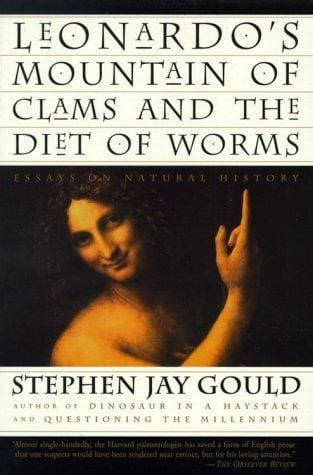
I’ve also been reading one essay per evening from the Stephen Jay Gould collection that bears the gloriously verbose title Leonardo’s Mountain of Clams and the Diet of Worms, and contains a run of Gould’s essays written for the USian magazine Natural History. These are mostly mildly hagiographic studies of science and scientists, predominantly with some connection to evolutionary theory; the form and format is already a bit repetitive, after reading around half of the book, but Gould’s sentence-level style has a sort of calm lyricism that makes it pretty good bedtime reading.
It also stands in contrast to the vast majority of other science writing in the same fields, and not just at the time these pieces were written (I.e. the late 1990s): the careful, measured prose echoes Gould’s careful, measured approach to science itself, which put him on the wrong side of the so-called “Darwin wars”.
I’ve been vaguely aware of Gould for many years for exactly this reason. Back when I was myself much more aligned with the prevailing New Atheism—a period which, not coincidentally, overlapped with my peak engagement with utilitarianism, as discussed above—his was a name that featured regularly in that movement’s demonology. But as I came to first distrust and later revile not only utilitarianism but evolutionary psychology (and related disciplines), and came to see figures like Dawkins, Pinker and Dennett as hypocrites pontificating way beyond the bounds of their disciplinary expertise, I started to think that maybe it was time to summon up this particular prince of hell for a more sustained discussion.
On the basis of the writing in these essays, I still intend to do so! But I think I need to go after the man’s monographs rather than his essays—particularly given the resurgence of interest in biological determinism and so-called “race science”, which Gould was opposing in its somewhat more subtle (or perhaps simply less shameless) form back in the 1980s.
lookback
I took the early train to Gothenburg of Thursday morning, in order to do some promo work around Over the Riddle, the latest collaborative foresight book from my good friends at Media Evolution.
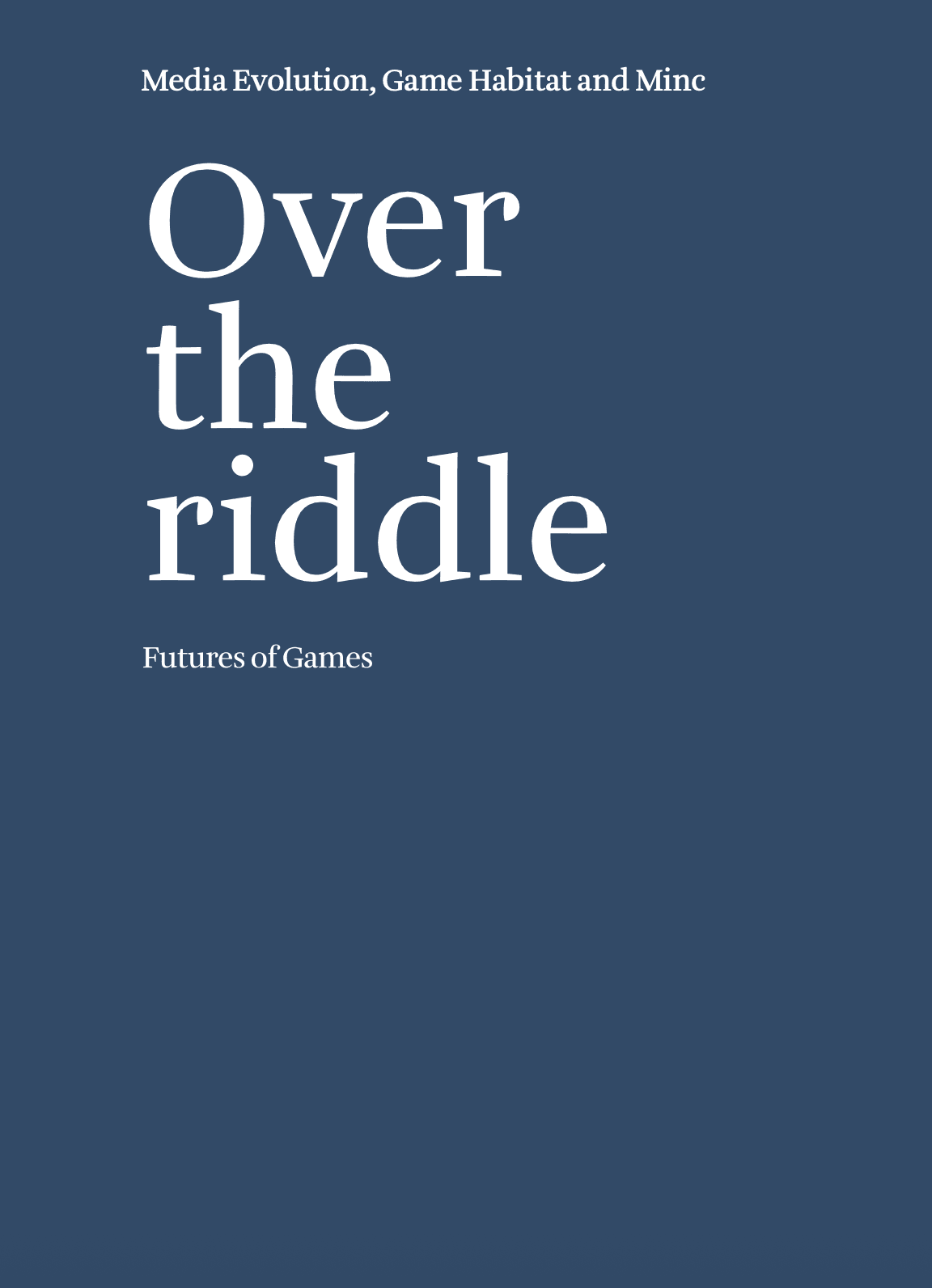
(This was PROJECT LUDIC, of course. All the content of the book is linked there in online form, including all four of the stories I wrote, but you can also request a free PDF copy, or grab a physical one if you’re passing through Malmö! Big thanks to Game Habitat, Minc and Region Skåne for making the project possible, and making it so we can just give away the results.)
As I have said to a number of people in the days since: you’d probably think that the Gothenburg book fair is the sort of place that any writer would absolutely love to be, but for this writer at least, it was about as unconducive an environment as I could possibly imagine.
This isn’t entirely surprising, once you give it some thought. After all, it is in essence a giant trade fair, albeit one with strong legacy threads from Sweden’s residual social-democratic literary culture—which means that, yes, you get stands with presses large and small showing off their latest books alongside solo self-published authors promising to “unleash your inner millionaire”, and displays from the games industry (tabletop, digital and everything in between) competing for attention with talking-head panels arranged by, for instance, the Swedish James Joyce Society.
All that I could probably have coped with well enough, were it not for the basic environmental issue: it’s a vast and overly warm conference hall, crowded with thousands of people all talking loudly at once. I’m fond of saying that the writer’s natural environment is to be alone in a small, quiet room with the door closed; for all the many fine things that it may be, Bokmässan is very much not that.
That said, it was nice to hang out with the Game Habitat team for a day, and to shift a box or so of books to curious punters wandering past; I also got to have dinner (and a few restorative beers) with a local friend before getting the last train home. But it was a very long day, and everywhere I went there seemed to be people coughing and sniffing and blowing their noses, so I am half expecting to be hors de combat in the coming week due to whatever plague is currently doing the rounds…
ticked off
- Eight hours of promotional work. (Damned right I'm putting it on the ledger! It was not leisure time, by any means.)
- Six hours of admyn.
- Four hours on PROJECT PILDAMM.
- Four hours of essaywork.
- Three hours of art practice.
- Three hours on these here weeknotes.
- Two hours of research.
- Two hours of bizdev.
- Two hours of networking.
- One hour of blogging.
- And ten hours of undirected writing and reading, albeit somewhat chopped up and out of schedule due to early starts and time spent on trains.
(There are great merits to having a routine, but the overlooked downside is that when circumstances necessitate the disruption of your routine, you’re left feeling a bit unmoored and out of sorts. Unless that’s just the incipient book-fair plague...)
Right then, that’s all for this week—I’ve got chores to do, plus writing jobs on which I need to make up lost time, so I’ll bid you farewell. In the meantime, thanks for your attention, which is always appreciated. I hope all is well with you, wherever you may be.
This has been the Worldbuilding Agency weeknotes for Week 39 of 2026. Thanks for reading! If you've enjoyed them, it's free to subscribe. If you are already subscribed, please send to a friend!


Comments ()