

week 34 / 2026: boats and boxes
In this instalment: container shipping is starting to hit its logistical limits, at least on the land, even as it enables some seriously dirty business models. Plus: Byung-Chul Han, and E J Swift’s Clarke Award-winning novel When There Are Wolves Again!

“I make my way over the dunes / desolate and dry / the remnants of empires past / too stubborn to die…”
 Mr. Roberto
Greetings from Malmö, where teenagers haunt playgrounds and carparks, exhibiting the restlessness that accompanies the end of summer’s freedoms. This week we’re asking where the shipping containers go, and what’s inside them, before sitting down to think with Byung-Chul Han…
Are we good to go? Then raise the anchor, and let’s set sail…
among the pixels
Many moons ago I was asked to answer a question along the lines of “what was the most consequential technology of the C20th”. Setting aside my usual qualms about such questions—like, what do we even mean when we say “technology”? how do you propose to quantify consequentiality?*—I gave a fairly straight answer: the shipping container.
(* Yeah, I’m an absolute blast at parties, me.)
This piece at the Financial Times goes some way to explaining why, though of course it’s rather more celebratory of efficiency and the weakening of labour power than I would be:
For decades before the 1950s there were attempts to standardise the messy business of cargo shipping. Open wooden boxes for coal to be hoisted by cranes from barges to railway carriages during the English industrial revolution were arguably the first “intermodal” containers, capable of switching from one form of transport to another.
The growth of rail freight across Europe also drove moves to regulate the “lift van” boxes — heavy wooden crates used in railcars. A bureau set up by the Paris-based International Chamber of Commerce in June 1933 set rules for containers used in western Europe to fit crosswise on railway cars and lengthways on the flat beds of trucks.
Later, the US Army developed a “transporter” — a ribbed steel box just over eight feet long — that would remain sealed until the point of delivery and led to the 1952 creation of the “container express” or Conex. These boxes, which could be easily shifted between road, rail and ships, halved shipping time from the US to Korea from 55 to 27 days and reduced theft on the docks.
Any infrastructure nerd worth their salt already knows most of this stuff. What’s new are the signs of a paradigm starting to hit its limits: the capacity of container shipping itself is hypothetically limitless (if you choose to overlook the emissions problem, which seems to be a very fashionable thing to do), but you’ve still got to get the containers to the port and onto the ship—and that’s starting to be a serious bottleneck.
Then there’s the trade imbalances, particularly (but not exclusively) between China and the west, which has effects other than the purely economic. Sending the containers back east with nothing in them is a drag on profits:
“On the Asia-US route, it used to be that for every 10 containers coming from Asia about six were going back with US exports. Today that is more like three or four [going] back full,” says one container shipping executive. “We’re moving a higher percentage of containers empty now than we ever have done before.”
That means more expensive freight rates for Asian exports or shipping companies scrambling to find cargo to fill their ships.
“We are generally trying to find any containerised goods,” the executive says. Scrap paper for recycling, wine in huge plastic bags and even grains that would normally be shipped loose in dry-cargo ships have become critical backhaul trades.
The mention of scrap paper is a hint at the problematics, here. If you’re already aware of the system by which the west is shipping all sorts of waste—particularly electronic scrap, but also plastics and other things that have become tricky or expensive to dispose of locally—to low-income countries where new businesses are promising to recycle them, you can probably see what I’m seeing: a further structural incentive for a dirty, exploitative and frequently cynical business model. When you sort your plastics and other household waste, you probably assume it’s off to be recycled; in a lot of European cities, it actually goes straight to the local furnace to be burned for energy generation. Commercial waste, meanwhile, is theoretically held to higher standards of disposal—but what that can mean in reality is handing it off to a “recycling” company that ships it to remote parts of Turkey and burns it, before tipping the spoils into the local rivers.
(And if you’re not already aware of how it goes with electronic waste, then you really need to get yourself informed.)
The cheaper it becomes to ship what is basically ballast to the south and east of Europe and the US, the more profitable it will become to set up a business that relieves western businesses of negative environmental externalities by dumping them on the less regulated environment of the rest of the world.
In my doctoral work, I developed a definition of infrastructure as a system-of-systems whose core purpose is to bring that which is desired closer to you, and to to move that which is undesirable to where it can no longer be seen. Unless you’ve made a deliberate effort to do so, you’ve probably never seen a landfill site. That’s quite deliberate, an expression of the logic of waste infrastructure in action, which is essentially Victorian in its prurience: fixing the problem at source (i.e. reducing the amount of noxious material produced) comes a very distant second to getting it out of the sight (and smell!) of anyone who might have the wherewithal to make it a political issue.
That model is now working at the scale of countries and blocs as well as at the scale of towns and cities. So, next time you hear someone mutter about “pull factors” in the context of migration from global south to north, consider instead the factors which might be pushing.
Looping back to the question of shipping more broadly, the port facility bottleneck is prompting a search for more capacity—but space is at a premium, so automation is the holy grail, as it is everywhere else. Quite who will be able to buy the stuff that gets moved around the globe in shipping containers once we’ve all been replaced by machines is a question that no one seems particularly keen to ask…
Moving from the very concrete to the somewhat more abstract, The New Atlantis has an overview of the work of the Korean-German philosopher Byung-Chul Han. I’ve been vaguely aware of Han’s work for a while, but have yet to read any of his books; this piece is a reminder that I should address that oversight. Maybe you should, too?
Heidegger had argued that moods are not merely psychological states. They are ways in which the world comes into view. The mood of a painting, for example, is not simply an addition to an otherwise neutral scene. It is the very atmosphere — of, say, a stormy sea or a sunlit haystack — that can never be reduced to the objects in the frame. Peasant shoes in a Van Gogh painting can evoke a world of labor, of soil, of fields and the weight of rural life. Painting is an art of disclosure. And like the art of painting, wrote Han, “Philosophy always takes place in a basic mood.”
What Han would later diagnose as burnout is not just a condition of exhaustion; it is a condition of perception. Moods are how we feel the world, even before we think about it. They are less like emotions than the background conditions of our experience, like slow-moving weather patterns that give times and places their character. They cannot be examined like objects from the outside — we are always already within them — but they can be named and described. In Heidegger, Han found a way to notice them. And it made him weather-wise, alert to the world at a time when the weather was changing.
between the pages
I’ve gotten quite a bit of book reading done over the last couple of weeks, which leaves me unusually spoiled with choice regarding what to talk about here. It’s not often I get to lean on topicality, either, so I’m gonna grab it while I can: E J Swift’s When There Are Wolves Again won this year’s Arthur C Clarke Award last week, and I happened to have a copy in my bag while I was in Berlin, having acquired it around a month previous.
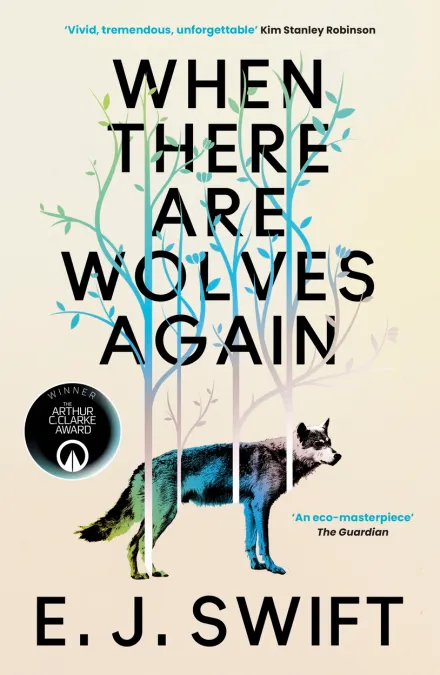
The Clarke is a juried award, and I imagine that the context in which the deliberations were taking place were to the book’s advantage in terms of its seeming timely: the run of savage heatwaves that struck the UK (and many other places) this summer must have felt like pages torn from Swift’s future and pasted into the present.
Wolves is a story about the rewilding of the British Isles. In that sense, it is a hopeful novel, but it does not shy away from either the environmental consequences that decades—nay, centuries—of pollution and enclosure have made inevitable, or the political turmoil that will attend those consequences, as well as the changes that will need to be made in response to them.
Swift makes what might have been a drily technical and political story into a highly emotive one, partly through her deft decisions with regard to character choices. The two focaliser-narrators are both alienated from their origins: Hester, born the day of the Chernobyl accident, fled the family farm in her late teens for the numb wasteland of precariat labour before eventually finding creative escape (and, later, opportunity) as a documentary filmmaker; Lucy, meanwhile, is a primary school-age child when she’s shipped off to stay with her grandparents during the pandemic of 2020, where she finds affection and interests which her careerist parents are unable or unwilling to provide. Both become intensely engaged in climate politics, but in very different ways: Hester’s chapters are narrated in the second person, emphasising the extent to which she has come to identify with the camera eye of her calling, through which she works to make sense (and story) of the beauty and horror of the world, while Lucy, inspired by her grandmother, becomes a direct-action activist and organiser, less by deliberate choice than by doing what feels necessary to her when the opportunities arise.
Both narrators are extremely inward people, who do not feel they belong in the world in which they came to adulthood. Having this layer of personal stakes to balance the big-picture climate stuff gives this novel an emotive impact that Kim Stanley Robinson’s climate futures never really manage to pull off: Swift makes the problems feel very personal and immediate, and we feel not just the abstract tragedy of the catastrophes that occur, but the very concrete heartbreak of living through them, as well as the joys of hard-won triumphs along the way.
I did a fair bit of crying while reading this novel, but they were not always tears of sadness; there are moments of joy and hope throughout, and if it feels like a rollercoaster as you swoop between these highs and the savage lows of crisis and disaster, then that’s testament to Swift’s capturing the dynamics of individual lives, as well as the back and forth struggles of long-haul political work. In a period where it can feel like the environmental movement has been kicked to the curb, it’s a timely reminder that change comes in fits and starts, powered by the work of those who don’t give up in the worst moments.
Politics aside, it’s also a compact, powerful novel, beautifully written and carefully constructed. Heartily recommended.
lookback
The bahn-gods had mercy on me as I returned from Berlin early this week, but I did not escape completely unscathed: I may not have picked up any substantial delays on my journey, but I definitely picked up some minor form of train-plague. As such, this has been a rather slow week, work-wise; I just didn’t have the spoons to do more than futz about with overdue admyn and poke at half-cooked bits of writing, in between bursts of proofing for the final sprint of PROJECT LUDIC.
I seem mostly to be over it, though, so I’m hoping that next week I can hit the ground at a decent walking pace, if not exactly running right away. There’s plenty of writing to do, including a fun little fiction commission (with a very spicy deadline) that’s gonna contrast nicely with the more academic form of the other stuff…
ticked off
- Nine hours of admyn.
- Eight hours of essaywork.
- Six hours of proofing and edits for LUDIC.
- Three hours on these here weeknotes.
- One hour of networking.
- One hour of blogging.
- One hour of art practice.
- And ten hours of undirected writing and reading, as always.
Right, that’s my duties discharged for the week. Now I’m gonna make the time for some collage work; I managed to scare up a very affordable desk magnifier on Blocket, so it’s time to see how much easier it will make the more fiddly cutting tasks I’ve got waiting to be done!
In the meantime, thank you for your attention, which is always appreciated; I hope all is well with you, wherever you may be.
This has been the Worldbuilding Agency weeknotes for Week 34 of 2026. Thanks for reading! If you've enjoyed them, it's free to subscribe. If you are already subscribed, please send to a friend!


Comments ()