

week 47 / 2026: genres and gen(i)uses
Some thoughts in recommendation of M John Harrison’s Booker-winning novel, The End of Everything—does it represent the end of the genre it seeks to escape from? Plus the return of Lamarckian evolutionary theory, and the challenge of narrating agency in complex systems.
“You get down, real low down / you listen to Coltrane, derail your own train / well, who hasn’t been there before?”
Greetings from Malmö, where I have sworn roundly at three different people in the last seven days for making the chipper observation that it’s only five weeks until Christmas. (Yes, so now you get to swear roundly at me.)
OK, onwards!
among the pixels
If you’re at all interested in written fiction, you’ve probably heard that this year’s Booker Prize went to M John Harrison. You’ve likely also heard that he’s a science fiction writer, and the first such writer to win this most prestigious of literary prizes.
Now, neither of those two latter points are strictly true, and the fuzziness and dubitability of both of them have spawned a busy swirl of debate in the more literary corners of science fiction fandom. There’s no denying that novels featuring tropes and techniques that might be identified as science fictional in their origins have won the Booker before—but the categorisation of such books by fandom as belonging to the genre (or not) is always contentious, not least due to an enduring resentment of touristic “outsiders” wandering into the genre ghetto and making off with its best-loved knick-knacks.
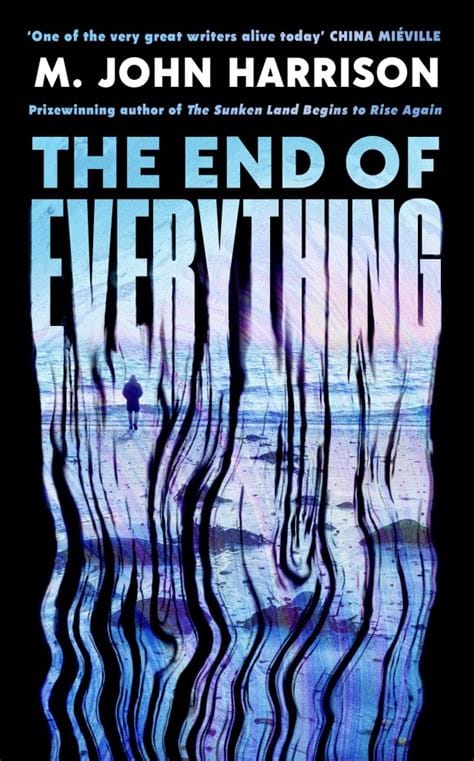
Given Mike Harrison’s six-decade career began at New Worlds magazine under Michael Moorcock, it’s much easier for people who identify with the genre to claim the Booker as having gone to “one of ours”. However, given that career has also been characterised from the get-go by a relentless attempt to subvert and undermine genre tropes and styles, and in more recent years an open disavowal of science fiction (not to mention publication outside of the genre’s traditional venues and machinery), that claim is perhaps not entirely legitimate.
I came late to Harrison’s work in the late Noughties, and count myself a huge admirer thereof, though that admiration is tinged with the somewhat regretful realisation that I’ll likely never be able to replicate the effects I most admire, because we write for very different reasons. Harrison is also known as being fiercely opposed to worldbuilding—though that is a simplification of his real position, as he explains in this interview at The Observer:
I’m not against what’s known as building a world, and I’m perfectly aware that realistic mainstream mimetic fiction is just as much world-built – and has to be for it to work at all – as sci-fi or fantasy. What I object to is the overexplanation of everything in the text and the settings overcoming the narrative and anything else – the mood, the vibe, all the human interest disappears in this desperate effort to make a world come to life in front of you by adding more and more information.
I’ve said before that one of the ways that fiction for futures differs from “real” science fiction is that you are obliged to do more of the expository work that Harrison here decries: after all, the whole reason you’re writing the piece is to explore the future in question, and show the reader around a bit. But I try nonetheless to provide as little detail as I can get away with, and for reasons pretty similar to Harrison’s: in a nutshell, it makes for bad fiction. If there’s a point to writing fiction for futures, it’s precisely to provide that human interest, and reintroduce the social dimension to work that, all too often, still tends to end up as paeans to some new gadget or business model.
That said, I have to assume that Harrison would think poorly of my turning fiction to this end! Few writers have been more resolute in their non-commerciality.
The internet is currently awash with people with the opinions who have bought The End of Everything and found it difficult, baffling, pointless and strange, and for that reason (among others) I’m not going to suggest that you’re going to love it! But as many others have noted, it’s also an uncanny capturing of what it is to be alive, not in some imagined future, but in the confusion and chaos of the present—and it is in that sense that I commend it to you as a brilliant, challenging and urgent work of fiction, regardless of genre.
Speaking of narratalogical challenges: it’s interesting to see some steps toward the rehabilitation of the ideas of Jean-Baptiste Lamarck, a predecessor of and influence upon Charles Darwin whose proto-evolutionary ideas were monstered and memory-holed for the better part of a century.
... around the turn of the 20th century, Darwin’s followers expurgated every trace of Lamarckism from their neo-Darwinist version of evolution, rendering living beings the objects of random variation and outside forces. For the neo-Darwinists, living things played no direct role in the evolutionary process. Evolution happened through random genetic variation and external environmental pressures. For Darwin’s followers, organisms were just as passive as they had been for the creationists, who saw them as products of divine will.
Throughout the history of modern biology, most powerful figures in science and politics have ridiculed and repressed Lamarck’s radical idea that organisms have agency in the evolutionary process.
If you’re wondering why I’ve characterised this as a narratological challenge, I invite you to think of evolution in the neo-Darwinian sense, and how we customarily talk about it. Now, see if you can answer the following question: what is the subject of the verb “to evolve”? What is it that does the evolving? Who or what is the actor performing that role?

We tend to say of some plant or creature that “it evolved to do such-and-such”—but the individual plant or creature in question did not evolve, because that’s not how evolution works; you can’t “do” evolution! So perhaps it was the species which the individual represents that evolved? But again, no: speciation is a result of the evolutionary process, but a species cannot evolve any more than an individual can, because for it to evolve would mean it becoming a different species. And in either of this cases, the implication of intention in our everyday language also stands in stark contrast to what is supposed to be happening: by saying “it evolved to [x]”, we tacitly suggest that the capacity to achieve [x] was the objective of the process when, according to the neoDarwinian notion, there is zero intention involved in the process, only blind selection working on chance mutations.
On a somewhat banal level, this presents certain challenges when we try to write (or otherwise narrate) processes of change—a problem which, I should add, also manifests when we try to describe sociotechnical change. Indeed, to loop back to points made above: one way of thinking about classic science fiction, as first formed in the middle of the C20th, is as a kind of neoDarwinian narrative of sociotechnical change, in which “progress” takes the role of “evolution” as the verb without a subject.
But the neoDarwinian account also strips the non-human universe of any agency whatsoever:
... the idea of the fundamental passivity of organisms has helped inform two centuries of environmental destruction, as it has encouraged people to regard the living world as raw material to manipulate and exploit for economic and imperial gain. Lamarck, who witnessed the Industrial Revolution firsthand, warned of this in his last work. He pointed out deforestation and its consequences, and he lamented that people were selfish and shortsighted, waging wars and plundering nature for riches, annihilating their own means of conservation. He concluded despairingly: ‘It looks as if man were destined to exterminate himself after making the globe uninhabitable.’
So it’s good to see cracks appearing in these top-down accounts of the world. Perhaps, by recognising the extent to which the narratalogical assumptions of the scientific episteme have sustained and reinforced the assumptions of human dominion developed by the Christian church over the preceding centuries, even as they secularised them, we can learn to narrate the world in which we live in a way that recognises agencies other than our own, and redistributes the power of worldmaking throughout it.
between the pages
I’ve not been reading much offline lately, which is an indication of the shatteredness of my schedule: it’s unusual for me to go a few weeks without having at least one book of substance on the go, but the aftermath of my recent viral encounter has not allowed me the time or the focus to read properly. (The worst of said virus is long behind me, but sometimes they have a long tail, and all you can do is blunder on as best you can.) However, I’ve been dipping in and out of Grimms’ famous fairly tales, the shortness of which makes them ideal snacking literature.
Now, like most people of my background and age, I grew up exposed to stories from the canon of the Grimm brothers, but I don’t recall that I’ve ever read the originals before. As a small child, I encountered them through classic Disney movies, and in the bowdlerised and reworked forms they took in Ladybird books and other collections of mythology aimed at young audiences, and in adulthood they turned up as sources and/or subtext in all sorts of media… but I’ve been surprised by the deep weirdness of the originals.
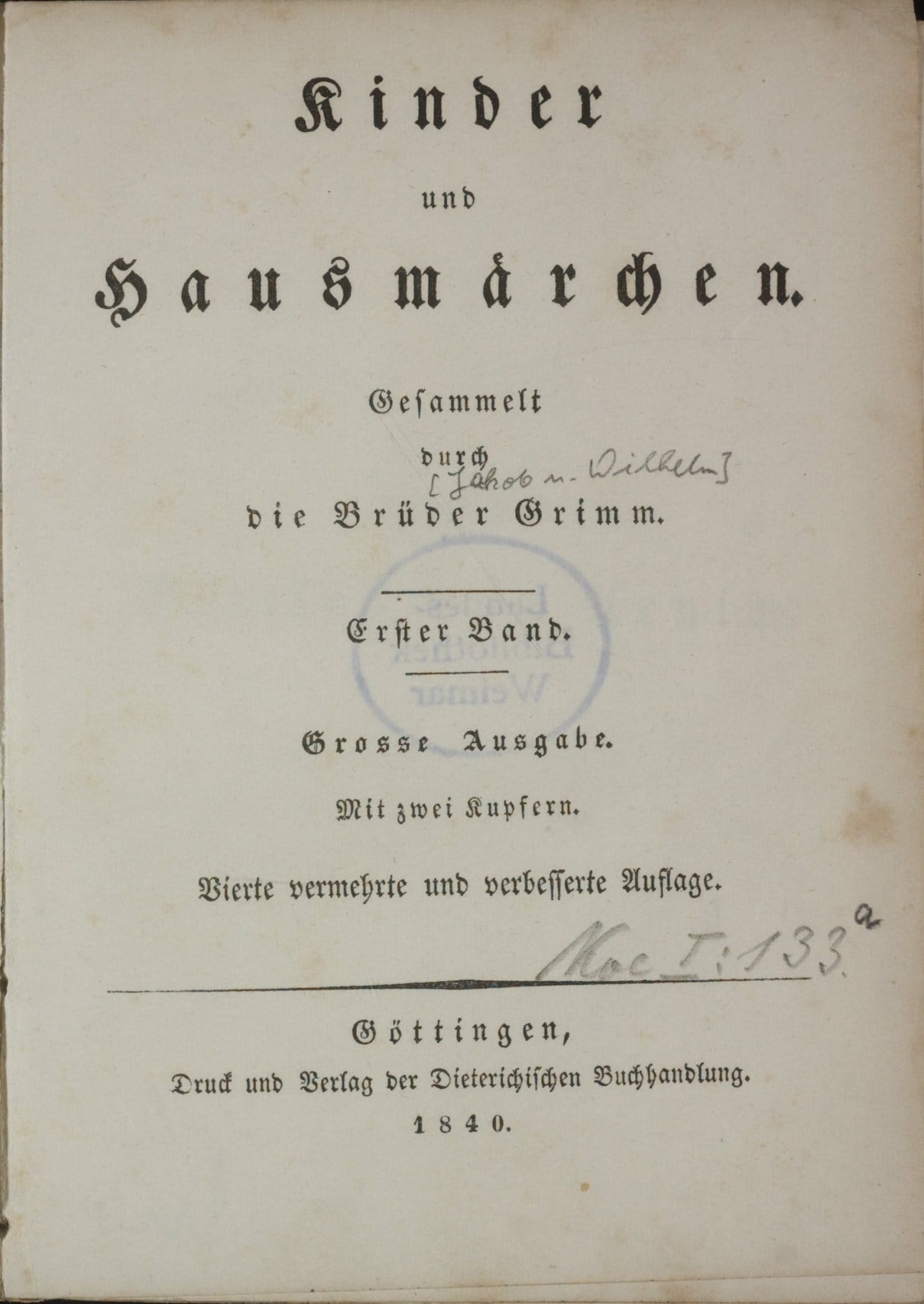
Of course, “originals” is a tricky term in this context, as the Grimm brothers released multiple editions of the collection during their lifetimes; the stories were gathered from a variety of sources, often at the end of long chains of oral tradition in the Germanic lands; and the Grimms often tweaked them to enhance the moral dimensions, or to remove suggestions of sex. (The violence, however, mostly survived the editing process.)
The weirdness is, I suspect, a function of the familiarity of certain story elements—some of which, particularly the tasks assigned to characters whose virtue is being tested, can be seen to have wandered in from the myths of earlier civilisations such as the Greeks and the Romans—combined with everyday realities of medieval life which now seem deeply alien. For example, the wicked stepmother trope is notable for its frequency but also its bluntness, and even if you don’t want to take too functional or structural an approach to interpretation, one rather has to assume that stepmothers (as distinct from mothers) acquired this mythical reputation for a reason. I’m no expert in this stuff, but my guess would be that high rates of mortality in the middle ages, especially among women of childbearing age, meant that stepmothers were fairly common: a man who lost his wife would need a replacement to look after his surviving children, but this arrangement presents all sorts of opportunities for resentment and exploitation on all sides. That the mantle of wickedness should so reliably fall on the female is regrettable, but quite in keeping with the medieval period, in which Christian doctrine assumed a sort of baseline badness in women that went all the way back to Eve’s appropriation of the apple in Eden.
Also weird to modern sensibilities are the legacy forms of oral storytelling: stock tropes and characters, epithets and cliches, and loops that repeat with variation, often in sets of three. In the edition I’m reading—which is, regrettably, so cheap that there’s not even any frontmatter to tell me which edition and/or translation it’s based on—there are also still some stories where the informant recounting to story either forgot the ending, or rushed it, or decided to crank it up to eleven, and these endings have survived various rounds of editing and revision. To be reminded that, not all that long ago, a tale was almost always a thing told rather than read, is a strange but magical thing.
lookback
As hinted above, this week has felt pretty sub-par, and I’ve tried to strike a balance between doing what most urgently needs doing—which is quite a lot—and giving myself time in which to shake off this plague. I’m now at a point where I can no longer cut myself much slack; there’s a great deal of fiction to be written over the next couple of weeks, plus some non-fiction pieces that need filling out and finishing off.
And then there’s the looming prospect of the end-of-year admyn… but we’ll cross that bridge when we come to it, I suppose.
ticked off
- Eight hours on PROJECT GESTALT. (Workshops all done for this foresight cycle, which means it’s time to start writing…)
- Eight hours of essaywork. (A couple of lingering assignments being herded toward the finish line.)
- Six hours of admyn.
- Five hours on PROJECT LONGLINER. (Another one where the preliminaries are done, and the storywork beckons.)
- Four hours on PROJECT RADBURN.
- Four hours of bizdev.
- Three hours on these here weeknotes.
- Two hours of art practice.
- Two hours of non-client storywork. (Story ideas have a way of emerging at moments when you have the least capacity to spare for them…)
- Plus ten hours of undirected writing and reading, as always.
Huh—guess I wasn’t going as easy on myself as I thought I was. I think I’ll take this afternoon off! Thanks for your attention, and for your forbearance; I hope all is well with you, wherever you may be.
This has been the Worldbuilding Agency weeknotes for Week 47 of 2026. If you’ve enjoyed them, it’s free to subscribe. If you are already subscribed, please send to a friend!


Comments ()