

week 46 / 2026: products and prefigurations
Here are three very different projects that showcase the breadth of worldbuilding as a practice: a newspaper from a city where time works differently; a packet of panda jerky; and a genre-defying graphic novel by an artist whose work should define the era.
“This is about time / it’s been a while / I’m glad to see you here, glad to see you here / you’re so clear / crystal clear...”
Greetings from Malmö, where even the most ordinary of people are discussing an infrastructural fragility that they don’t quite have the language for, and everyone agrees that they always hated email anyway. This week I’m plugging various worldbuilding projects: an imaginary city in which I had a hand; a deep-cut classic prototype from the House of Bleecker; and Ganzeer’s unflinching far-future satire in physical form.
Strap yourselves in, and let’s fly away…
projects for plugging
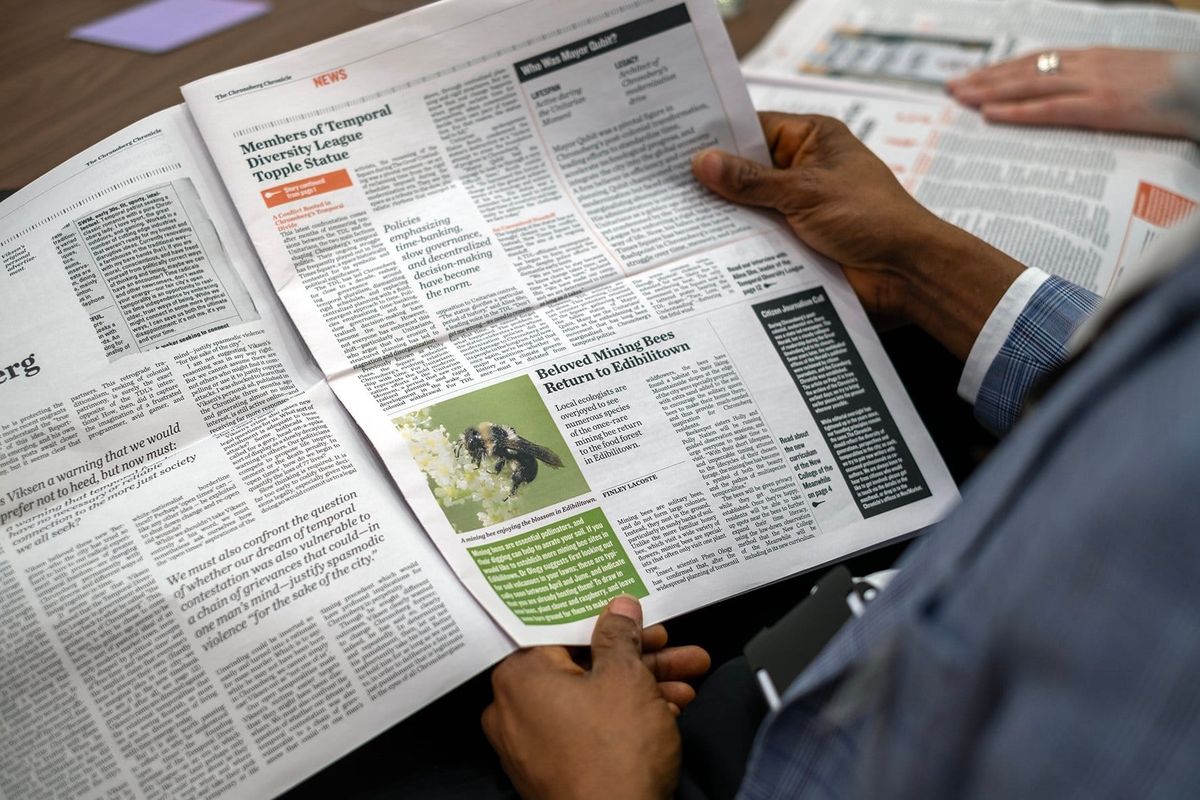
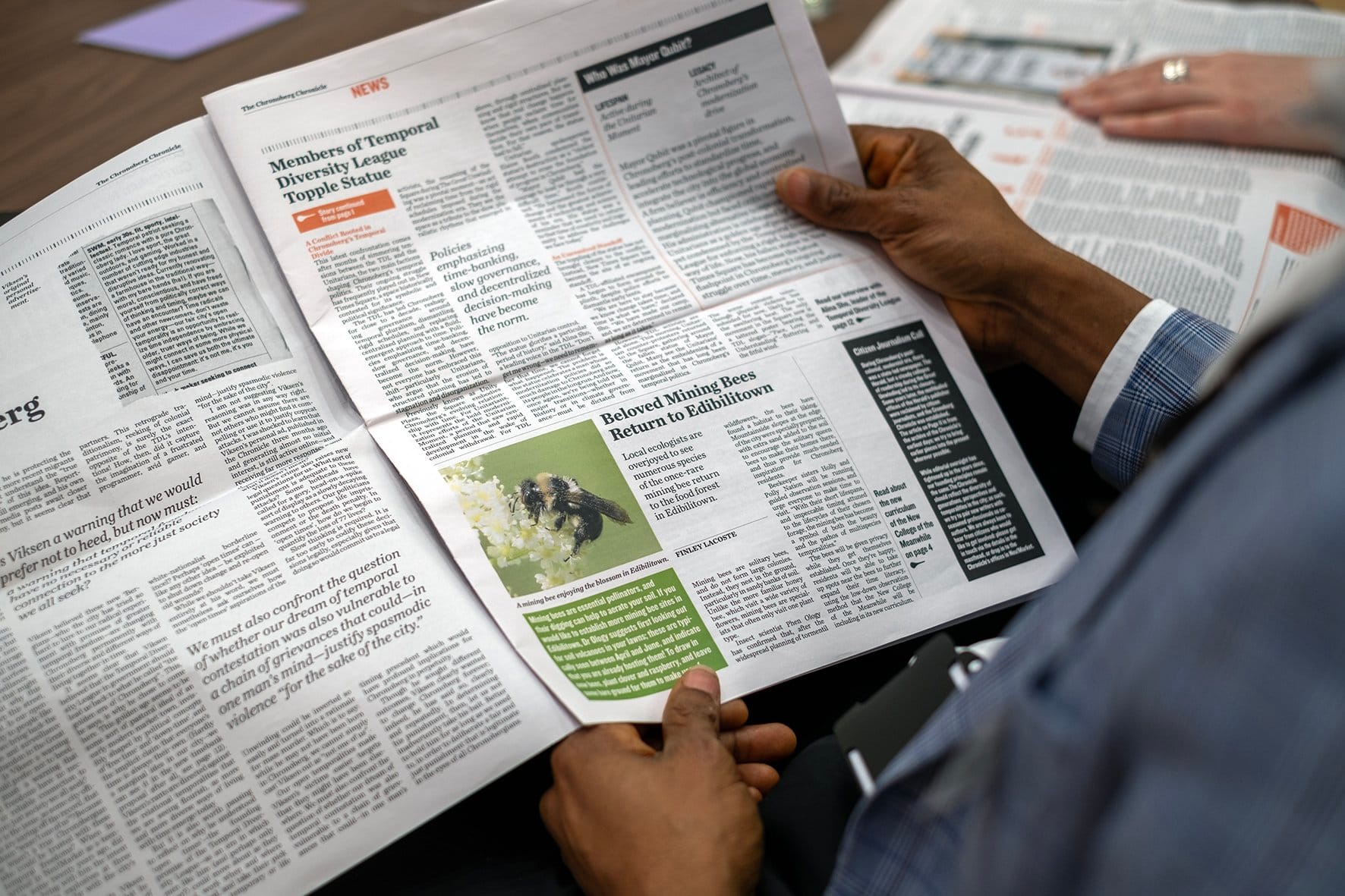
First among equals is the Chronoberg workshop toolkit from Temporal Imagination, the centerpiece of which (in my somewhat biased opinion) is the Chronoberg Chronicle—a local newspaper from a fictional city in which “time is visible, political, and endlessly debated”.
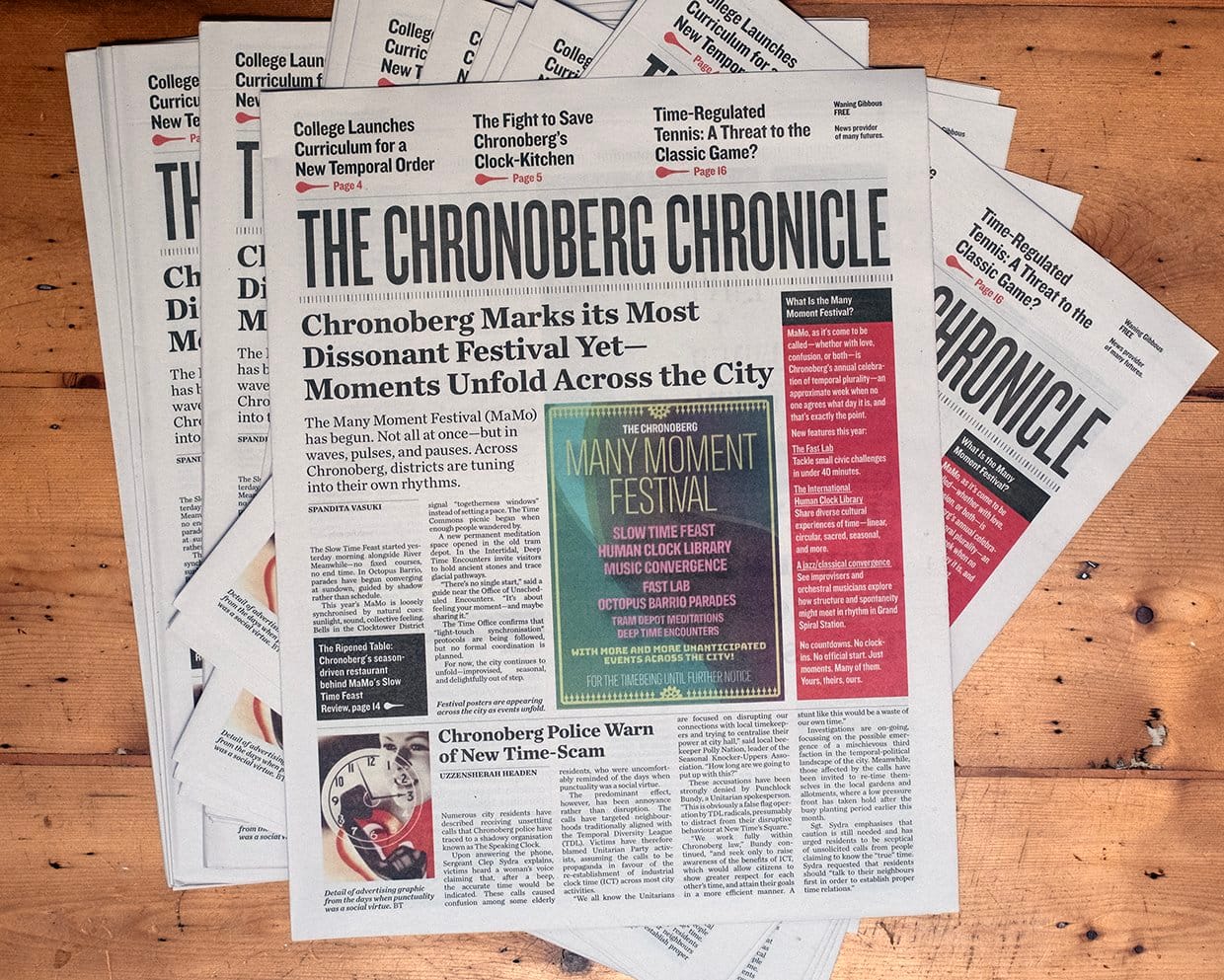
There are apparently still print editions of the Chronicle available by request, though you can also print your own from the digital versions, which can be found alongside various assets aimed at scaffolding a workshop in which your participants get to explore not futures so much as parallel presents: imagined communities in which our “standard” social attitudes toward the temporal are in the minority, and other rhythms compete to shape the patterns of urban life.
Veteran readers here at Worldbuilding Agency may have guessed that this was PROJECT TEMPORAL, which saw me teaming up with my good friend and former postdoctoral supervisor Johannes Stripple, as well as Keri Facer (until recently of Bristol University, and now at Cardiff) and artist/scholar Harriet Hand, as part of The Times of a Just Transition, a project funded by the British Academy.
I co-edited the Chronicle with Harriet, which is to say that we orchestrated the worldbuilding process through which the city coalesced. We designed and delivered the initial workshops in Bergen, Norway, during which a few dozen academics and artists from all over the world came together to imagine Chronoberg’s neighbourhoods and life-ways; we curated the resulting drafts and sketches of articles, supported the participants to further develop their ideas, then buffed them up and brought them together into the Chronicle itself.
Regular readers will know that, for me, worldbuilding means a lot of different things—but when I tell people that worldbuilding is my professional specialisation, the Chronicle is the sort of thing I mean. In this sort of work, I’m not making it all up from scratch, as I do when I write my own fiction; nor am I taking a world developed by other people in a workshop process and concretising its ideas on their behalf. If writing speculative fiction is about as close as one can actually get to playing god, then this sort of project is like being the demiurge to an enthusiastic pantheon of other deities, channelling and shaping their ideas in order to help them make a world that hangs together—something that’s bigger than the sum of its parts.
It’s a literally magickal process, and I want to do it more often! The theme or subject could be pretty much anything; part of the fun, for me at least, is working out what sort of settings and stories will get you close to the stuff that matters.
Like any scene of note, speculative worldbuilding practice has its big dogs—and they don’t come much bigger than Julian Bleecker of Near Future Laboratory, who has a pretty good claim to being the person who came up with the phrase “design fiction”.
If you’re at all interested in this sort of work, you should be (and probably are?) following NFL already, not least because Julian gives a lot of space to other people’s work, as well as fostering spaces where speculative practitioners can come together and exchange ideas.
But every now and again he drags something out of the archives, too—and earlier this week he surfaced a project that I’ve been mentioning in presentations for well over a decade. More truthfully, I’ve been referring to one particular prototype from the project in question (Corner Convenience, 2012), because it’s such a great example to show people who haven’t really encountered speculative prototyping before and don’t quite get what it’s supposed to achieve:

It has just the right balance of simplicity and strangeness: anyone can see at a glance what the product “is”, but it’s presented with exactly the right degree of corner-shop mundanity.
The point of the panda jerky, at least as I understand it, is not to propose that anyone should productise panda jerky—though I guess no one told those dopes who were promising woolly mammoth meatballs a while back. It is rather to to prompt a conversation about the sort of future in which that has already happened.
This is worldbuilding at the micro scale: your encounter with one small designed product is an encounter with the possible future implicit in its existence. If panda jerky is a thing in this world, then what sort of world is it? What else might exist or happen there?
(I should probably confess that I forgot for a while that the jerky is supposed to be synthetic protein, rather than actual panda meat… though I can confirm that the prospect of actual panda jerky is, if anything, even more of a speculative eyeball kick than the synthetic stuff, to judge by the resulting conversations!)
These methods are great fun to work with, for both participants and facilitators. My own prototyping workshops do not result in such designerly outcomes as Julian’s, of course—we all bring our own skills and specialisations to the practice, and I will always be someone who leads with words and story. But the hill I will die on is that we’re all worldbuilders, whatever mixture of methods we’re using.

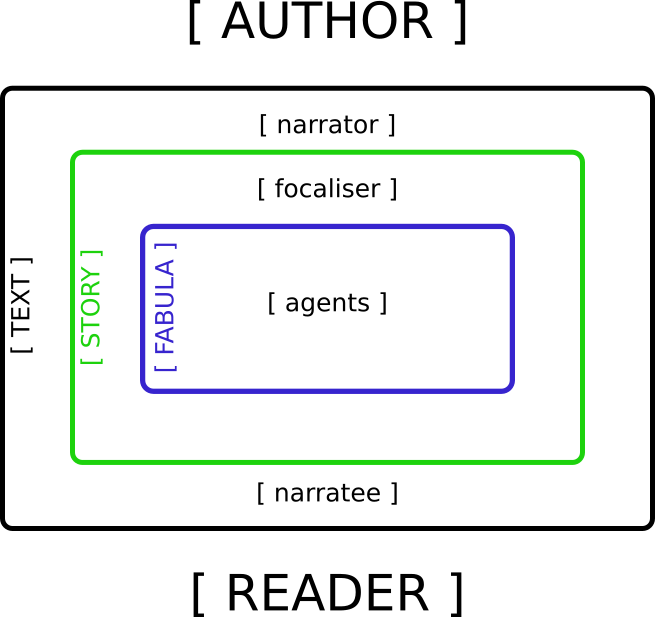
The worldbuilding label obviously also applies to imagined futures developed independently and for their own purely artistic sake. As I said above above, to write speculative fiction without a brief or a sponsor is to take on the role of a god: to build a world and explore its implications without restrictions.
That “no restrictions” bit is harder than you might think, though. One finds one’s worlds shaped by the tropes of the genre as manifest in influential works, of course, but they are also patrolled invisibly by “the cop in the head”: the assimilated assumptions of your culture more broadly, the values that you don’t even hold consciously, let alone question. To tear down those assumptions, and to fly in the face of not just the culture that raised you, but of the culture that raised your culture—this is the mark of the true artist. The visionary presents us with worlds we could never have imagined, and makes them look obvious in hindsight.
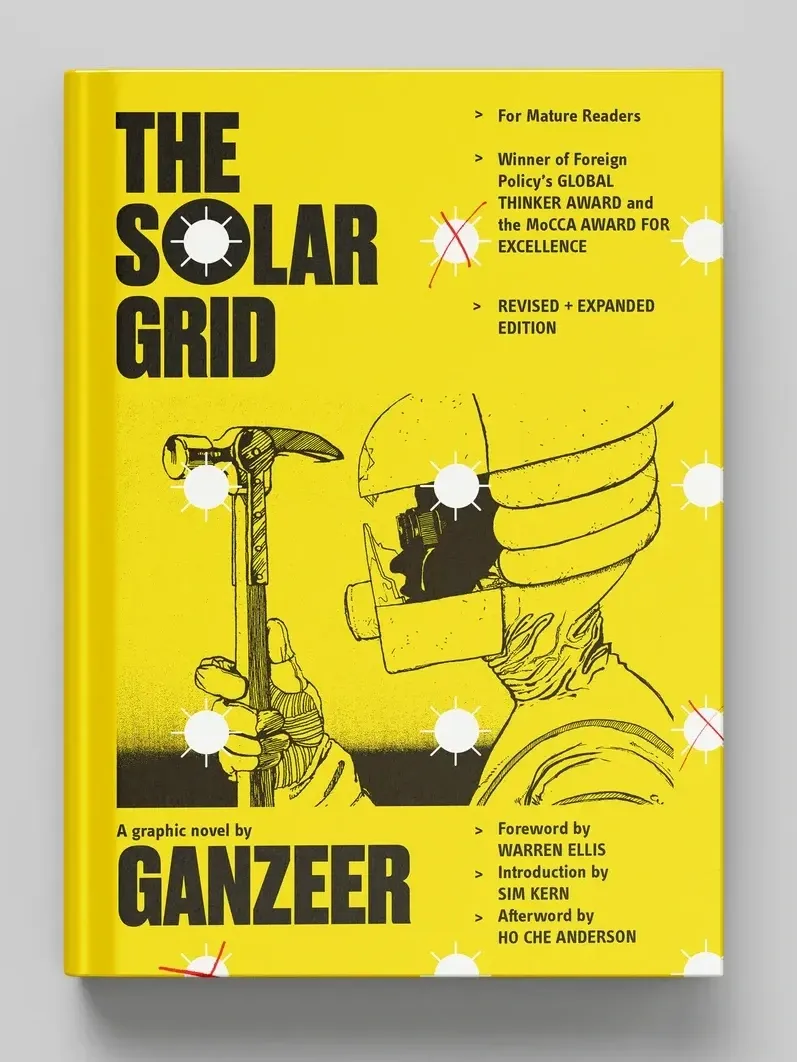
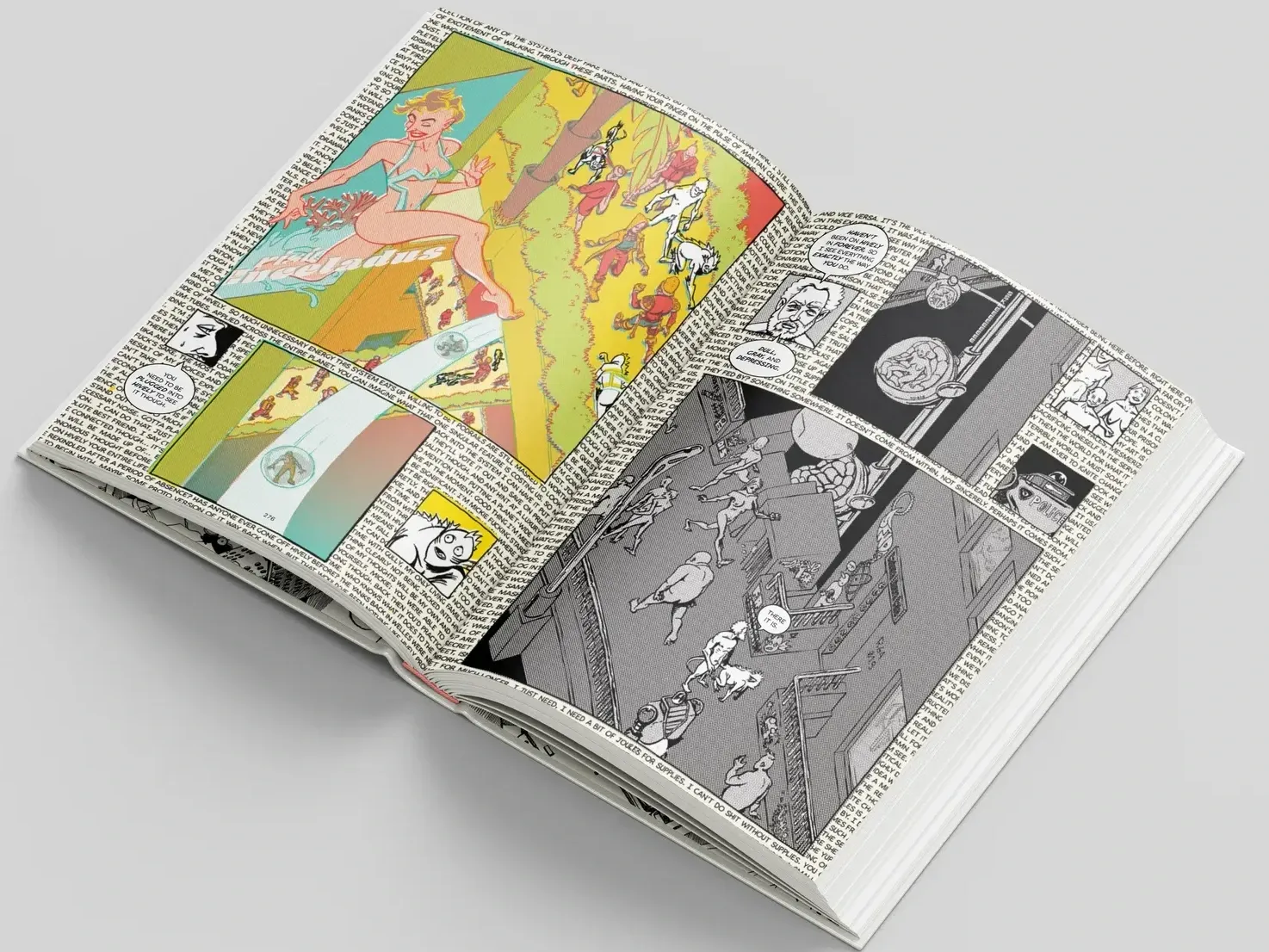
One such visionary is the artist and cartoonist Ganzeer. Shaped by his upbringing in and resistance to the regime of Hosni Mubarak in Egypt—as well as by his experiences in exile therefrom, after the so-called Arab spring—his work is singular in its aesthetic and its vision alike. The Solar Grid is his masterwork: a towering solo project, five volumes of a graphic novel that takes us on a tour around a deeply weird and unsettling far future which, like all great works of speculation, has a great deal of discomforting stuff to tell us about the present in which we live. It’s also a cracking good story.
Sad to say, it falls between the categorical cracks of an increasingly cautious publishing industry: too lacking in cape-shit tropes and pandering fantasies for the classic comics publishers, yet way too gnarly and sci-fi for the serious publishers of graphic novels, The Solar Grid has been cranked out independently by its creator over the course of a decade.
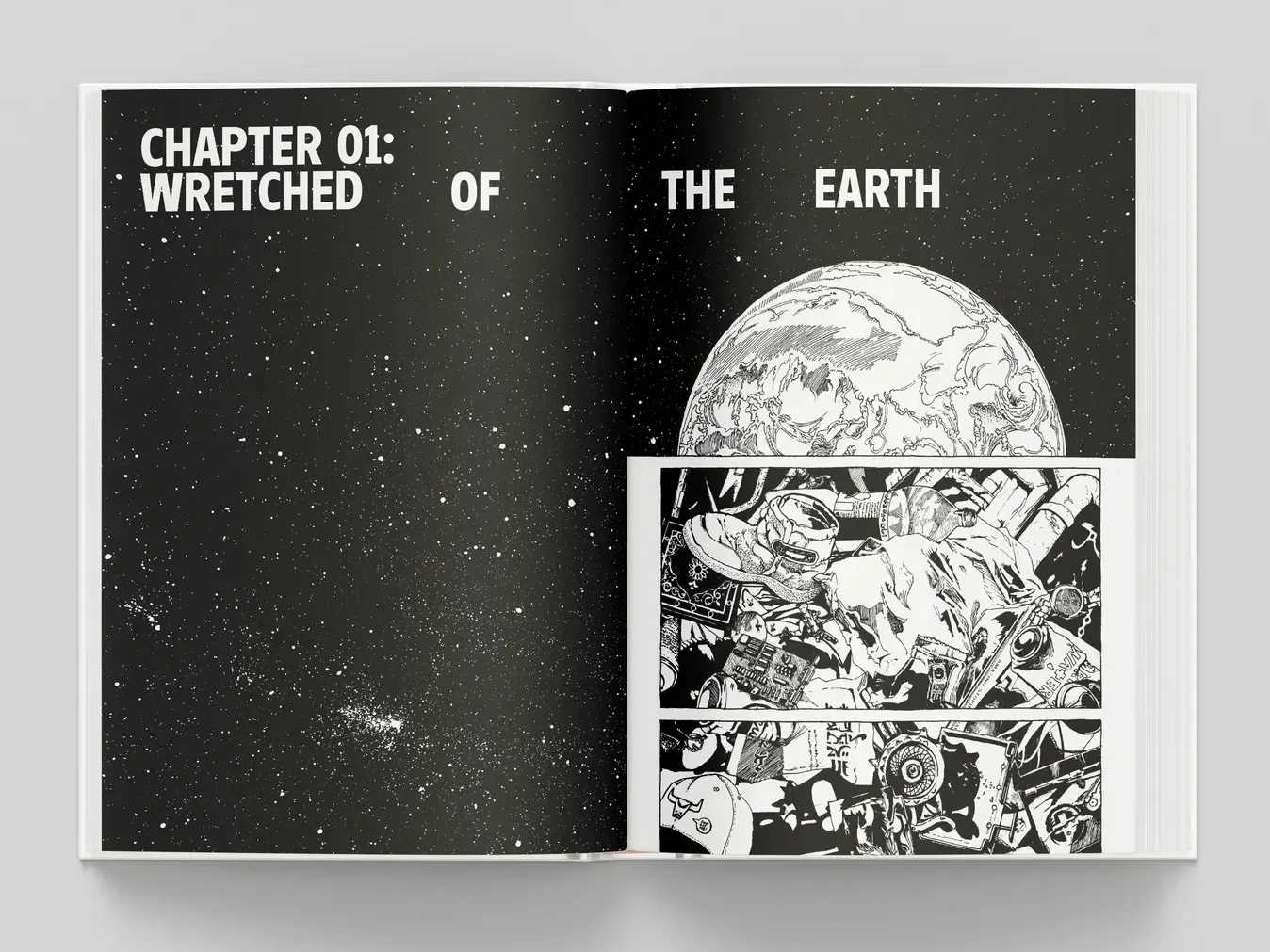
The time has come to put a physical collected edition out into the world—but even a relatively short and exclusive run requires sufficient pre-orders to make it pay for itself, even if it doesn’t pay its author. So think of this as a Kickstarter that isn’t relying on the middleman, if you like: you can pre-order a copy for US$45 directly from the publisher (which price includes international shipping), and if another 749 copies are also ordered before (date), then the book gets printed.
I have ordered a copy. I already have it in digital form, but screens really can’t do justice to comics as a medium, especially not if they’re made like this. I want to suggest that you too should order a copy, because it’s a singular and important work of C21st literature; I also want to suggest you order a copy because to see his decade-long project manifest as a physical artefact would be a moment of great pride for a great artist, as well as a man I hope I can claim as a friend.
I’d also like to suggest that, if you’ve been at all involved in recent arguments around the importance of outsider voices and perspectives in the arts, and particularly the arguments in favour of stories which do not flatter the notions that western/Global Northern audiences have of themselves and of the world they have shaped, then this is an opportunity to really put your money where your mouth is.
lookback
This week has been a bit bobbins, to tell the truth. The physical symptoms of the earlier plague are mostly gone gone, but I have been left with a lack of motivation and focus, with the result that I’ve struggled to do any more than a couple of hours at a time on anything. This would be suboptimal at the best of times; it’s particularly frustrating when the projects on deck are predominantly long-form writing projects, for which I need to hold complex ideas in mind while also cranking out the wordcount.
Well, selah—sometimes things just happen this way. All is far from lost, as I’ve been able to advance both projects by approaching them in sections, and doing shorter sprints of developmental work when the energy has been available. I’ve also kept the pilot light burning by making myself write shorter stuff on my personal blog, as it’s better to write something rather than nothing. But I’ve also, with the exception of these weeknotes, taken the entire weekend as a screen-free rest period, so I’m optimistic that I’m going to turn up on Monday with more energy than I’ve had over the last seven days!
(Even so, do please implore your preferred deities and/or daemons on my behalf; belt and braces, innit.)
ticked off
- Six hours on PROJECT RADBURN.
- Four hours on PROJECT GESTALT.
- Four hours of academic peer review.
- Three hours of admyn.
- Three hours on these here weeknotes.
- Two hours on PROJECT LONGLINER.
- Two hours of essaywork.
- Two hours of art practice.
And ten hours of undirected writing and reading, because that’s how we do shit downtown.
Right, time for me to step away from the keyboard! Thanks for your attention, and for your forbearance. I hope all is well with you, wherever you may be.
This has been the Worldbuilding Agency weeknotes for Week 46 of 2026. Thanks for reading! If you’ve enjoyed them, it’s free to subscribe. If you are already subscribed, please send to a friend!


Comments ()