

week 26 / 2026: filtration and modulation
Take a peek inside to find a strong point of view on point-of-view, to learn the differences between writing for the page and for the screen, and to consider the importance of abeyance in our dealings with futurity…
“Come ride with me through the veins of history / I’ll show you a god who falls asleep on the job…”
Greetings from Malmö, where a few days of record-breaking heat-dome temperatures have given way this morning to thunder and lighting with a distinct “signs and portents” vibe. (The rain is taking the edge off, but I suspect it’s gonna be a sticky afternoon.)
This week, we’re thinking about point-of-view in prose fiction, about how it differs from television, and about a new role for storytelling in the context of foresight and futures...
OK, dig in your spurs and let’s ride for the ridge!
among the pixels
We’re into the second week of my Rogue Worldbuilding course, and I’m really enjoying teaching it. After a couple of decades of being a writer, I still feel on most days like I’m a total n00b, but to talk with people nearer the start of their own arc of development is to be reminded by how much I’ve learned over the years.
(Of course, the more you learn, the more questions arise—hence the unending sense of being a beginner. However, I take a weird sort of comfort from feeling like an imposter, because better a perpetual sense of self-doubt than the blithe self-assurance of Dunning-Kruger syndrome…)
So it’s appropriate that this week’s clippings are all writing related, though that is mostly a happy accident. I’ll start with the most recent post from the ever-reliable Lincoln Michel, who is attacking—with tongue somewhat in cheek—the “standard model” of narrative point-of-view:
First-person POV implies a character who exists within the fictional story world while the various third-person forms are narrated by a voice that usually exists outside of the story world. But, that’s the gist. Most intro to literature guides will also say that second-person POV and third-person objective POV are rare in literature,2 meaning you’re left with only three common POV forms.
I disagree.
Michel argues that the standard model is rooted in grammar rather than storytelling, and proposes instead that we think about it through the functions or affordances that a given POV provides the writer.
I’m going to offer a different taxonomy of POV based more on storytelling than grammar. From a narrative perspective, I think there are three main questions as far as POV goes. 1) Information, aka what can the narrator know and convey to the reader. 2) Filtration, aka whose consciousness(es) is information filtered through. 3) Modulation, aka how is the narrator shaping information for the assumed listener.
I don’t think this is necessarily a good replacement for the standard model, whose failings are likely more due to sloppy simplifications by online writer-influencer types. Better sources are available! Ursula Le Guin’s Steering the Craft is the only assigned text for my ongoing course, and that’s precisely because she did such a great job of setting out the POV system and explaining the affordances. (I reread it at least once a year, and I always learn something new—an astonishing achievement for such a small, simple book.)
But Michel’s model has the merit of forcing you to think afresh about what you’re trying to do. It is, perhaps, an approach that treats prose fiction more as medium than art—and it is both of those things, of course. But new perspectives on something you already (think you) know can be very helpful, and I think this is particularly useful for folk writing fiction for futures work, where the transmission to the audience of information about the imagined world is a central concern.
Next up is a shortish interview with Rasheed Newson, a writer with whose work I am mostly not familiar. But he’s a writer and showrunner for TV as well as a published novelist, and he speaks fairly clearly to the differences between those two media from the writer’s perspective. Here he is talking about character interiority, which is perhaps the most obvious distinction:
In television, you’re typically looking for something visual that lets the audience know the character is uneasy, or that they’re lying. Again, that camera’s doing a lot of work for you, because it’s telling the audience, this is what this person is focusing on, this is what they want, this is what they desire. In television, we have to establish very quickly that this person can be violent at a moment’s notice, or is vain beyond comprehension. In a book, you can spend three or four pages getting ready in the morning, and talking about the worries of your day.
During this week’s workshops on my course, we spent a bunch of time discussing dialogue, which is where a lot of neophyte fiction writers struggle; I certainly did! (I still do, if I’m honest.) Various exemplars from TV came up in the conversation—The Wire, in particular—but while there are definitely things you can learn from TV dialogue for prose fiction, you need to remember that a lot of the impact of the dialogue in a show like The Wire comes from its delivery by excellent actors. Dialogue on a page, by contrast, has to be acted out in the reader’s head; you can’t rely on inflection or emphasis, unless you signpost it really clearly, and that can break the illusion in a different way.
The most important thing to remember is that, for all reviewers will talk about “naturalistic dialogue” in films and books alike, you really don’t want to write dialogue the way we actually speak. If you want to understand why, I suggest that you record a conversation or interview, and then transcribe it. It’s genuinely incredible how much real-time inference and interpolation we do when we speak to one another!
Third and final piece of the week, courtesy friend-of-the-show Karl Schroeder, is more about the purposes to which fiction might be put, and the role in which that work might be performed.
Karl is arguing, I think, that the “early warning” function of science fiction has failed in recent years, and that the toolkit might be better used to hold emerging phenomena at a distance in a way that prevents, or at least slows down, the process of definition and categorisation. Those who do this work might be called ambiguists:
I proposed an institution, the Department of Abeyance, whose function is to maintain productive contact with that which resists existing narratives, while not defining, categorizing, or dismissing it.
We need such a function in society to deal with rapid, unprecedented change. Arguably, we already have it, but it is not (directly) connected to the wheels of progress. Science fiction can say, “yes but—” to the introduction of driverless cars or personal robots, but we’re thought of as entertainers, so what we say is seldom taken seriously. Strategic foresight is a thing, and it does have access to power. It has strategies for abeyance, such as defamiliarization (also called strangemaking), but these are mostly upstream activities, inputs to a process that feeds decisions about what counts as real and actionable. Foresight feeds into decision-making but lacks the power to defer the decision about what counts. To make this concrete, I’ll use the example of the thing we have prematurely labeled as “AI.”
When it comes to how we could react as a society to new phenomena such as AI, there are two issues. Who performs abeyance, and, what would abeyance look like at the institutional, political, or legal level?
It’s very hard to paraphrase a person like Karl without doing them an injustice, especially when they’re proposing a complete rewrite of our relationship to sociotechnical change, so I strongly recommend reading the whole thing. To speak of “the futures of futures” is one of the great cliches of the field, and is usually as risible as it is irresistible—because who doesn’t enjoy talking shop and indulging the meta when surrounded by one’s peers?
But while most of us are happily tinkering around at the edges, Karl’s sat quietly in the corner, rebuilding the thing from scratch…
between the pages
Perhaps in reaction to my having imposed Colson Whitehead upon them last time round, my reading group’s most recent selection is the latest novel from Bob Mortimer.
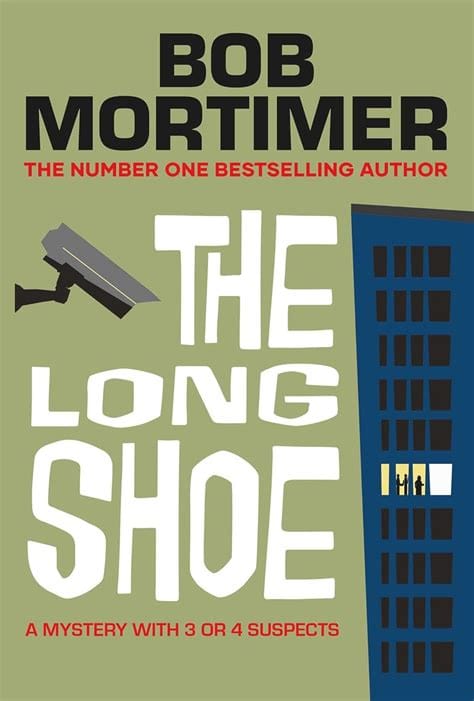
Vic and Bob were important, formative and beloved figures in the culture of my youth, and I will always have a soft spot for Bob’s surreal soliloquies—but on the basis of half of this book, I feel like that style loses a lot in translation to the medium of prose.
Or perhaps, more fairly, I simply have expectations and preferences regarding what a novel should do that aren’t compatible with the mostly light-hearted fun on offer here? I don’t find it objectionable in any way; I just don’t find it very engaging. And that’s OK: to every book its reader, as we used to say when I worked in libraries, and to every reader their book.
lookback
As I try to think back over the last seven days, all I seem to remember is heat—which is really only true of the latter half of the week. (So chalk one up to recency bias, I guess?)
But this is one reason we keep records—and the records remind me that I spent the best part of a day doing stuff for the worldbuilding course, and two full days in the final push to get the current phase of MUNICIPAL over the line. I would have liked to have done rather more than I did, given last week was meant to be a quasi-holiday... but given the climatic circumstances, I think I’ve made about as good a showing as could be expected!
(I’m very fond of my little studio—which, I realise, I’ve now occupied for nine months!—but the building it’s in was situated and built in a time when temperatures above 30°C were really not a concern in this part of the world. My apartment, by contrast, gets very little direct sunlight, which is something of a curse in the winter, when there’s too little sunlight to be had, but a blessing in this sort of weather, as it stays surprisingly cool and shady. I think I should make some sort of contingency plan for working from home when we next have weather like this… because, mark my words, we’re going to have weather like this again, and again, and again. The new normal is thatthere is no normal any more—and for most of us, adaptation is the only game in town.)
ticked off
- Fourteen hours on PROJECT MUNICIPAL.
- Six hours on the Rogue Worldbuilding course.
- Six hours of admyn.
- Four hours of research.
- Three hours on these here weeknotes.
- Two hours of bizdev, working on an application.
- Two hours of art practice. (Fairly desultory, due to the heat—but when better to mess around with new techniques?)
- One hour of blogging.
- And ten hours of undirected writing and reading, as always.
Well, then—another week ends, and somehow we’re halfway through the year already. Seems hardly plausible, does it? Thank you for giving me a slice of your attention, which I greatly appreciate. I hope all is well with you, wherever you may be.
This has been the Worldbuilding Agency weeknotes for Week 26 of 2026. Thanks for reading! If you've enjoyed them, it's free to subscribe. If you are already subscribed, please send to a friend!


Comments ()