

week 30 / 2026: here and elsewhere
In this episode: contemplating the end of the Western cosmopolitan urge; hanging with the New York neoLuddites; and Silicon Valley’s highly selective readings of science fiction. Plus, G K Chesterton!

“So afraid of what they’d see / underneath the fantasy / so afraid to actually / scratch the surface…”
Greetings from Malmö, where the death of mid-list musicians you first listened to as a teenager reminds your middle-aged ass that you only get so many turns around this mortal coil.
This week, we’re wondering whether the Western cosmopolitan urge might finally have fizzled out, watching the neoLuddites take New York, and shaking a finger at Silicon Valley’s shonky readings of sci-fi.
Ready to read? Then scroll on, good friend—scroll on!
among the pixels
This first clipping is a loooong one, and while the prospect of 10,000 words which take as their point of departure the changing experience of teaching the ethics of tourism to undergrad students may not at first blush sound like the best use of your time, I want to suggest that it really, really is.
Grant David Crawford begins by talking about the way he’s kicked off the teaching module in question for a number of years, assigning an old HuffPo article whose core position is that “authenticity is a story the tourist tells about herself, not a property of the place she visits”. This essay used to be a reliable conversation starter, but according to Crawford, it no longer is:
The class would read Sze, and where students used to push back (where they used to defend their gap year in Cambodia, or accuse Sze of being too cynical, or stage long debates about building wells in South America and ethical itineraries and whether it was possible to travel “right”) there was now a polite quiet. A few shy hands here and there. Still some carefully crafted comments. These are not less intelligent students than the ones who came before them. They are, by every measure I can take over the course of about fifteen weeks, just as ethical, just as curious, just as serious.
What has changed is something subtler. The question itself has lost its hold on them. They have moved past the argument by losing interest in its stakes.
The bulk of the essay sees Crawford putting together a loose grand theory of authenticity and the Other from the Western perspective, starting with Rousseau and the hey-day of the Grand Tour, trying to explain how the relative ease or difficulty of travel for young people has affected how they conceive of realness and the titular “Elsewhere”.
The basis of the theory is a cycle of contraction and resurgence, in which “[e]very generation thinks its particular crisis is the one that ends the search”. That’s turned out not to be the case every time so far—but Crawford is going in to bat for the argument that this time, something more final is happening.
The lineage I’m tracing here is a compression. I know it. You know it, too. The purpose of an overview like this is to show the shape of something real, not to record every contour that makes up the shape. From Rousseau forward, a particular Western reflex: when modernity makes you feel hollow, go find a place that hasn’t yet been modernized, and let its “realness” fill you back up.
Each iteration of the reflex got exposed, refined, and reborn. Each also had to find a new location for the cure, because the previous location had been absorbed by the apparatus the seekers were trying to escape. The Lake District became a tourist circuit. Tahiti became a colony. The Hippie Trail became a route. Khao San Road became a brand decorated with McDonald’s arches and Hendrix merch. The structure required a fresh elsewhere every generation, and for three hundred years a fresh elsewhere was always available.
The pattern, I had thought back in 2018, would continue.
I now think I was wrong about the continuation, though the pattern itself is intact.
I’m not going to attempt to synopsise the whole argument, but the finality Crawford sees is infrastructural, a substitution of simulacra through digital media, and is notably not just a “kids and their damned phones” routine—although, as I suggested here some time back, while the problem isn’t the phones, it isn’t not the phones, either.
What makes this a really great essay, though, is Crawford’s turn to serious reflexivity at the tail end, in which—having spent a bunch of time earlier in the piece highlighting the problematics of tourism, as one would expect a lecturer on ethics to do—he dares to retrieve that bit that all too often gets thrown away:
I did not understand, when I was doing that work, what the world would feel like without the thing I was helping to take down. I understood the thing as compromised, which it was and is. I did not understand it as also reaching for something, however imperfectly, however coded by the privilege of those who could undertake it, that the world may actually need.
The Western cosmopolitan ideal was an artifact of empire. It was also, in its better moments, an ambition. Maybe an ideal. It said that a person might belong to more than one place. That borders were administrative facts but not moral ones. That curiosity about people who were not your own was a kind of decency, even when the curiosity was structured by power. That the world’s strangers had inner lives worth attending to. I no longer think these claims were sufficient. I do still think they were claims worth making, and that the project of making them was, at least, trying.
A really deep, thought-provoking piece of writing. Go read it.
More journalistic than theoretical, this second clipping sees one Sarah Tankam Mathews reporting on her experiences in New York’s burgeoning neoLuddite scene:
Soon an early-twenties woman with beautiful soaring hair and combat boots was leading the crowd in a series of chants. I registered within myself a curious mixture of skepticism and longing. It was time to march upon the Cube. We crossed the street and encircled it, the glass Apple Store structure, chanting and singing as a brass band called Rude Mechanical Orchestra played. And then the crowd began to run.
All of us—circled up, chanting, and clapping—started to dance maniacally around the cube, as the band blasted something loud and impish and Slavic. So many of us, hundreds of gnomes. It was ridiculous and odd and totally delightful. A pulsing electricity found me as I moved with the others, drew me out of my mind and into the world. It was more distilled joy than I’d felt in months.
I struggled to explain any of this to other people in the days afterwards. You had to be there, maybe.
I have to admit that much of what Mathews describes here comes with a sort of late-Millennial earnestness that this still somewhat cynical late-Gen-Xer parses as more than a little bit cringe—but at the same time, it also reminds me somewhat of the weird, playful and anarchic energy of alternative culture in the early Nineties, in which I was an enthusiastic (if addled and inept) participant. I’ve felt for a while that some sort of movement-scale change is in the pipe—yearned for it, if I’m honest—and neoLuddism is fast becoming one of my main candidates for Patient Zero.
What’s particularly interesting is the commitment to the underlying principle: rather than shouting on social media about how awful social media is, they’re actually trying to build new systems of relation and contact outside that semiotic circuitry. Furthermore, their activities are not aimed at policy, but rather at prefiguration:
The Luddites I met made few direct demands of institutional power. There was no lobbying for antitrust legislation, or for regulating addictive design features and removing ed tech from schools (though a couple of Luddites volunteered for Alex Bores, the New York congressional candidate, and some were tracking the writer Jonathan Haidt’s work around adolescent smartphone use). Unlike their forebears, these Luddites did not advocate for property destruction, save the symbolic iPad at S.H.I.T.P.H.O.N.E. Instead, their focus was on the prefigurative, revolutionary potential of events—specifically free, public, participatory, unpredictable events.
There was a theory of change behind this. Back at S.H.I.T.P.H.O.N.E, someone had handed me a zine titled The Event Is The Medium, a nod to Marshall McLuhan that doubled as a succinct description of the Luddites’ strategy. The event: no tickets, no invitation on social media, no closed guest list, and no promise that things would unfold according to plan. The Luddites ran these events and hoped other people would run their own events, and in doing so, change their own norms around sociality.
This stuff has been bubbling along for a good few years now, which if nothing else puts paid to those who said it was just another performative socnet fad. To be sure, there definitely is a whole online ecosystem devoted to attempting to monetise people’s dissatisfaction with the platforms on which said ecosystem has grown, but this New York scene, at least, seems to be doing its best to avoid the trap.
Will it last? The thing with a good weak signal is that it’s genuinely impossible to tell; that’s why we play with them in futures work, in order to see what potential they might have. NeoLuddism has been a feature of the better sort of signals deck for some time now—though its reception varies hugely depending on the context in which said deck is being used. But if you use some sort of heuristic for assessing the or advancement of a signal—as you should!—I think it’s time you bumped this particular ping a few points up the maturity scale.
Last but not least, I’m very pleased to see this essay by Ali Rıza Taşkale at Aeon.
That [Silicon Valley] worldview is expressed through science fiction: not as decoration, but as the medium that makes its accumulation strategies feel natural, necessary and inevitable. This is not to say that science fiction precedes or causes these projects – it is part of the cognitive and institutional scaffolding within which certain ambitions become thinkable and certain power grabs feel like common sense.
The essence of the argument will not be new to anyone who’s been following me for a while, but it’s good to see it getting traction outside the usual echo-chambers, and it couldn’t happen to a nicer chap—I went to a few seminars that were part of Taşkale’s postdoctoral fellowship, over the bridge in Roskilde, and he’s a damned good researcher, as well as sitting on what I deem to be the side of the angels in this particular matter. Bravo, Ali!
between the pages
This week I have been reading G K Chesterton’s Heretics, one of a long list of philosophical works that I put together with the deliberate aim of pushing myself out of not only my epistemological comfort zone, but also the penumbra of presentism.
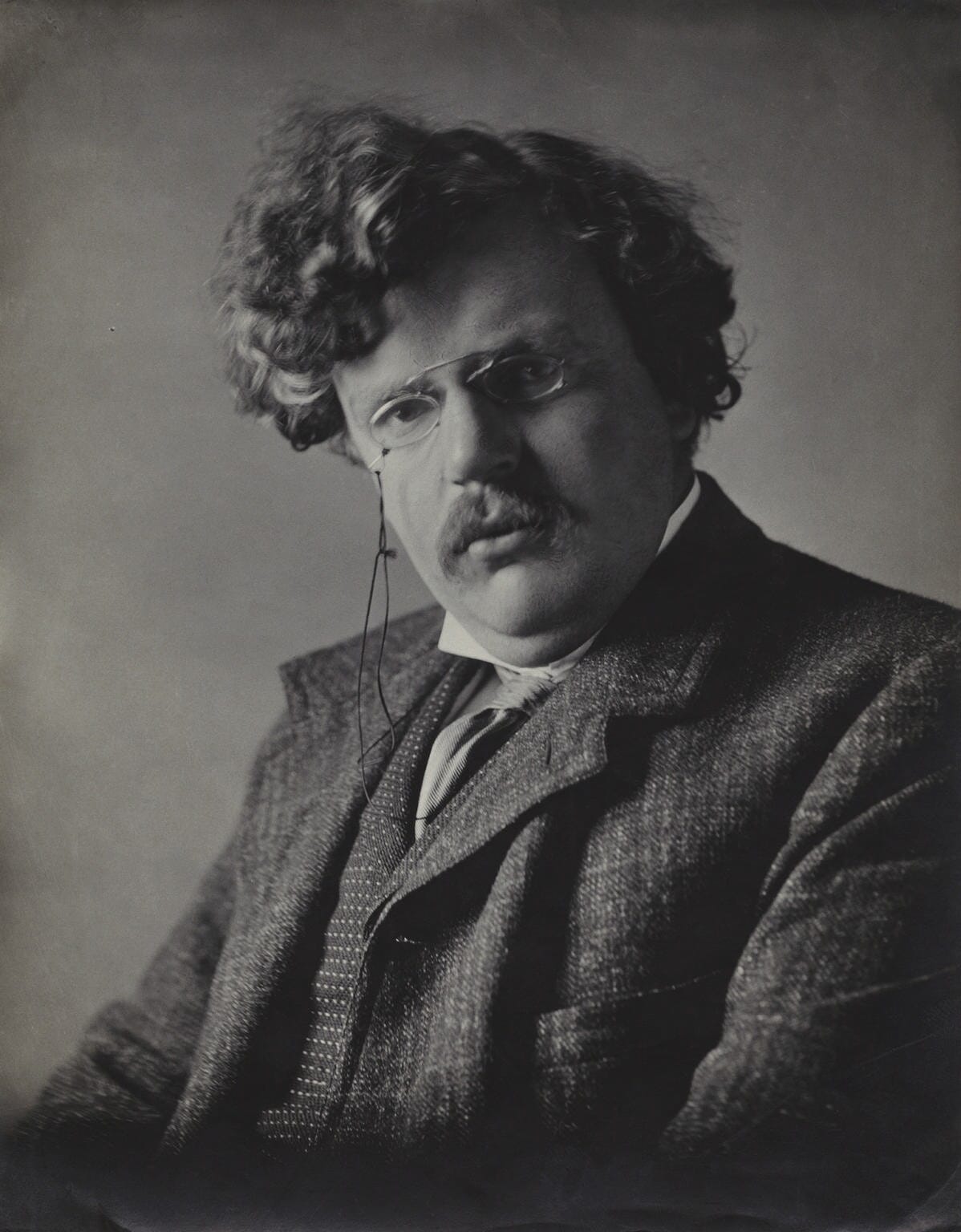
Heretics is a collection of fairly short pieces in which Chesterton takes issue with what he deems to be the most significant failings of the great thinkers and writers of the era, namely the very first blush of the C20th. As such, some of the names he’s taking on are unknown to me, or footnotes at best—George Bernard Shaw, Ibsen—though others, such as H G Wells, are rather more familiar.
Two things are apparent, the first of which is Chesterton’s generosity in critique: he’s at considerable pains here to put forward what he thinks best about his target’s thinking or writing, before turning to the bit that bugs him—at which point he is unsparing in his attack, while still engaging in good faith. The second is a combination of raw wit and the peerless ability to turn a phrase. It’s very florid writing by contemporary standards, of course, but gloriously good reading nonetheless; a wonderful antidote to the encroaching affect of LLM-generated prose.
In one of the early chapters he notes that among the goals of a great orator is to convince their audience that they are no orator at all, but rather a plain-spoken everyman. By that measure, Chesterton himself falls short—but he’s plainly not interested in that sort of political point-scoring, as the rest of the chapter makes clear. Instead, there’s an unalloyed delight in wordplay, and a desire not to impose his beliefs on others, but to enter into discussion with those who hold positions different to his own*.
He displays, in other words, an intellectual sincerity and curiosity which is currently in short supply, and which seems of a part with what Justin “Esoterica” Sledge advocates for at the end of this long podcast interview. I’m not sure I’m anywhere close to modelling such a sincerity myself, to be clear—but it’s a fine thing to feel you have some examples to steer by.
(* Well, most of the time: his assault on the so-called “yellow press” of the time is not exactly an attempt to meet its publishers halfway! But it’s a pretty fly move to argue that the problem with these proto-tabloids was not that they were sensationalist, but that they were not sensationalist enough…)
lookback
This has been a writing-focussed week, which has been a nice change. I enjoy working on projects as part of a team, and I like running workshops with new people, but at heart I am a writer—and the writer’s natural habitat, as I’m fond of saying, is in a small quiet room with the door closed.
The lion’s share of that writing has been toward toward PROJECT LUDIC, slowly putting together the preface and the short stories for the latest Media Evolution collaborative foresight book—rtaher more slowly than I’d like, in fact, but that’s just the way it goes sometimes. But there was also some final draftwork on a critical essay for Vector, and the beginnings of the draftwork for what is planned to be the first of a running series at a different venue.
It feels good to be getting back into critical writing, but I feel distinctly rusty. I used to reliably do two or three substantial pieces a year for the BSFA Review, but the cost of their sending review copies out of the UK—plus, if I’m honest, a dwindling number of new novels that I’m in any way interested in reading or writing about—has seen that habit fall away. No surprise my chops feel sloppy, then! But starting again is always the tricky bit, and my intention is to build up a rhythm again.
This week has also been heavy on the admyn, as I’ve let various things—particularly my correspondence—lie fallow rather too long. (Apologies if you are among the not insignificant number of people waiting on my reply to your email! I’m catching up, albeit slowly.) I’ve also had to do a bunch of planning around what looks like an out-of-town adventure in the middle of next month, which should be fun, but has eaten a whole bunch of time.
Notably, I haven’t done much art, or indeed any, for a few weeks now. Still, no excuses: as I tell my writing students, you’ll never find the time for creative work, you have to make it.
ticked off
- Thirteen hours of admyn.
- Thirteen hours on PROJECT LUDIC.
- Eight hours of essaywork.
- Three hours on these here weeknotes.
- One hour on PROJECT MUNICIPAL. (Wash-up meeting.)
- One hour of networking.
- And ten hours of undirected writing and reading, as always.
There’s more to be done on LUDIC today before I can head home and do my Sunday chorse, so that’ll do for now. Thanks for your attention, which is always appreciated, and I hope all is well with you, wherever you may be.
This has been the Worldbuilding Agency weeknotes for Week 30 of 2026. Thanks for reading! If you've enjoyed them, it's free to subscribe. If you are already subscribed, please send to a friend!


Comments ()