

week 32 / 2026: nature and culture
In this episode: we wander into the forests of medieval Europe, return with the underlying imagery of Enlightenment and Romanticist thought, and then feel for their bones beneath the skin of the present.
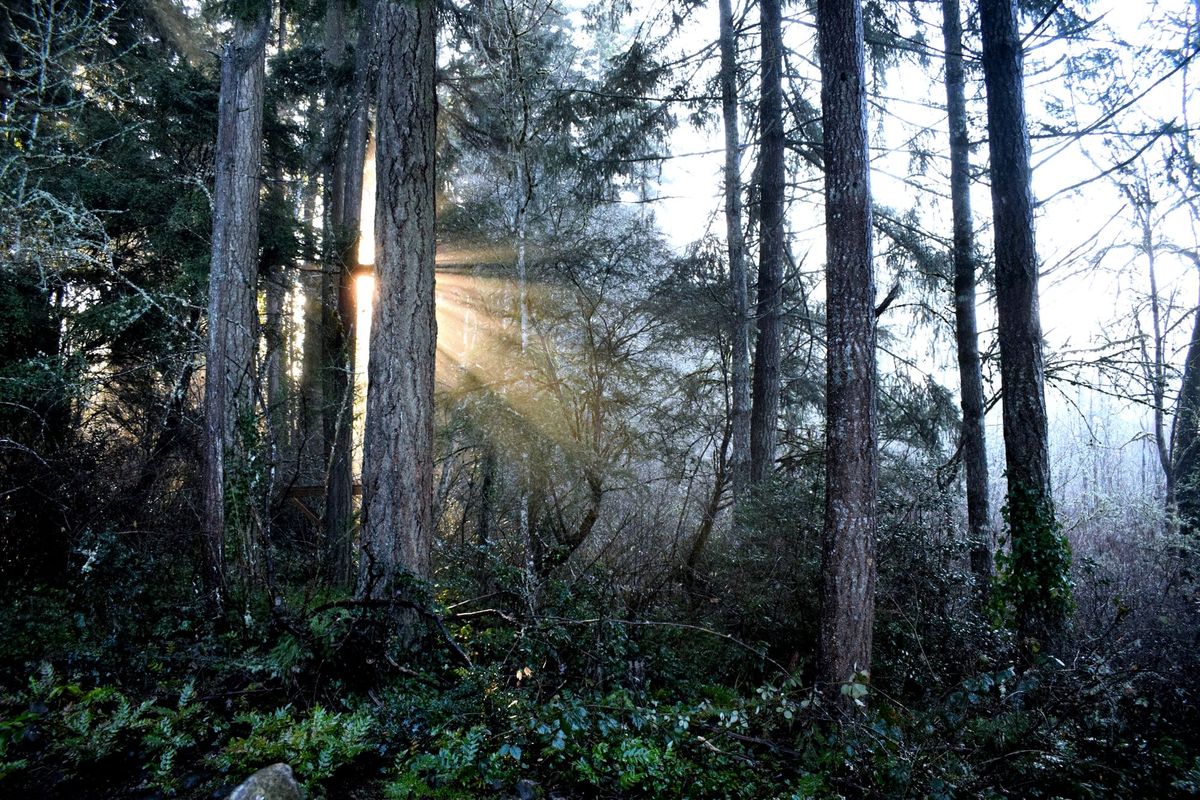
“Hell is round the corner where I shelter / isms and schisms; we’re living helter-skelter...”
Greetings from Malmö, where we have entered råtmånaden—literally “the month of rot”, which is the Swedish term for the dog days of summer. This week we’re riffing on the mutually entangled philosophies of Enlightenment and Romanticism, and their long, long legacy.
Set out your fly-traps and bury your banana skins, it’s time to head home from the stuga…
among the pixels
Here’s an excerpt from Cal Flyn’s new book, in which she sketches out the medieval reimagining of Europe’s rewilded landscapes after the collapse and withdrawal of the Roman empire’s colonial influence, plus a succession of plagues and ruinous shifts in climate.
Towns were depopulated or abandoned altogether; farmland was left fallow; forests regrew; busy thoroughfares fell silent and grand villas derelict. In turn, these changes were also reflected in the remaining inhabitants’ evolving attitudes towards the natural world and the association of wild places not only with hardship but with fear and the supernatural. In some senses the status of medieval wilderness is peculiar to its time and place, but I believe it also offers us a more general insight into the interaction between a human sense of security and our sentiments towards wild nature. Loss of control, or the fear of it, has a powerful hold on us.
Now, I would read stuff like this regardless, but I think it chimed for me hard this week because I’ve begun to make my way through Marci Shore’s introductory course on European Intellectual History since Nietzsche, which you can find on Yale University’s Y*uTube channel. (You can skip the first lecture, which is basically Shore telling on-site students how the course will operate.)
As Shore notes, the course title is a little misleading, in that she starts the story quite a way before Nietzsche—but she inherited the module from a respected predecessor, and elected to keep the original title in memoriam. The first couple of substantial lectures provide a whistle-stop sketch of the Enlightenment as an intellectual-textual phenomenon, as well as one of its obverse alter-ego, Romanticism.
With apologies for further simplifying what Shore admits is already a necessarily huge simplification: Enlightenment was an optimistic philosophical mood that fetished the human capacity for reason as the inevitable path to virtue and social harmony, while Romanticism was a darker, more pessimistic take on the same ideas, which focussed instead on passion and the will as the engine of individual human becoming. If you’ve dabbled in this era of philosophy, you’re probably familiar with this split being expressed in terms of alignment with either Team Hobbes (“nasty, brutish and short”) for the Enlightenment realists or Team Rousseau (“born free, found everywhere in chains”) for the Romanticist idealists.
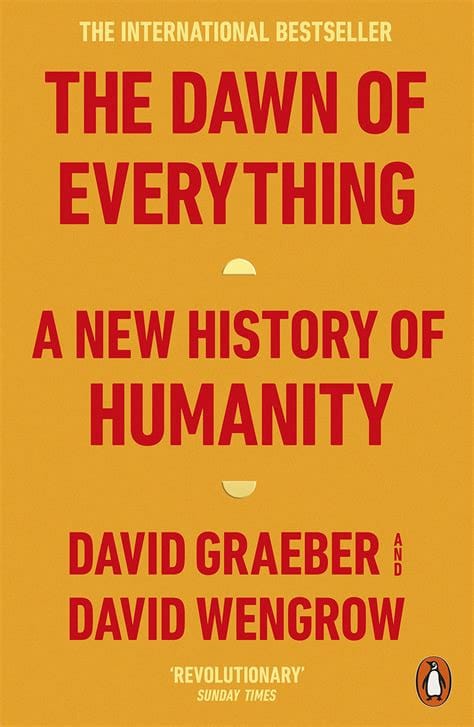
It is of course rather more complex than this—Rousseau in particular can be read as a fountainhead for either stream—and among the many triumphs of Graeber and Wengrow’s The Dawn of Everything is its opening section, which basically demolishes the duality by demonstrating that it was based on ignorance (wilful or otherwise) regarding the range of different ways that pre-modern peoples arranged their relations with one another and with the world, especially outside Europe.
False though the dichotomy may have been, it has nonetheless been an engine of Western thought ever since, and mutated versions of both positions are still very much present in what we might think of as vernacular philosophies today: liberalism was the heir of Enlightenment thought, for instance, and still carries the torch for its optimistic arc of progress through history, while Romanticism’s bone-structure underlies both nationalism and a lot of environmentalism.
This is why it’s useful for people who think about times to come to spend a lot of time thinking about times long past. There has been much confusion in the last five years or so regarding the supposedly inexplicable convergence of wellness culture, spiritualism, environmentalism and nationalism, based on the assumption that all but the latter are fundamentally leftist positions. That certainly appeared to be the case for much of the late C20th and very early C21st, but realignments are always occurring along that axis which we assume to be so stable—and intellectual history shows us clearly that this seemingly new formation is better seen as a re-formation of something like Romanticism.
What has this to do with Flyn’s medieval peasantry and their fear of the deep, dark woods? As the excerpt indicates, the medieval wilderness of forests that had reclaimed previously settled land was their imaginative repository of the scary and the uncontrollable. To work backward from Max Weber’s well-known term, they were the site of enchantment, as can be seen in the fairy tales that carried the folk mythology of the period—and that enchantment was far from benign. The armature of medieval Christianity was therefore set in opposition to its threatening (yet also enticing) pagan mysteries.

Shore glosses Enlightenment thought as the attempt to replace God with something more rational and human. Thinkers like Hobbes and Rousseau were all building what contemporary social theorists describe as the social/natural (or culture/nature) dichotomy, though in different ways and to different ends. What Enlightenment and Romanticism share is the idea that humans and nature are somehow separate; where they differ is in whether they approve of that separation or deplore it, respectively. Where Enlightenment celebrated human mastery over nature through empirical science—the taming of the wilderness, if you like—Romanticism projected its own aspirations into those dark, wild spaces, just as they were starting to disappear quickly due to socioeconomic processes such as enclosure, and the earliest phases of what is now the infrastructural metasystem.
Or, to put it another way: as Enlightenment thought busied itself with the disenchantment of the world, the Romantics went in search of the last places in which it might be hiding.
As already hinted above, we’re currently seeing not an exact replay of the Enlightenment vs. Romanticist dynamic, but something that nonetheless rhymes strongly with it: a fierce backlash against a rigidly rationalist paradigm rooted in the optimistic assumption of progress as an inevitable historical force, which has through a process of enantiodromia become its own contradiction (as in the soi disant Dark Enlightenment, whose members likely didn’t realise quite how accurate their supposedly ironic moniker really was).
But for us, however, the forests (and other such signifiers of “nature”) are all but gone. The natural was “out there” in the era of modernist thought, still largely surrounding our little enclaves of culture and civilisation; now, however, it is the natural that is surrounded, reduced to dwindling pockets.
How will all this play out? I have no idea—though I do think that the tables are turning as we speak in favour of what I suppose we could call a post-post-Romanticist position. That’s not an entirely comforting thought, even though I have definitely had enough of reason’s unreasonable rule! But this historical perspective allows me to understand the present as a continuation of an opposing dynamic that is by this point centuries old. This does not fuel any easy hope for its neat resolution any time soon, to say the least—but it does somehow get me closer to something that feels like acceptance.
between the pages
I finished Leckie’s Radiant Star this week, and found myself as ambivalent on its final pages as I was on its first few. I have thoughts about this which need teasing out and setting down properly, but there hasn’t been time to do anything more than batter out rough notes, and I’m not going to subject you to those!
What I will note is that when a critic such as myself says them have problems with a book, that doesn’t necessarily mean “this book is bad” (though it can sometimes mean exactly that). Radiant Star is deftly written, and I enjoyed it enough to finish it, as is evident.
But as a fresh knot in the ever-evolving tapestry of genre literature, it feels to me part of a pattern that has become overly repetitive, focussed on motifs that have crowded out a lot of what used to attract me to speculative literature. On one level, that’s probably as it should be: as I’ve been known to say of music, if what you’re doing isn’t somehow irking people of the older generation, you’re probably doing it wrong! However, as discussed above, albeit in a rather different context with higher stakes: when patterns of thought become overly dominant, the result is stagnation and backlash.
Back in the day, I fought on the side of the Blog Wars which claimed that the question of representation in genre fiction was important, and I still believe that to be the case. However, it feels like it has become the only question of concern, to which innovation (and often quality) in style and story is increasingly sacrificed. To borrow a line from a recent blog post by Paul Kincaid, “this is wishful thinking rather than a serious attempt to envisage what [a speculative] society might be like”.
Science fiction in particular has become boring—and it may simply be that the genre has run its course, given that it was very much a creature of C20th techno-progressivism; as the critic John Clute was already observing some two decades ago, sf was obliged to mutate in order to survive the collapse of the ideological framework on which it had been trellis’d. The economic realities of modern publishing are also a factor: there’s little tolerance or taste for the risk of publishing that which doesn’t appear to be a dead cert success, which results in rapid homogenisation.
Perhaps I am just entering—or rather fully embracing—the “old man shakes fist at clouds” phase of my life in this regard? If so, selah. But what strange times are these, when the older folk are complaining that the young have become too cautious?
lookback
Another week in which I’ve mostly been head down in work for LUDIC—though this time I’ve been editing other people’s work rather than writing my own. Various bits of admyn, a couple of calls, but otherwise not much to report—other than Magrathea Futures AB having passed its third birthday this Friday just gone. Time flies when you’re having fun, they say!
Next week promises to be a little more dynamic, as I’ll be spending much of it in Berlin—so if you’re based in that fair city, do drop me a line if you’d like to meet up! This trip is something of what we Brits call a busman’s holiday, but I will have a decent amount of time on my hands with which to do my own thing, so I’ll also gladly receive any recommendations of good stuff to see. It’s been close to a decade that I was last in Berlin for more than an hour between trains, and the time before that was a decade earlier, so I know that much has changed…
ticked off
- Sixteen hours on PROJECT LUDIC.
- Six hours of admyn.
- Three hours on these here weeknotes.
- Two hours of essaywork.
- Two hours of networking.
- Two hours of art practice.
- And ten hours of undirected writing and reading, as always.
OK, that’s about all for now, I think. Thanks for your attention, which is always appreciated, and I hope all is well with you, wherever you may be.
This has been the Worldbuilding Agency weeknotes for Week 32 of 2026. Thanks for reading! If you've enjoyed them, it's free to subscribe. If you are already subscribed, please send to a friend!


Comments ()