

week 31 / 2026: art and artifice
In this episode: a long hard look at the distinction between art and artifice, and what it means to make things for their own sake. Plus: technical aspects of the new Ann Leckie novel!

“I have known no other methods / so don’t presume there’s wisdom / when all that I am is time, now…”
Greetings from Malmö, where somehow it’s August already, and I’m not quite sure how to feel about that. This week, we’re asking whether humans invented art, or whether it happened the other way around.
OK, turn on your torch, and let’s wriggle our way into the cave…
among the pixels
I’ve only got one clipping for you this week, as I’ve not been reading as much as usual. I’ve mostly been blasting out short stories for PROJECT LUDIC, which is always a delight, but it also really reduces my capacity—or perhaps just my willingness?—to sit around reading stuff on the internet.
(If you’re thinking “then maybe you should spend more time in Output Mode”, uh, you’re not alone?)
So, just one clipping, but it’s a really good one. I’ve actually discussed its basic argument here before, if only in passing, because it’s essentially a condensation of the thesis of J F Martel’s Reclaiming Art in the Age of Artifice, which is a super little book that comes highly recommended.
Martel starts from the idea that there are two forms of truth: the quantifiable, objective truth with which rationality and science is concerned, and the qualitative, subjective truth—the ecstatic truth—that we encounter in art.
In addition to telling us much about murders of crows, fields of wheat, darkling skies, and footpaths, van Gogh’s painting is showing us what it means to be alive on this planet, in this universe. No doubt it does this by means of the subjective ideas that critics and historians have found in the painting, such as mortality and despair (the picture was made shortly before the painter took his own life). But what the painting reveals through these themes is not subjective at all. It is, in fact, the one thing we can know objectively: the radical mystery that every event, by its mere occurrence, affirms. The mystery isn’t what the crows and the field mean, but that they mean, and that they mean because they have all come to be, just as they are. The truth of artists, in this deeper sense, precedes and contains the truth of accountants. It is what must be acknowledged – if only unconsciously, sometimes perhaps resentfully – before anything can be said to be worth counting or accounting for.
The two types of truth imply two types of beauty, which in turn imply two modes of making, namely artifice and art, and only the latter expresses ecstatic truth; artifice is hampered by its telos, by its being a means to a predetermined end.
(In practice, as is the case with most such oppositions, most any actual creative work will be a mixture of both modes: flashes of the ecstatic appear in the most mundane things made by humankind, and even the most visionary works or art tend to have some sort of rationalised intentionality in them.)
This distinction is much on my mind, because when I’m writing fiction for foresight (as I am currently with PROJECT LUDIC), I am necessarily on the artifice side of the balance: these stories have a job to do, namely the capture and expression of scenarios developed by others, with a particular theme and direction of enquiry.
But there are moments in the process of writing them where I feel flashes of wilder, weirder inspiration and vision sneaking in—or trying to, at least. The rapidity of the process both helps and hinders this generative phenomenon, I suspect. It helps, because if you’re cranking out a four thousand-word story in a day, you’re necessarily suspending a bunch of evaluative and rational mental processes; I think of this like raising a sluice-gate to let the water flow fast, and it is shockingly effective!
But it also hinders, because the channel you’re releasing the water into has been prepared in advance, and with a particular purpose in mind: the ideas thunder down the sluice, yes, but that means they don’t get to meander slowly across the landscape, seeking what Lao Tzu (via Ursula le Guin) calls “the low loathsome places”, where that ecstatic truth might be found.
Martel takes a fairly strong line on artifice:
The privileging of utility over uselessness, of work over play, is the death of art – and the death of the given world in which our utilitarian spirit must be grounded if it is to have purpose and meaning.
I don’t feel chastised, because I’m not pretending that the stories I do for foresight work are true art; they are artifice, and I think it’s fine to put creative tools to purposeful use, so long as we don’t start saying that purposeful use is the only game in town.
(I also don’t feel chastised because Martel is one half of the Weird Studies podcast, and as such can be counted among the very small number of human beings with whom I have some sort of parasocial relationship. Which is to say: I’m fairly confident that he’s not the chastising kind!)
However, as Martel argues, we’re in dire need of ecstatic truth as a counterbalance to the utilitarian instrumentalisation which has come to characterise our world, much to our detriment. So go make something that has no purpose other than to fulfil your urge to make something!
(Seriously, though—read the essay first.)
between the pages
I have managed to do some dead-tree reading this week, though not much, for reasons already discussed; as such, I’m only around a third of the way through Radiant Star, the latest novel from Ann Leckie.
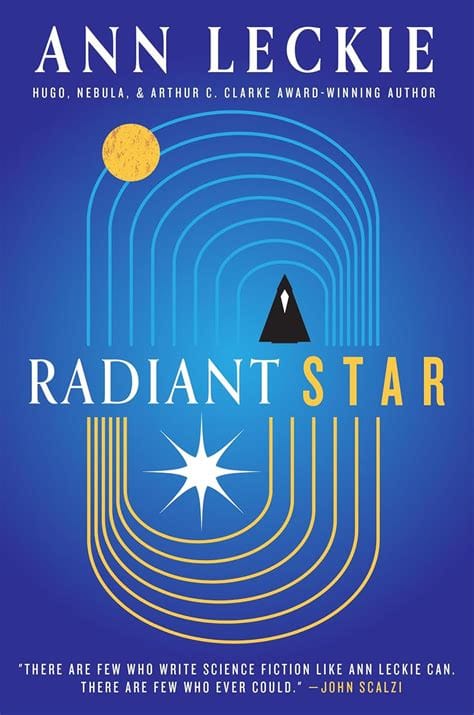
Like pretty much everyone else, I went nuts for Leckie’s break-out Ancillary trilogy when they appeared—and with good reason, because they delivered a much-needed kick in the pants to a subgenre that had once again lost its way.
For me, though, the follow-ups have never quite managed to recapture the excitement of those earlier books, because they have tended to keep a very close and local focus, and to examine the politics of the Raadch primarily as it expresses at the very smallest and most intimate levels. It’s a sort of hypocrisy on my part, I suppose, given how much I talk about the importance of making the abstract concrete, but I find myself wanting more of the bigger picture—perhaps because that’s what space opera as a subgenre has always tended to concern itself with, and so my expectations are primed in a particular way.
(An alternate explanation would be that I am a male person, and therefore deem this more female-coded concern with the minutia of care, social customs and protocols inherently icky. I find that argument offensively essentialist, and as much an insult to the book as to me, but there you go.)
Radiant Star represents something of a technical departure, though, in that I think it’s the first time Leckie has written from an engaged third-person POV. At least one of the narrative threads here is being presented as an explicitly written and historical account of the events, though it’s not yet clear whose POV it is; politically at least, it appears sympathetic neither to the Raadchai, who are in the position of colonisers in this scenario, nor to the various local factions, whose squabblings form the spine of the plot. I’m finding I’m much more interested in finding out who is telling me about the events of the story than in the event themselves, if you see what I mean? The novel is not exactly replete with sympathetic characters—and this is clearly a deliberate choice, given how much the narrative takes care to emphasise their less savoury sides. Perhaps my sympathy with the as-yet-unidentified narrator is exactly the effect intended? I guess we’ll see…
lookback
As already noted, this week has mostly been all about writing stuff for PROJECT LUDIC, though I had a nice trip across the bridge to Copenhagen on Friday to do some consulting. The weekly count of hours is lower than usual, but that’s a function of the intensity of Output Mode: four or five hours of pure writing per day is magical, and it’s my great privilege that I get to call it my job, but it’s also very draining!
ticked off
- Twenty-one hours on PROJECT LUDIC. (Phew! And probably a few more to come this afternoon, and all through Monday... because while I’ve been blasting it out, I’m still a liiiiittle bit behind where I should be.)
- Four hours of on-site consulting.
- Three hours on these here weeknotes.
- Two hours of essaywork.
- Two hours of admyn.
- Two hours on MUNICIPAL. (Mop-up meetings.)
- And ten hours of undirected writing and reading, as always.
OK, that will do for now; I might take a little time to sit in the sun before descending once again into the word-mines. Thanks for your attention, which is always appreciated, and I hope all is well with you, wherever you may be.
This has been the Worldbuilding Agency weeknotes for Week 31 of 2026. Thanks for reading! If you've enjoyed them, it's free to subscribe. If you are already subscribed, please send to a friend!


Comments ()