

week 23 / 2026: now and then
In this edition of weeknotes: Adam Curtis on the trap of self-hood, USians on their preference for the present over “The Future”, Sherryl Vint on the merging of the two meanings of speculation, and Chris Butler on the necessary friction of the uncertain present...

“Out for summer, out till fall / we might not come back at all...”
Greetings from Malmö, where gymnasium graduates have spent the week driving around town in their parents’ cars, hooting their horns and blowing whistles and letting off fireworks, and I’ve had to remind myself on the regular that, once upon a time, I too was young.
Perhaps that’s why this week we’re mostly looking at the weird things that happen to culture when we reify futurity and make it a destination rather than a direction of travel…
Fire up those clicking fingers, folks; it’s time to scroll!
among the pixels
First up is Dean Kissick interviewing legendary documentarian Adam Curtis, the general vibe of which reminds me of the time I first interviewed Bruce Sterling, back in the day: a well-meaning young man with some bright ideas gets gently but firmly schooled by someone who’s actually done the hard yards.
Of particular interest to me is the way that Curtis, like many others, seems to be bending toward the idea that the aching void in contemporary Western lives is the space left by the chasing away of religion—or, perhaps more accurately, its wholesale replacement by rationalism (which has many merits, but makes a lousy foundation for a worldview).
But Curtis has also got the gimlet eye on futurity that only ever tends to come from spending a lot of time thinking about history:
We look back at the Victorians and say that their conformism was going to church and being moral and hypocritical at the same time. Others will look back at us in a hundred years’ time and say that our conformity was self-expression, that everyone believed that the most important part of life was self-expression, which is ridiculous because if everyone is self-expressive, what’s the point?
History is vital to foresight, but so is the present—perhaps even more so. I’ve been saying for a long time that The Future is dead, and that talking incessantly about it (or even about its less hyperbolic lower-case cousin) serves mostly to entrench the problems we believe ourselves to be addressing, because to dream of The Future is to give up on the present.
As such, where others in the foresight community were distressed by a recent survey that suggested that far more USian respondents would like to live in the past than in the future, I was greatly heartened by what I thought the more important and intersting result, namely that far more respondents would rather live in the present than in the future.
For many, I think this was seen as confirming of the “futures literacy” argument, which—to paraphrase with acknowledged crudity—claims that ordinary people can’t imagine better futures because we haven’t trained them to do so. (For the record, I believe this argument to be well-intentioned, but deeply and dangerously wrong.)

Perhaps there is something problematic in people wishing they lived in the past, but I doubt it is a particularly novel phenomenon, and it is plausibly explained (at least in part) by a generational nostalgia for the circumstances of a lost youth. I would be much more worried by similar numbers in the opposite temporal direction, but I would categorise that as a sort of nostalgia, too.
Most of what people think of as The Future is really a jumbled collection of tropes from the past, a melange of paleofutures built from failed predictions, repeatedly reskinned and resold, first as entertainment, then as commerce. As Sherryl Vint has been at pains to point out, there are two meanings of the term “speculative”, one of which refers to imagination, and the other to finance; a useful way of thinking about the present moment is to understand that those two meanings have been quite deliberately merged, and repackaged in both cases as prediction, promise, prophecy.
Which brings me at long last to designer Christopher Butler, whose attitude to foresight is pretty much in sympathy with my own:
There is a real and difficult tradition of looking ahead — Jeane Dixon’s bolder claims and Alvin Toffler’s quieter ones are not the same kind of thing, and I am not equally persuaded or put off by either. I actually think that underlying project they share is honorable, so much so that I have tracked predictions of all kinds in a spreadsheet for years. But to attend carefully enough to the present, in either mode, that some pattern of the next becomes visible, is a necessary balancing discipline. It is hard, being present. When it works, it is generous, because it gives the rest of us something to do with our anxiety besides be ruled by it.
What we have flooded the commons with is something else, and on inspection most of it is the opposite. It is a way of buying the feeling of foresight without the practice — of metabolizing uncertainty by paying someone to swallow it for you. It is, I think, a form of intellectual cheating. The prediction industry sells us the feeling of having figured something out without the friction of actually figuring it out: a way of being done with uncertainty in advance of doing the slow work of moving through it.
To say that prediction is bunk is a shibboleth of foresight and futures work, but it is a shibboleth honoured far more often in the breach. This is understandable: clients are hungry for certainty, and there’s money to be made in selling it, while there’s currently little money to be made selling anything else.
But uncertainty—like its more intimate and personal cousin, anxiety—can never be banished; it can only be lived with. There will always be another thing, and another, and another.
The uncertainty of futurity can only be met here, in the present, and history is a far better ally in that struggle than is currently appreciated.
between the pages
I’ve not had a lot of dead-tree reading time this week, but I had just enough to rattle through Colson Whitehead’s Crook Manifesto.
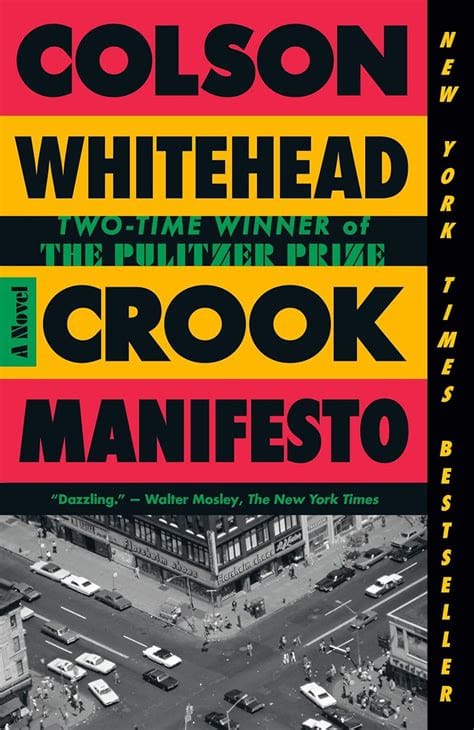
A sequel to (or perhaps more fairly a continuation of) the story begun in Harlem Shuffle, this novel might be thought of as three novellas set in the uptown new York of the late-to-mid 1970s, each dealing with a different historical moment, and in combination conjuring up the rapidity of cultural change in those turbulent times.
I’m in no position to speak to the historical accuracy of Whitehead’s treatment of the African American experience, but I feel I can usefully comment on the deftness of his writing, which is spectacular—sometimes quite literally so. Working in a sort free-indirect-speech POV, Whitehead gets us close enough to his characters that we see the world as they see it, and hear the simultaeously wise-ass and world-weary voices with which they would describe it, if only in the privacy of their own heads. This is important, because our focal characters are, as the novel’s title implies, crooked, albeit to different degrees—which means that what they’re thinking and what they’re saying out loud are, if not exactly at odds, then frequently set distinctly slantwise to one another.
You can read Crook Manifesto as a brisk historical crime thriller, though I don’t think I do it much disservice if I say that it’s not suspenseful in the contrived way that I tend to associate with the thriller genre: Carney and Pepper’s entry into various sticky situations result from a combination of bad circumstances and bad decisions, and their narrow exits from them are often as much down to the chance choice of a more minor character than to their own derring-do or quick thinking.
Point being, Whitehead humanises his crooks, but he doesn’t hero-ise them. Carney in particular strikes me as a sustained study in moral ambiguity: a basically decent man raised in a societal context of cut-throat competition where crookedness is a way to get a little way ahead of the structural disadvantages stacked against him. Carney cares deeply for his wife and kids, and cries when his furniture store is firebombed, but he also asks favours of the crooked cop who takes the protection money that keeps his store in business, fences stolen goods, and tasks underworld associates like Pepper to do things that he wants done without him having to dirty his own hands.
Is Carney a good man, a bad man? Whitehead’s point, I think, is that he’s just a man—a product of his environment, yes, but also an agent within it.
All that aside, it’s just a cracking good novel. Thoroughly recommended.
lookback
A busy week, and it’s not over yet. Two days out of the studio for the final workshops of LUDIC, two days very much in the studio working on MUNICIPAL (including some online facilitation as well as lots of writing and editing), plus various little bits and bobs. Some internal deadlines on MUNICIPAL are very close, in fact, which is why I’m keeping this section brief; once these weeknotes are done, I need to do a bit more work before I can actually close the laptop and take some downtime.
(Yes, I know, I’m eating into my weekends again, which experience dictates to be dangerous—but sometimes the deadlines fall in clusters on the calendar, and you do your best to deal with the ones that can’t be deferred. That’s the job.)
ticked off
- Fifteen hours on PROJECT MUNICIPAL.
- Eleven hours on PROJECT LUDIC.
- Three hours of reading for research.
- Three hours on these here weeknotes.
- Two hours on PROJECT RADBURN.
- Two hours of networking.
- Two hours of courseware development for my increasingly imminent Rogue Worldbuilding course. (Places are still available, by the way!)
- Two hours of art practice. (Snatched on Saturday afternoon as a much-needed decompression modality after a long time down the word-mines.)
- Two hours of admyn.
- And ten hours of undirected writing and reading, as always—though there were times this week when I was sorely tempted to unfence that fallow land, I gotta say. This is what makes it viable to burn through weekends from time to time, perhaps? A period of creative play, protected as the work it actually is.
OK, it’s time for me to switch back to business for a while. I am grateful for your attention, and I hope all is well with you, wherever you may be.
This has been the Worldbuilding Agency weeknotes for Week 23 of 2026. Thanks for reading! If you've enjoyed them, it's free to subscribe. If you are already subscribed, please send to a friend!


Comments ()