

week 27 / 2026: progress and myopia
This week, a debunking of bio-factory protein production, which leads us to a broader look at solutionism, and the frustrating impossibility of simply swapping one metanarrative for another. Plus, the short fiction of Iain M Banks...

“Long distance information / I’ll take the same / I got the fuel for the transformation / I’m a naked flame…”
Greetings from Malmö, where matters meteorological have reverted rather to the mean—which is to say, it’s overcast and windy, and that’s just fine. This week we’re looking at the seductive myth of the technological solution, and the metanarratological structures that lie behind it.
Ready to go? Then roll up the windows, and we’ll be on our way...
among the pixels
This piece by agrarian advocate Chris Smaje is partly a debunking of the crazy pro-environmental claims made for factory-based bacterial protein production, and that’s the aspect that provides this pull-quote:
... efforts to decarbonize the global economy rest heavily on renewable/rebuildable electricity, which will be needed to power almost everything if we expect life to continue along present lines – including things currently energised more efficiently by fossil fuels. We will need renewable electricity for transport, mining, construction, cement, plastics, fertilizer, metals, data centres and so on. Agriculture is the only major sector that at present is significantly energised directly by zero cost and zero carbon sunlight. Yet just at the time when we need renewable electricity to do the heavy lifting of the global economy, advocates of bacterial food for mass nutrition are effectively implying we should use all current renewable electricity, and more, for food production that can otherwise be energised directly by sunlight.
However, it’s also about Smaje’s ongoing dispute with George Monbiot—though to call it a dispute makes it sound rather more even-sided than it actually is. Monbiot is a household name in the UK (at least among a certain demographic slice of the population), while Smaje is notably more niche, meaning that the dynamic boils down to Monbiot using Smaje as a sort of straw-person punchbag in public, for the sin of Smaje having had the temerity to look at Monbiot’s claims closely and show them to be rather flimsy.
So there’s a kind of double-meta aspect to this piece, as well, at least for me. First of all, it’s illustrative of a phenomenon that we might call “substack brain”, but for the very good reason that it both predates and exists beyond that platform. In more theoretical terms, we might go to Mark Fisher’s observations regarding the genuinely remarkable capacity of capital not only to recuperate criticism, but also to co-opt the critics who produce it—and with nary a shot fired, so to speak. Monbiot’s trajectory from firebrand environmentalist to partisan peddler of boondoggle solutionism is not unique, of course—there have been plenty of previous agitators whose ire was successfully redirected by means of their incorporation into the punditry—but I don’t for a moment imagine that some shadowy cabal met up and planned it this way. The grim irony is that the amorphous thing we refer to when we talk of “the media” is an ecosystem of sorts, and that this sort of dynamic is a textbook example of autopoiesis.
The other meta aspect that interests me, in a similarly peering-at-roadkill sort of way, is closely related: it’s the incredible hunger for “solutions” to the climate challenge, which leads to people swallowing whole the carefully constructed claims of the companies in question.
To be clear: the biochemical process involved in factory protein production is a scientific fact, as is (to pick the homecoming queen of this sort of thing) the process that underpins advocacy for direct-air capture (DAC) of as a mitigator for continued CO2 emissions. But the numbers just don’t add up, as Smaje shows with ease in the linked post, and as countless people have shown with regard to DAC for over a decade.

It’s not even complex math! Indeed, it’s the sort of math that even I can do, and—rather more importantly—it’s the sort of math you’d expect that the business world, with its avaricious mantra of “but does it scale?”, would be doing as a matter of due diligence with regard to long-term investment. Because these things don’t scale—or at least cannot scale without the making of contextual assumptions (around, for example, energy availability) which are demonstrably ridiculous.
A similar blindness, drizen by the dazzle of both novelty and number-go-up, pertains in the less sexy but arguably even more consequential world of logistics: as Benjamin Fong explains, even Amazon’s fiercest critics tend to grudgingly concede that its ability to provide pretty much anything to pretty much anyone, pretty much anywhere (uh, terms and conditions apply) is pretty impressive—and as a feat of abstract technical problem-solving, that’s true! But considered as a solution to a social problem, the story is rather different.
And yet, and yet, and yet… the technological solution story is always irresistible.
Again, I don’t think there’s any conspiracy at work here—unless you count the profit motive as a conspiracy, which is an understandable error when you’ve spent your life at the shitty end of that particular stick.
But this is part and parcel of what I’m talking about when I say that The Future is dead, and that we are trapped in its rotting corpse: the false assumption that we can somehow “innovate” our way out of the accumulated consequences of decades, if not centuries, of prior “innovation”. If that was ever true, then it is demonstrably untrue now—but it remains among the foundational myths of the age.
And that, I suppose, is why I feel a kinship of sorts with Smaje: we are fighting the same monster.
The problem is exactly one of narratives—or, more accurately, of metanarratives. And while there was a time when I definitely did, I no longer think of my work as an attempt to destroy and/or replace the prevailing metanarratives of the age. That’s not because I don’t want to see them destroyed or replaced, but rather because I have come to understand that it’s not a thing that can be done quickly or totally, and that historical attempts to do so have tended to end up very messy indeed.
I might have come to that realisation a lot earlier had I discovered sooner the work of Sharon Blackie, a narrative theorist who has been wrestling with these questions for far longer than I’ve been aware of them. Much to my regret, I discovered her only very recently, thanks to Patrick at Sentiers linking to an interview she’d recently dug out of her archives and spliced together with an extract from one of her books. If you’re even slightly interested in the sort of stuff I write about here at WA (or elsewhere!) then this is a real must-read:
Q: One of the points you make in your writing is that ‘stories work from the bottom up’. That we arrive at a larger, coherent metanarrative through our ‘smaller’ stories. A metanarrative isn’t simply something we can make up, or decide on, that then will make sense of everything for us. Working with stories and narratives as a process of change requires more than simply choosing a story of the world that we like. What do you see as the dangers of what you call ‘magical thinking’ around narrative: the idea that all we need to do is to invent a new or better story and then our problems will be overcome?
SB: What I fear is very simple: a shorting out of the batteries. I fear that people – for a bunch of very good reasons, and armed with both enthusiasm and talent – will waste their time and energy trying to create something which can’t be created. That they’ll go running off down paths that ultimately don’t lead anywhere, and we don’t have enough talented people who understand the nature of the problem we’re facing that we can afford to lose a bunch down some dark alley. I also fear above all a killing of the magic. Because that’s what this process is, of changing the story that a person or a group or an entire civilisation tells about itself. A curious mixture of magic and alchemy is required to create a story – with all its depths of symbols and its archetypal imagery – that buries its way into a person’s heart, and then the heart of a community, and then the heart of a whole culture. And magic and alchemy have to be learned. And given time to work. You can’t short-circuit the process. We’re too quick these days to want to fix things. But some things can’t be rushed. They have to grow. Slowly. And deeply.
Somewhat amusingly, Blackie mentions that she met the interviewer at the 2011 Dark Mountain Festival, where he was pretty much the only person who didn’t take her informed caution regarding the project of rewriting the cultural narrative as a personal insult. I was at that festival, too—with my journalistic hat on, no less—and came away with my own sense of disquiet regarding its articulation of ideas which, on the surface, I’d previously found very compelling.
(That a number of the more prominent players in that movement ended up making similarly bold claims for ever more outré ideas should, with hindsight, not be entirely surprising… though I would be remiss not to note that at least one of them, Dougald Hine, has come around to a point of view rather more aligned with Blackie’s.)
between the pages
Having put myself, perhaps unwisely, on the hook for a series of critical essays on the Culture stories of the late Iain M Banks, I have been getting warmed up for the project by returning for the first time in decades to The State of the Art, a collection of Banks’s short speculative works.
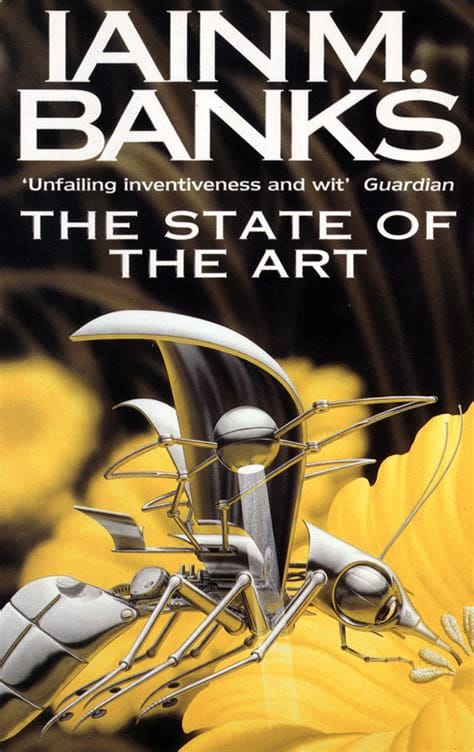
In practice, this is basically two stories and a novella set in the Culture (the latter of which sees a GCU and its crew poking around Planet Earth circa 1977), one angry experimental prose poem seemingly done with a variation of the cut-up method, plus a handful of other minor bits and bobs which, while not terrible, are the sort of thing that only a completist could love. These are also—not coincidentally—the sort of thing that was still both common to and beloved of the core science fiction scene in the mid-to-late 1980s, which goes a long way to explaining why outsiders tended to treat it as a joke genre: with a number of significant and notable but otherwise hard-to-find exceptions, a lot of it was both disposable and self-congratulatory. Banks is in each case subverting the form a little bit, but when held up against the cool sophistication of the Culture material he was producing (or at least publishing) around the same time, there’s a very clear line that speaks to more than simple literary quality: with the Culture, he was doing something really quite new, something lightyears away (sorry, not sorry) from the hokey cliches of the genre.
This was recognised at the time, of course, though I was not aware of it; while I was a genre reader early on, my resources and my access to new titles were incredibly limited, and I didn’t actually discover Banks—or the other mostly-British authors of what was at the time called the “new” space opera—until the late Nineties, around the time I realised that the libraries (and the second-hand bookstores!) in a fairly large city had a much bigger selection than the rural libraries and mail-order book-clubs I’d grown up with.
Which is to say: Banks was badged a re-inventor of the genre long before I started reading him, and while I never questioned it, I think I had on some level assumed it was partly the sort of hype that attached to an author who achieved sustained success with regard to sales: you know, “utterly changed our idea of what the novel could do”, blah blah, OK, whatever, show me the spaceships.
But now, returning to these early stories as a much better informed and more sophisticated reader, I can see that there really was something special going on—and, much to my relief, there’s also clear evidence in support of the thesis of my essay series, right here in some of the earliest examples of the Culture as a sustained project of worldbuilding.
So, an interesting read for me with my critic’s hat on—and if you’re an established enthusiast of the Culture, you’ll probably enjoy the novella that gives the collection its own title. Otherwise, while I would never want to discourage anyone from getting into Banks’s work, I wouldn’t advise them to start here!
lookback
This has been an easier week than the last one, not least because the weather has been much less punishing. There’s also a sense of one set of projects and commitments coming to an end, and a new, different set arising to take their place—like a slightly delayed seasonal transition, almost. (July looks like it will involve a lot more writing and a lot less meetings, and I can’t say that’s an unwelcome development!)
Perhaps due to that sense of shift, I’ve also felt a certain fogginess of thought starting to dissipate, which I suspect was due to a certain amount of unconscious function being spent on juggling priorities and keeping needful things in medium-term memory. In some ways it’s quite nice to be working across a number of different projects at once; you can rescue yourself from moments of motivational slump by switching to a different job, for instance. Nonetheless, I’m very aware that my best work tends to get done when I’m fairly closely focussed on one big thing; shifting projects can be a short-term relief, but there’s definitely some energy and momentum lost when changing gears and direction.
One of the paradoxes of freelancing is that you get to set your own schedule, but your schedule is at the same time almost entirely determined by external factors. I am reminded of a Peanuts strip that has always struck me as rather profound…
ticked off
- Nine hours on PROJECT RADBURN. (Blasting out an overdue draft, here.)
- Five hours running the Rogue Worldbuilding course. (This is turning out to be an absolute delight to do, and I’ll definitely be doing more of it.)
- Five hours on PROJECT BAVARIA. (Prepping and gridding a prototyping workshop to be delivered in just over a week.)
- Four hours of assorted admyn.
- Three hours on these here weeknotes.
- Two hours on PROJECT MUNICIPAL. (This phase is now complete—or so we think, at any rate.)
- Two hours of bizdev. (Writing and filing a mercifully simple application… though one of the great irritations of being located in the liminal zone between academia, non-profits and regular businesses is that each of them has totally different expectations about the shape and function of a CV.)
- Two hours of networking.
- Two hours of reading for research.
- One miserly hour of art practice.
- And ten hours of undirected writing and reading, as always.
Well, then. The draft that is RADBURN—or at least the current phase of RADBURN—is not yet finished and filed, so that’s this afternoon taken care of. Thanks for your attention, which I greatly appreciate, and I hope all is well with you, wherever you may be.
This has been the Worldbuilding Agency weeknotes for Week 27 of 2026. Thanks for reading! If you've enjoyed them, it's free to subscribe. If you are already subscribed, please send to a friend!



Comments ()