

week 28 / 2026: flats and boxcars
In this episode: can you make the words come without effort? You might think your LLM is helping, but really it’s a fast track to empty mediocrity. In the meantime, why not get a grip on your curiosity and (re)learn to enjoy reading books the old-fashioned way?

“Whatcha gonna do, child / when your thoughts are movin’ slow? / Find another / to show you where to go...”
Greetings from somewhere in Germany, where I am either on a train or bus, or waiting to board one. I’m giving a workshop in Munich on Monday, so these weeknotes have been prepared a day early. As such, I’m not going to say whether it’s nice to be back on the rails again, because it’s better not to tempt the caprice of the gods of infrastructure…
We’re into the final full week of my fiction-for-futures course, so this week’s clippings are once again related to writing, and to reading.
All aboard! This train is now departing…
among the pixels
This little piece from Irina Dumitrescu is not really instructive, in that it’s not offering advice on how to achieve effortless flow in creative work, but rather reflecting on it as a sort of personal utopian horizon. Dumitrescu says she has tried many different methods for getting the words to come, and many of them have worked for her—but something still seems to be missing:
Basically, I’ve given everything but drugs and alcohol a go. Mainly because I’m afraid those would work too, and then I’d have a problem. No, this is not quite right. I’ve tried everything but drugs, liquor, and prayer.
So what is the fantasy? Yes, those techniques all work, but they still involve trying. Is it childish of me to dream that it could all just come out? Without effort, without ache, without the blood?
Is that like asking for childbirth without pain?
This is interesting for two reasons. One of them is that Dumitrescu is an excellent and accomplished writer, and so there’s a certain sort of relief in seeing that even someone whose work you admire still finds it effortful in a way you recognise.
That said, at the same time there’s a sort of existential horror in seeing that even someone that good hasn’t found the magic switch in the mind that just lets the words pour out! I’ve been talking to my students about this, and also to a friend who’s not on the course: the phenomenon whereby the more you learn about something, the more you realise there is still to learn; the more territory you know, the more unknown territory can be seen beyond it. I’m also reminded of the many, many experienced authors who have observed that every time you write a novel, it seems you have to work out how to do it from first principles all over again. This makes sense, in a way: every piece of writing is a new problem to solve, and there’s no definitive solution. You acquire more techniques and strategies as you go, but that if anything results in something like option paralysis.
The second interesting thing is that Dumitrescu finds she can achieve the sort of ease of creation she dreams of in painting and drawing—a practice that she doesn’t think of herself as being particularly good at, but which nonetheless comes easily to her. I have to say, I do not find that my own dabblings with the visual arts come easy, at least not yet—though I seem to recall that I did a lot of fairly spontaneous scribbling as a child. This leads me to suspect that a lot of it is about one’s identification with the work, and with the results. When you draw for the fun of it as a child, you’re not holding yourself to any standards other than the joy of the process; once you start thinking of this as “making art”, a whole bunch of external measures of success start to intrude. (This is basically Austin Kleon’s entire thesis, as I understand it.)
All of which is to say: writing becomes harder when you think of yourself as a writer, and your writing as capital-W writing. (I know this to be true from my own experience with the morning pages practice, which relies precisely on training yourself to write without trying to Write.)
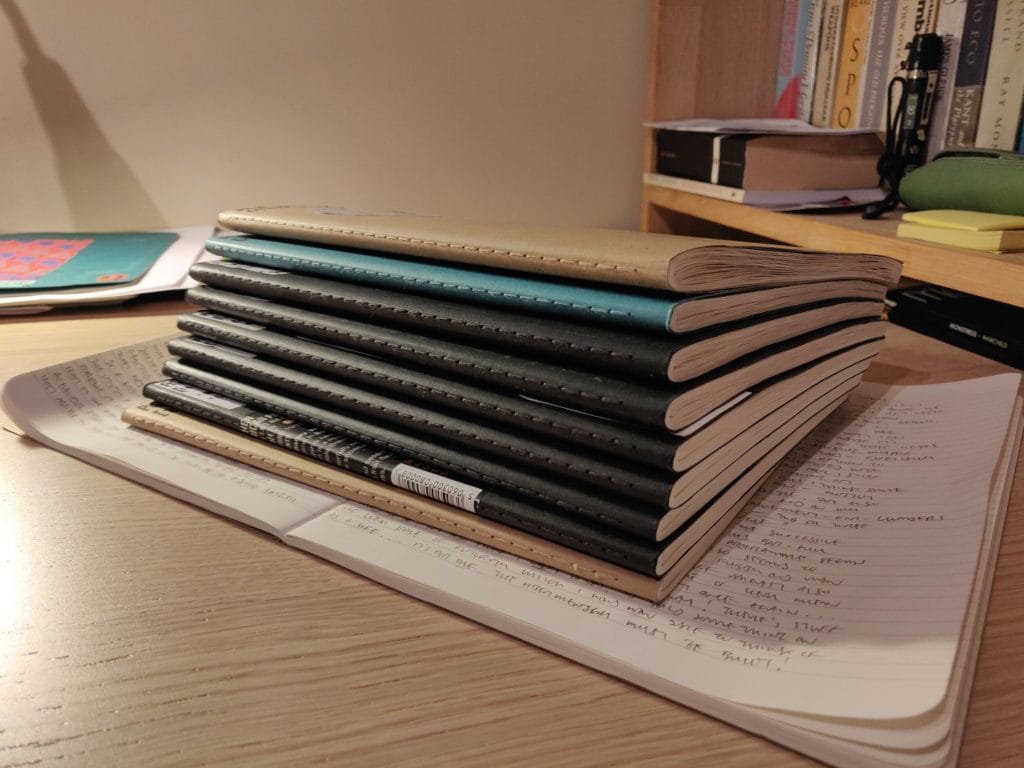
I’m not sure if there’s a way out of this bind when you earn your living by the pen, unless perhaps you’re lucky enough to get to a point where folk will buy pretty much anything you decide to put down on the page. But at least, as Dumitrescu notes, there are reliable ways to get the engine running—and once the engine’s running, there’s a good chance of getting carried away, if the circumstances are right!
Next up, some words of well-earned wisdom from Heather Parry, who—like the majority of published authors—makes a living partly by teaching the literary arts. As such, she has in recent times encountered an increasing number of people “collaborating” on their writing with large language models, and she’s not mincing her own words, as the title of this piece indicates clearly.
I recommend reading the whole thing, not least because any paraphrase on my part would not do it justice. But I want to pull out this part, in which she addresses the way in which “AI”-assisted work is discussed by its most strident advocates, because she puts her finger right on one of the things that has been bugging me for years, but which I’ve failed to articulate in a way that I felt was worth publishing:
There is an inherent position taken in [Marc] Carter’s piece, and over and over again in others, that actual talent or skill should not be a necessary condition for publishing a book. That you should not have to work hard at the craft of writing, as you have previously had to for many centuries, to hone a unique voice, to express yourself in new and inventive ways, to put the words on the page in a beautiful and surprisingly way that is entirely your own. To insist on this is to be exclusionary, to create barriers, to elitist. To be ‘accessible’, by this view, is not to remove the very real obstructions that stop talented marginalised people from enjoying equal opportunities to the non-marginalised; instead, it means that the publishing industry must publish any old shit written (or indeed AI-generated) by anyone who wants to be a writer, and if it has nothing to say and only exists to be published, then that’s fine, and to suggest anything else is sheer snobbery. The truth is that there are real, material barriers to people who are trying to make a career in the arts, right now, and especially those who are doing this from a marginalised position, but the technology that Carter and others posit as a solution is in fact exacerbating those very conditions. If you actually gave a fuck about barriers in the creative arts, you would swear off generative AI forever.
One reason this piece landed so well with me is because earlier in the week there was another article floating around on LinkedIn, in which some tenured academic managed to find a way to to argue that opposing LLMs is an expression of privilege. It wasn’t the first example of the genre I’d encountered, but it was particularly mealy-mouthed and hand-wringy—and, truth be told, exemplary of the aspects of academia that I really do not miss. Parry’s paragraph above nails the hypocrisy with concision and verve. I doubt we’ll see an end to this stuff until the bubble finally pops—but once it does, man, it’s gonna be fun going through the receipts.
Last but not least, here’s an essay by John Paul Brammer on how he managed to increase his reading. His commentary takes a line very similar to friend-of-the-show Jay Springett’s long-standing thesis about the sovereignty of your attention:
Pure attention isn’t rare. I see faces in pure attention all the time. Glassy eyes. Knitted brows. Slackened jaws. Immersed. Enthralled. This state is pleasurable because it removes us from the world. There’s no suffering in pure attention. Some call it prayer. I’m inclined to as well. Not because I’m religious, but because prayer goes somewhere. It’s addressed to something. It faces a direction. Prayer faces upward. In pure attention, we are malleable. We absorb and we melt into and we pass through, like mercury. It matters a great deal what we take in while in this vulnerable state. It matters what direction we’re facing.
Brammer’s corrective is the careful control—the parenting—of curiosity:
It’s no coincidence the internet is holding our attention with ever more colorful, infantilizing distractions. Take those AI-generated videos of anthropomorphic fruit. Sugary. Bright. The strawberry cheats on the banana with the pineapple. And then what? The strawberry gets pregnant and gives birth to a pineapple. The banana is present. And then what? The only thing that distinguishes this from entertainment for babies is its lewdness and lack of a perfunctory moral lesson. If prayer makes the Catholic more like a saint, then pure attention, spent like this, makes us more like crass, immoral babies. Attention here is only the price. The thing that’s spent. The child is the one that stole the credit card.
This is a discipline, but at the same time a freeing-up: following the curiosities that you’ve always had into the books and authors that have always called to you, and then following the trail of their influences and inspirations. Brammer’s particular path may not be right for everyone, but I think his direction of travel probably is.
That said, the flow state of reading is like that of writing, in that you have to want it enough to work to get it, at least at first. I encounter a lot of people who say they wish they could read more—but if wishes were fishes, we’d all live in the sea. As it is, we live in a version of the Spectacle whose relentless, sticky importuning would likely have horrified even its original, deeply cynical theorist. There is no outside to it, but you can take control of your attention and minimise your exposure, and thus your complicity.
War is over, if you want it.
between the pages
This week I’ve been wolfing down Five Ways to Forgiveness, a collection of novellas set in Ursula Le Guin’s Hainish universe—I.e. the one in which The Dispossessed and The Left Hand of Darkness are also set.
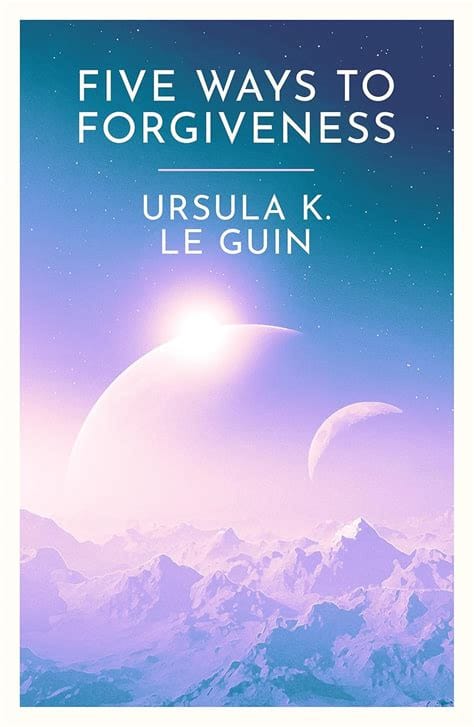
Predominantly first published (and hence, I assume, written) during the early and mid-1990s, these stories are perhaps Le Guin’s most direct engagement with slavery and colonialism as theme, which I further assume to be a response to the end of apartheid in South Africa during that period, as well as the politics of race in the United States.
I’d encountered two of the five in other collections I already own, but three of them are new to me. They are all at turns harrowing and sad and beautiful and hopeful, and above all relentlessly human—everything that Le Guin’s work always is.
If you’ve mostly only encountered her long-form books, this collection might be good entry point into her shorter works, not least because the shared thematic and setting of the five stories means you can treat them as a sort of large-tile mosaic novel. The novella’s more manageable length also means you can realistically finish a story in a single sitting—which might be helpful of you’re trying to train your curiosity, a la Brammer above.
lookback
This has been a somewhat mellower week, and somewhat bits’n’bobs: teaching the course, finishing a chapter draft (RADBURN), prepping Monday’s workshop (BAVARIA). I’m still feeling frustrated and disorganised, which I don’t think is entirely a true reflection of the circumstances—but suffice to say that Dumitrescu’s piece landed the way it did because I have not been feeling much flow in my work for some time now. I’ve been keeping all the juggling clubs aloft—and that’s no mean feat, and worth celebrating—but I feel like there’s a lot of little things left undone, and I’ve struggled to find the extra energy and motivation required to make time for them.
With that in mind, I’m going to treat the two travel days either side of BAVARIA as a sort of holiday—which means not that I won’t be working, exactly, but rather that I’ll be working on things that aren’t for clients. A couple of days on the rails, reading and writing… there are worse ways to spend your time, provided the train-gods smile upon you.
ticked off
- Six hours running the Rogue Worldbuilding course.
- Six hours on PROJECT RADBURN.
- Four hours on PROJECT BAVARIA.
- Four hours of admyn.
- Three hours of research and notes toward an essay.
- Three hours on these here weeknotes.
- Three hours of networking.
- Plus ten hours of undirected writing and reading, as always… and however many extra hours of essaywork I get done on the train today.
Right, I’ve got bags to pack and travel snacks to buy. Thanks for your attention, which is always appreciated, and I hope all is well with you, wherever you may be.
This has been the Worldbuilding Agency weeknotes for Week 28 of 2026. Thanks for reading! If you've enjoyed them, it's free to subscribe. If you are already subscribed, please send to a friend!



Comments ()