

week 29 / 2026: protocols and performances
In this episode: Scott Smith on “protocol communities”; the face as the site of surgical interventions into reality itself; and another look at “body futurism” as dark enantiodromia.

“All I’ve undergone / I will keep on…”
Greetings from Malmö, where cool south-westerly breezes have mercifully taken the edge off the heat. This week we’re looking at the increased prominence of the body as a site and focus of contemporary politics, commerce and culture…
So neck those supplements and chug those protes, it’s time to grind…
among the pixels
I’ve linked to Collision Detector a few times before, and given Scott and Susan of Changeist appear to be gearing up to a much more regular schedule of blogging there, I’m going to suggest you start following directly, because there are few folk who can match their gimlet-eye perspective on the state of things.
If you need further convincing, then I suggest you go take a look at this piece on what Scott is calling “protocol communities”:
Voluntary groups organized around comprehensive, rule-governed systems for living, where following the protocol becomes the basis of identity, belonging, and knowing what's true. The word matters: protocols are the rules by which things function—without them, the system breaks down.
A tribe or a lifestyle is affinity-based. A protocol is a specification: what counts as in and out. This is a community held together by rules, and by the shared conviction that the rules are the difference between order and chaos, optimization and self-harm.
Scott argues that the engine of formation for these groups is epistemological, and was kicked into high gear by the pandemic, and in particular the inconsistencies and hypocrisies in the application and enforcement of the rule-sets that came with it.
There's a reason so many of the visible formations cluster around the body: the institutional damage ran deepest in public health, and the substitution is happening where the failure occurred. Other failures are quietly breeding other formations—around money, parenting, politics, machines—but the body is where the pattern shows most legibly.
Second verse, rhymes with the first: Jia Tolentino at The New Yorker, drawing parallels between the illusory bodily plasticity promoted by the normalisation of cosmetic surgery and a more general retreat from the real.
About a decade ago, the most visible faces on Instagram—those belonging to famous white models and influencers—began to resemble one another. They already had full lips, catlike eyes, high cheekbones, flawless skin; Botox and filler made their lips more plump, their eyes more catlike, their cheekbones more pronounced. They began to look like cyborgs, their faces contoured by the algorithm, perpetually glinting in the light of digital approval. Looks, particularly for women, have long been a capital asset, and smartphones systematized this neatly, providing users with digital tools to make themselves appear more beautiful in photos and videos, and monetized platforms to broadcast those edited faces, which, back in the real world, could then be retrofitted, via cosmetic intervention, to match. The cycle of digital and physical optimization produced a new ideal and new habits. The needle tip of a cosmetic syringe measures roughly a quarter of a millimetre: the Overton window of what happens to faces has widened in almost imperceptible increments.
Tolentino notes that this system of aesthetic judgement is increasingly being brought to bear on men as well as women, in part because social media enabled women “to assert new norms for men, both deep and superficial”; the more extreme response to this scrutiny is the phenomenon known as “looksmaxxing”, as toxic as it is tragic.
She also discusses the “radically attenuated” culture of critique around these issues, drawing a line backward through the pop-feminist websites of the 2010s to the old-guard fashion-and-style rags at which the former took aim, which—when held up against “Instagram and TikTok, where the P.R. operations of celebrities and influencers can propagate the same aspirational imagery without dialogue or substance or investment in anything”—seem almost halcyon by comparison.
It’s not a happy essay, by any means, but these are not happy times—and people engaging seriously with the question of why we’re so unhappy (rather than simply announcing that we are, or yelling that we shouldn’t be) are surprisingly hard to come by. Well worth finding your way past the paywall for.
Both of these clippings reminded me of a piece I quoted here earlier in the year, which I think is worth the re-up: Toby Shorin’s examination of what he called “body futurism”, in which he starts from the emergence of the term “protocol” as a way of talking about practices to do with the human body.
The embodied turn is much more than a trend in the marketplace of ideas. Body stuff is the moral source of what is fashionable, even when the fashions themselves are competing. Paleo warriors wolfing down steak and eggs and Ray Peatheads on a carrot salad and ice cream diet are both capable of earnest moral posturing—that is the point. Anything that captures the popular imagination today, whether scientific or spiritual, unfailingly draws from the realm of embodied practice. The network ideologies that matter are the ones that promote diets, mindfulness and prayer practices, biometric monitoring systems, and health “protocols.” These lived activities do what products never could: fulfill the moral premise of a lifestyle through embodied practice.
I think this makes a good complement to Scott’s piece for two reasons: first, it emphasises the commercial dynamics from the get-go, and the “D2C” (direct-to-customer) dynamics in particular, understanding the political-epistemic dimension that Scott explores to be strongly influenced and amplified by, if not necessarily downstream of, a media ecology in which vernacular video has centered whole-body performance and influence. In other words, Scott’s communities are also markets, and as such perhaps not quite so self-formed as they might seem—because the first secret rule of marketing is that a market is never found, but made.
The second is that Shorin positions body futurism as a refuge or escape from the “disembodied cloud utopias” of the software paradigm:
In comparison with the disembodied ideologies of social media worldbuilding, these imaginaries are grounded in fully corporeal interventions. Swap blockchains and transformer models for Pilates and peptides. The platform is different; the style of utopian extrapolation is the same. But body imaginaries are not just believed, they are physically lived.
It’s a fairly grim analysis, though Shorin sees this phase as a moment of dark enantiodromia, arguing that…
... things grow from rot.
The demise of our political and social organs is a necessary prelude to societal renewal. I believe that this is what is happening now: a literal decomposition of our tired political bodies, our geriatric institutional bodies, our abstracted social media bodies, a decomposition back into firm, energetic, sensual individual bodies.
“The way out is through,” as the song would have it.
All the stuff above is both real and concerning—but at the same time, I think it worth noting that underlying the phenomena being discussed is a more general media dynamic in which that which is drastic or extreme is made to appear more commonplace and widely accepted than it actually is. I was reminded of this by Alan Jacobs eye-rolling at the latest theory-of-everything that’s got the USian abundance-liberal pundit class excited, and I think it a generalisable critique:
The problem with the theory of the “uni-context” is that it’s an explanation of the behavior of Extremely Online People masquerading as an account of “everyone” or “the world.” Extremely Online People are like strong secularists: they think they’re more common than they are, and they believe that the whole world is trending in their direction.
Selah.
between the pages
This week I have been re-reading Slow Gods by Claire North, as I’m talking about it in one of the essays I’m currently working on.
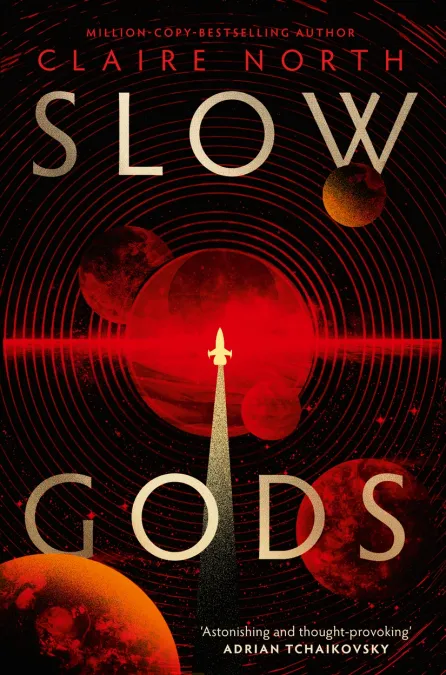
It is not North’s best novel, in my opinion. Nonetheless, even a sub-par North novel is often head and shoulders above its closest competitors, and it’s fun to see them playing in the space-opera toybox—even if the scale of that subgenre, and its bias toward the Big Idea, is perhaps contrary to what is best in their writing, namely an uncanny insight into and empathy for the human condition.
I won’t write more about it here, because I want to keep my powder dry for the essay, which is already many times delayed and deferred by circumstance, and which needs to be finished and delivered very soon! If you’re interested in recommendations, then I’d say Slow Gods is a good choice if you’re already a space opera enjoyer, but North’s earlier Notes From the Burning Age is perhaps a better entry-point to their purely speculative work.
(If you’re not much of a science fiction head at all, then North’s Ithaca trilogy, which tells the story of the Odyssey from Penelope’s perspective, comes very highly recommended by me, and is also a good fit with the cultural zeitgeist…)
lookback
It’s been a week of contrasts, I think it fair to say. The workshop I delivered in Munich on Monday went really well, but the journeys there and back were both marred by delay and disruption; the bahn-gods were indeed angry, and saw fit to interfere with my piddling mortal quest. That said, I’ve had worse delays on previous trips, without the extenuating circumstances of the crazy weather, and while I arrived at both ends later than expected—nearly five hours later, in the case of the journey home—I nonetheless did arrive, even if I didn’t get the serene hours of knowledge-work I always hope for when travelling by train.
(We have come to expect fast, efficient and timely travel as something close to a human right, thanks to the secondary effects of the late-C20th focus on infrastructural optimisation and efficiency. However, the very complexity of the systems thus built is now working counter to the reliability they were designed to deliver. I hope we don’t come to see that period of human mobility as a historical blip before a reversion to the mean, but in the meantime I’m trying to accommodate myself in advance to what seems like a very likely outcome.)
The middle and tail end of the week were more stable in spatiotemporal terms, but the heat presented a serious obstacle to getting anything done that required the involvement of the higher cognitive functions. So while the hourcount for the week doesn’t look crazy low, given two whole days sacrificed to the bahn-gods, a lot of those hours weren’t particularly great hours in terms of the quality of work turned out.
That said, learning to forgive ourselves for environmental constraints on our ability to do our jobs is another advance accommodation we’d do well to work on—because it’s not gonna get any easier within my lifetime, nor within the lifetime of anyone currently alive. We shouldn’t give up on goals of mitigation, but while we wait for the wheels to fall off the money-cart, adaptation—psychological and cultural, as well as material and practical—is the only game in town.
ticked off
- Eleven hours of essaywork, including research and thinking and drafting.
- Nine hours on the last week of the Rogue Worldbuilding course. (This has really flown by, and been a genuine delight; I can’t wait to do it again.)
- Eight hours on PROJECT BAVARIA. (Workshop: delivered!)
- Three hours on these here weeknotes.
- Three hours of admyn.
- And ten hours of undirected writing and reading, as always.
OK, then—this essay isn’t gonna finish itself, so I’m gonna sign off and get on with it. Your attention is appreciated, as always, and I hope all is well with you, wherever you may be.
This has been the Worldbuilding Agency weeknotes for Week 29 of 2026. Thanks for reading! If you've enjoyed them, it's free to subscribe. If you are already subscribed, please send to a friend!



Comments ()