

week 19 / 2026: centres and edges
The openings of stories, and the titles we give them, have a huge effect on how they land with the audiences—but as always with stories, it’s an art rather than a science. Plus: in praise of living and working at the edges.

“There is no safe way out of here / no passage below the dungeon / no mothership will save you / so goes the rapture of Riddley Walker…”
Greetings from Malmö, where spring is swinging between bright and warm and grey and cool, as usual. This week we’re thinking about the titles, and how to start stories in a way that gets the reader’s mind working…
OK, let’s get to it.
among the pixels
We’ll start at the start, with the matter of titles—which matter not only for stories intended to entertain, but also ones intended to persuade. Here’s Ariwoola Ogbemi, a student at the University of Houston’s foresight programme, referencing friend-of-the-show Scott “Changeist” Smith with regard to dealing with what Ogbemi is calling the “so what” problem in futures work:
You can build a beautiful set of scenarios, map out a dozen emerging trends, and put together a fancy presentation, and still get a room full of polite, disengaged faces staring back at you.
The challenge lies in getting your audience from your insights to the implications that matter to them. Recently I’ve been calling this the “landing in their lap” problem. Ogbemi’s “so what” is rather more direct, but (as WA regulars will know) I like to work with images and metaphors, particularly when explaining methods to clients; the idea of a problem landing in your lap, like an agitated cat—or, perhaps, an incontinent chihuahua—seems to work well to explain how something that initially seemed like someone else’s problem can suddenly become your problem, in a very immediate way.
Now, that’s not to say my label is inherently better—but it is to say that my label has an extended image and story that I can roll out behind it. Even if you don’t do the sort of narrative-focussed work that I do, foresight is all about stories, and a good label or title should act as a sort of mnemonic for the details:
Smith also talks about the importance of labeling. He calls it micromarketing: your insights are products, and you have to give them good names. The name is often the only thing that stays with the audience long after the presentation is over.
I’ve heard the same argument from lots of different practitioners over the years, and I’ll be honest: I find that scenario titles are a very good advance metric of the quality of the scenarios themselves. If it sounds like it came out of an overworked marketing department equipped with an LLM trained exclusively on golden age science fiction—and a lot of them do—I’m going to file it in the “I don’t need to read this” pile, because it’s surely a story I’ve heard too many times before.
That said, a scenario title shouldn’t be too original or way-out, because your client likely doesn’t have the same degree of exposure (and consequent hunger for novelty) that you have as a practitioner. Nor should it entirely explain away the scenario… but then, if your scenario can be explained away in a few words of title, it’s probably lacking the tensions and dynamics that a good scenario needs.
Next up is a note from the critic B D McClay, in which she does some thinking-out-loud about the opening passages of notable science fiction stories, which often use a tactic of deliberately (yet constructively) wrong-footing the reader.
Now, you don’t want to be doing this sort of stuff in scenarios, because scenarios are meant to deliver information at a fairly abstract level. Implicitly, they’re meant for an audience who already knows something of the big picture being discussed; if we wanted to get technical about it, they’re narrated from a systemic perspective, which is why they can be so impenetrable (and cold!) to outsiders.
But if you’re writing fiction for foresight, it’s worth considering using milder versions of these techniques, because you’re writing for the other end of the audience spectrum: you’re trying to make those abstract systemic issues concrete and relatable—and thus interesting—to someone who might not know much about the bigger picture. The reason I talk specifically about using the science fiction toolkit for this work is that writers of sf have over the years iterated techniques to engage and sustain a particular type of attention:
Many of these stories are designed to be read at least twice, one time understanding nothing and the second time understanding something. The opening lines can never be as disorienting as they were the first time but they become charged with the knowledge you now possess, because the stories are enriched by knowing what’s coming instead of being deflated. For comparison one can look at the kind of science fiction that is all about the twist ending: “To Serve Man,” “The Star,” and so on. These stories are memorable—but once you know the ending you may not feel any need to reread them.
Another way to put this—which McClay might or might not agree with—is that these sorts of story aren’t interested in giving the reader epistemic closure, at least not on the first read. The story is a sort of puzzle interface: rather than simply delivering the workings of its world to you directly, it sets out the clues in such a way as to imply them, and let you figure them out for yourself.

This strategy is not without risk, especially in a world where sustained attention to a text is hard to come by, and audiences have become accustomed to being spoon-fed revelations that have been sign-posted with little subtlety. Much as it saddens me to admit it, pure prose fiction is not a medium that’s going to popularise an issue in the way it might once have done in the era of Dickens!
But this strategy can be adapted to other media—indeed, I’d argue that design fiction basically condenses this “opening move” into a visual/material object, pulling the audience into the world while also prompting them to think about how that world must work in order for the object to make sense. The trick, regardless of the media you’re working with, is to give the audience something with a bit of buoyancy while simultaneously tipping them into the pool—and much like the crafting of good titles and labels, it’s an art rather than a science. There’s no formula to follow.
“But Paul,” you might be thinking, “this all feels a way out from the middle of the bell-curve. Shouldn’t we be aiming for the widest possible audience, and making it as easy for them as possible?”
In a word: no.
Perhaps the greatest contradiction of our current era is the elevation of the largely undefined notion of “innovation” to the status of a sacred shibboleth, set against the unspoken imperative to produce the homogeneous, the comfortable, and the banal. I see this not as a reaction to an uncomfortable and uncertain world, but rather as the force that has made the world that way.
This is why the bland scenarios I mentioned earlier are so widely cited (if not actually read): tired tropes from what Karl Schroeder has deftly dubbed “the science fiction of the 1900s” offer less of a challenge (and less of a threat to comfort) than the gnarly sociotechnicality that we actually need to get to grips with. Simplifying things until they become palatable serves only to obscure the issues. To talk blithely of “solutions” is to ignore the way in which two centuries or more of chasing “solutions”—of trying, to put it in the terms of Joseph Tainter, to fix the problems of complex systems by adding still more complexity—is exactly what got us where we are today.

Of course, it’s hard to sell discomfort to an audience that craves the opposite, as I’m sure anyone working in foresight knows all too well. But I believe—perhaps foolishly, certainly quixotically—that it is my duty to try. That means arguing as persuasively as possible that the edges in any given project should not get sanded off too early (or, ideally, at all); yes, bumping into the difficult bits is painful, and may result in awkward conversations and disagreement, but without those conversations and disagreements, the change you know you need is going to be much harder to come by.
It also means looking for the sort of client who really wants to do things differently, rather than merely performing whatever superficial difference is currently fashionable. It means working at the edges, with people who recognise not only that the edge is where they are, but where they belong. Because the edges are where change and innovation actually happens, as Charles Foster argues in this inspiring essay:
None of the centre’s strategies will work – or work for long. Pity the poor centre – so puffed up that it can’t see beyond itself. Missing out on so much. So mistaken about how the world is made and what sort of creatures humans are. Fated to stand fuming and impotent, like Canute on the beach, as the advancing edge of the sea threatens to overwhelm it. Doomed by the laws of physics and metaphysics. For the apotheosis of the centre is of course the black hole, whose immense gravitational force destroys everything drawn into its orbit.
To survive and thrive, you have to act as your constitution and your surroundings decree. That means acknowledging that you’re an edge person in an edgy world, resisting, for all that is sacred, that pull towards the centre. The centre will fight tooth and nail to stop you acknowledging it.
Go and read the whole thing. If you think you recognise yourself in that passage above, click here and book a call; we should work together.
between the pages
This week I’ve started reading Ada Palmer’s Inventing the Renaissance—an experience I’m embarking upon alone, my reading group having baulked at the prospect of a ~700-page popular history book.
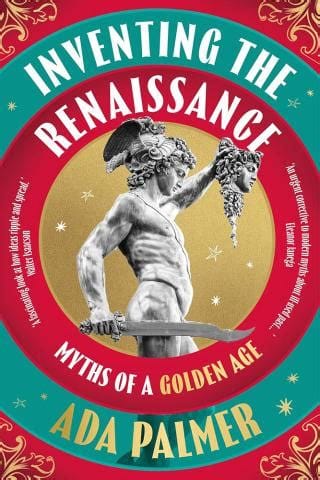
(My second choice was a Colson Whitehead novel, which shows I do at least understand some principles of marketing: lead with an option you’re fairly sure will be rejected, and then follow with another choice that you’d be just as happy with.)
The basic topic of Palmer’s book is right there in the title, but it’s worth pointing out that she’s trying to do something unusual for a book from a popular press, namely trying to expose and explain the mutability of history: the way the stories we tell about the past have been (and still are) twisted to fir the stories we’re trying to tell about the present (and, increasingly, our futures). In more technical terms, she’s popularising historiography—which isn’t quite “the history of history”, but that’s good enough for now.
Her main argument is that “the Renaissance” is a story—actually, a whole skein of conflicting and competing stories—about things that actually happened, but seen through the priorities and concerns of the times in which those stories were written. Interpretation plays a huge role, of course, but so do various loops of reinforcement: for instance, one of the reasons we tend to see the Renaissance as a particularly important period is that earlier arguments to that effect ensured that things related to the Renaissance were better preserved and more closely studied than things from other, less sexy periods and/or locations. It’s a sort of historical-material form of availability bias, in other words.
There’s a lot more to it, and I’m only a hundred pages in so far, so I’ll leave the explication there. The style is worth a mention, though: when I started reading, I was refreshed and energised by Palmer’s erudite yet conversational approach, which is a smart choice when dealing with something as meta as historiography. But it’s already a little wearing in places—and for every memorable metaphor or pointed aside, there’s a moment where I find myself wishing that it read slightly less like a snarky blog post. This voice may be a better fit with the back half of the book, which comprises character studies of Renaissance figures both famous and obscure.
That said, I’ll happily take somewhat-too-online over choked-with-library-dust for now…
lookback
April was a real hit-the-ground-running sort of month: it wasn’t actually that insane in terms of actual workload, but what it lacked was any opportunity to get a bit of strategic distance from the operations and plan ahead. As such, it was very agreeable to be able to sit down at the start of this week with some printed-out blank calendar sheets from May and June, and actually map out the next couple of months. Now, no plan survives contact with the enemy, of course—but having a plan and needing to adjust it in light of sudden changes or emerging issues feels very different to waking up each morning and triaging your task list on the basis of which thing is most likely to catch fire first.
The week came with some bad news, in the form of a bounce response to one of the bids I worked on last month—and so it goes—but also some good news, in the form of a prospective project that, should it materialise fully, will be extremely My Sort Of Thing: the right topic, the big scope, the fun methods, and the very best of colleagues. I’m trying not to get my hopes up too high, because nothing’s real in this business until the contracts are written and signed, but I’m fizzing a little bit nonetheless!
I even managed to make some time for my art practice, and to have a proper weekend, and I’m feeling much less fried as a result. I need to gather the skein and get weaving again on Monday, but once these weeknotes are done, it’ll be time to step away from the keyboard and toward the cutting mat…
ticked off
- Ten hours on PROJECT MUNICIPAL.
- Seven hours of networking. (Including four hours at a conference on “AI” and industrial design, which I will be writing about soon—stay tuned!)
- Six hours of admyn.
- Six hours of art practice.
- Three hours of bizdev.
- Three hours on these here weeknotes.
- Two hours of reading for research.
- And ten hours of undirected writing and reading, because that’s the infrastructure of edge-work, y’all.
Alright, that’s a wrap—your attention is appreciated, as always. I hope all is well with you, wherever you may be.
This has been the Worldbuilding Agency weeknotes for Week 19 of 2026. Thanks for reading! If you've enjoyed them, it's free to subscribe. If you are already subscribed, please send to a friend!


Comments ()