

week 18 / 2026: truth and lore
Games and prose fiction are very different media, but worldbuilding works basically the same across both of them—which is why you can learn a lot about fiction for futures from the better sort of game dev. Plus: why does music in science fiction sound like it does?

“Looking to something we just can’t understand / a paradigm shifting in the air...”
 pictureelement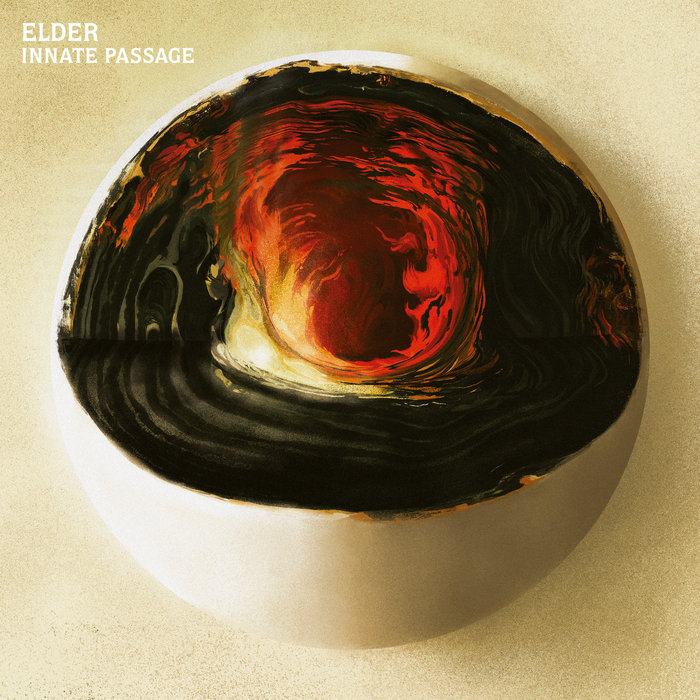
Greetings from Malmö, where the May Day weather has been an idyllic foretaste of what one might hope will be a glorious summer to come. This week we’re talking worldbuilding technique...
Are you sitting comfortably? Then I’ll begin!
among the pixels
For reasons which will become obvious in the next section—but also in no small part due to natural inclination!—I have worldbuilding technique on my mind this week.
I’ve quoted the game developer/writer Alexis Kennedy here before, and will surely do so again, because he approaches the craft in a way that resonates strongly with my own. Today I’m drawing on a post of his from back in the late Teens, where he’s talking about how to deliver “lore” to the player—the art of exposition.
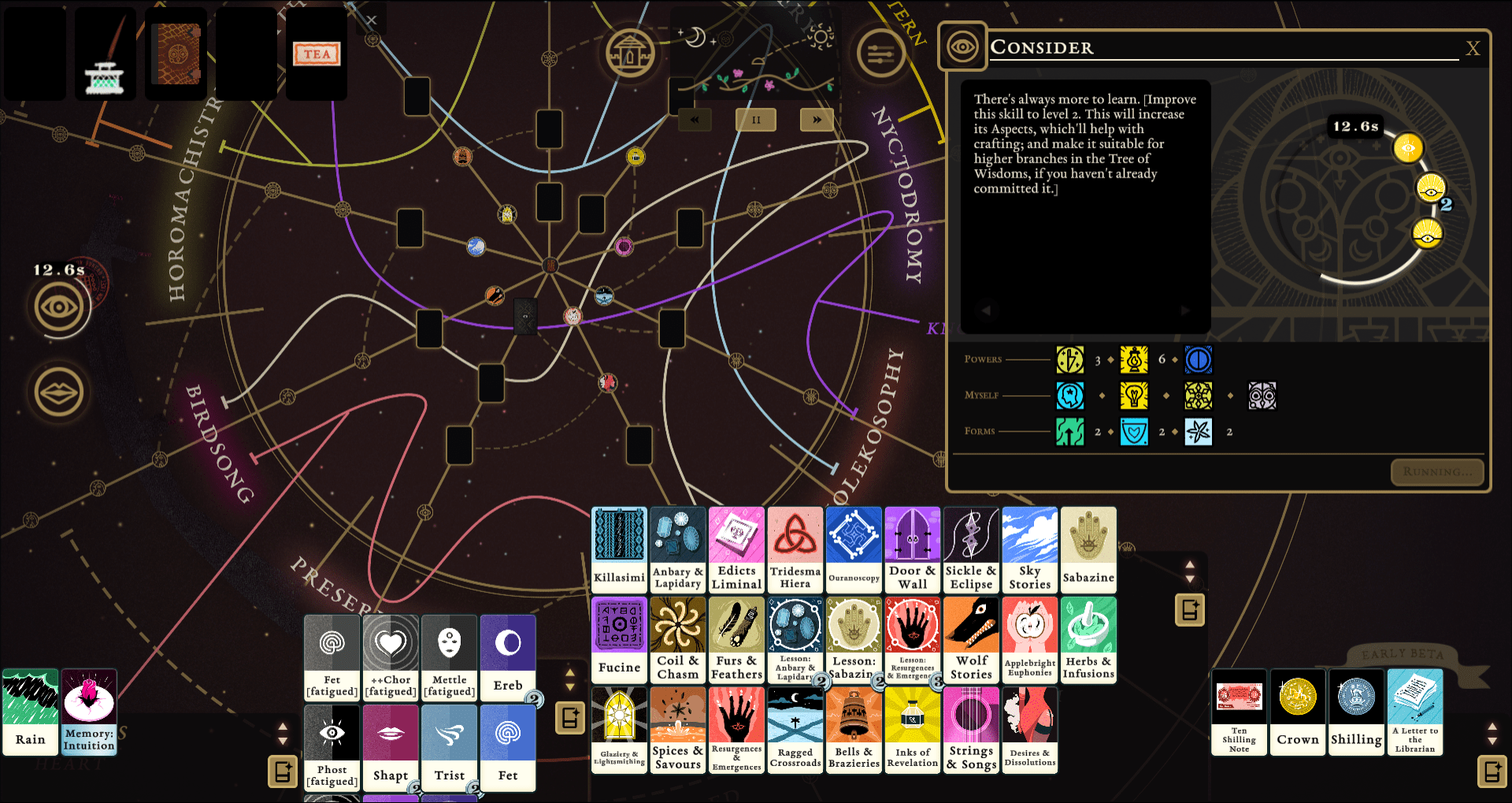
(This is a topic I will be covering in detail in my Rogue Worldbuilding course! Early bird prices still apply, by the way.)
Now, it works a little differently in prose fiction, for reasons which I’m going to assume are obvious, but the basic principles are applicable across the board. Kennedy’s post leans heavily on ironic examples, which won’t work well if quoted out of context, so I’m just going to pull the nine strategy subtitles from the back half of the piece and suggest you go read the whole thing:
0. DON’T WRITE THE LORE IN THE FIRST PLACE.
1. Keep the information to an absolute minimum.
2. Give the player a reason to be curious.
3. Write it extremely good
4. Add a point of view.
5. Let the player ask questions about it.
6. Break it up and scatter it through the game.
7. Lampshade it.
8. Don’t use words.
Point 5 is the only one that can’t really be applied directly to prose, unless you’re writing interactive fiction (which I tend to classify as belonging on the “game” side of the fence—if indeed there is a fence rather than much-argued-over line on a metaphorical map). Meanwhile, point 4 is (or bloody well should be) the default move of a fiction writer; if your narrative doesn’t have a point of view, it’s just a gazetteer.
Now, technically a gazetteer also has a point of view, but it’s implicit rather than explicit. (If you want the theory, go read my Magrathea Protocol essay.) This expository approach is much the same thing that your common-or-garden scenario description tends to do in futures work… and there’s inherently nothing wrong with that! But it’s a narrative strategy with a very narrow audience: just as you have to be a pretty serious Star Wars fan to want to buy the X-Wing Haynes Manual—and yes, that’s actually a thing—you have to be a pretty serious nerd for a given topic to appreciate a scenario description without a POV.
The point being: narrative activates engagement. For most audiences, the world in the abstract only becomes interesting when you give them concrete things to care about. But when you’re writing fiction for futures, delivering the “lore” is part of the job description—and seeing how a game dev like Kennedy approaches that challenge may be useful in thinking about how to do it yourself.
People often assume that prose is more limited than more technically advanced media like cinema or games when it comes to portraying the otherness of an imagined world—but in many ways it actually has the advantage over all of them. This is captured in a well-worn gag that I’ve heard many authors deliver a version of: it’s much more fun to write science fiction novels than make science fiction movies, because the special effects budget is bigger.

In other words, your imagined future is limited only by your capacity to conjure it up in the reader’s imagination, which is a function of your own imagination, your vocabulary, and your narrative chops. Perhaps more importantly, this means a written future is in some respects more future-proof than a cinematic one, as explained in this JSTOR bit about music in science fiction:
As entertaining as they might be, most of these pieces of music “conjure up an image of what audiences of the day thought the future should sound like, and thus with each passing year their ‘contemporaneous strangeness’ seems more and more dated,” writes Wierzbicki. This music, ultimately, is earthbound. Even Diva Plavalaguna’s performance in The Fifth Element falls into this category—through no fault of composer Eric Serra or singer Inva Mula-Tchako. If you attempt to create in-universe music for a science-fiction franchise, according to Wierzbicki, you’ll inevitably run into an impasse.
“To reify such sounds—as is necessary in a filmic adaptation—is to ‘fix’ them permanently, to make them ‘heard’ in just a single way,” he writes. “To keep such sounds vague, as Bacon and Swift and so many others have done, is to give the sounds the freedom to be whatever individual readers imagine them to be.”
I actually think this is one of the strongest arguments in favour of prose fiction for futures, though it also perhaps the hardest argument to make, because it seems so counter-intuitive. Of course, prose futures inevitably come to look dated in their own way—particularly when it comes to the social values embedded within them. But if you learn to avoid reifying the things that don’t need to be reified, you can leave space for the reader to do a lot of the worldbuilding themselves, which in turn leaves you space to work on the stuff that’s important in the context of the project.
Again, Kennedy’s strategies above are a good starting point for thinking about what to reify and what not to reify, and particularly his zero’th point. It took me a long time to learn it myself, but a huge part of the art is learning what not to include explicitly; at first, you’ll probably have to go through the painful but necessary process of deleting exposition when you’re editing and redrafting. But after a while, you’ll develop an instinct for the telling detail—the foreground things that activate the reader’s imagination and prompt them to paint in most of the background of their own accord.
(This is not only more efficient, but it’s also a big part of what makes reading fiction a pleasure. To paraphrase Kennedy regarding gamers: don’t underestimate the extent to which your audience may actively enjoy being made to work for the world.)
Not everyone wants to learn how to write, of course—though I would argue that understanding a little bit of how a medium works will serve to sharpen your appreciation of it. You can do this through reading alone, but you’ll learn a lot faster by reading and discussing in a group.
To that end, here’s a list of “reading experiments” from academic and author Jo Lindsay Walton, excerpted from the Applied African Speculative Fiction toolkit, a project he and various colleagues have been working on for a few years. Some of them are perhaps a little academic in their analytical approach, but as prompts for thinking about fictional futures as futures, they’re well worth a look:
- Box up the magic. Identify elements that you think are too fantastical ever to happen in the real world. Make a list of their narrative inputs and effects. Then rename each one ‘black box #1,’ ‘black box #2’ etc. A black box, in this context, is where we know the inputs and the outputs, but not what happens inside. Discuss these black boxes. Treat them as placeholders for events that cannot currently be foreseen or even properly imagined, but that really are possible.
- What is governed in the story? Identify the forms of governance that take place. How might the story unfold under different governance arrangements?
- What is evaluated in this story? Identify acts or processes of categorisation, evaluation, tagging, measurement, or similar. What would happen if these were different?
- Draw the story as a diagram, or a series of diagrams. For example, use systems thinking to map the systems in the story. Identify key actors, institutions, infrastructures, resources, feedback loops, pressures, and points of breakdown or control. Think about how different parts of the story’s world interact, and how a change in one part of the system might ripple through the others.
between the pages
I’ve been prompted to thinking about worldbuilding technique because I’m re-reading Gwyneth Jones—specifically her late-Noughties space opera Spirit, which takes Dumas’s The Count of Monte Cristo as its model.
Having not read Dumas, to my shame, I can’t speak to that aspect of the book—though Paul Kincaid could, and did, around the time of its release. But I can speak briefly to the worldbuilding in this and Jones’s other work, which is—for me at least—exemplary.
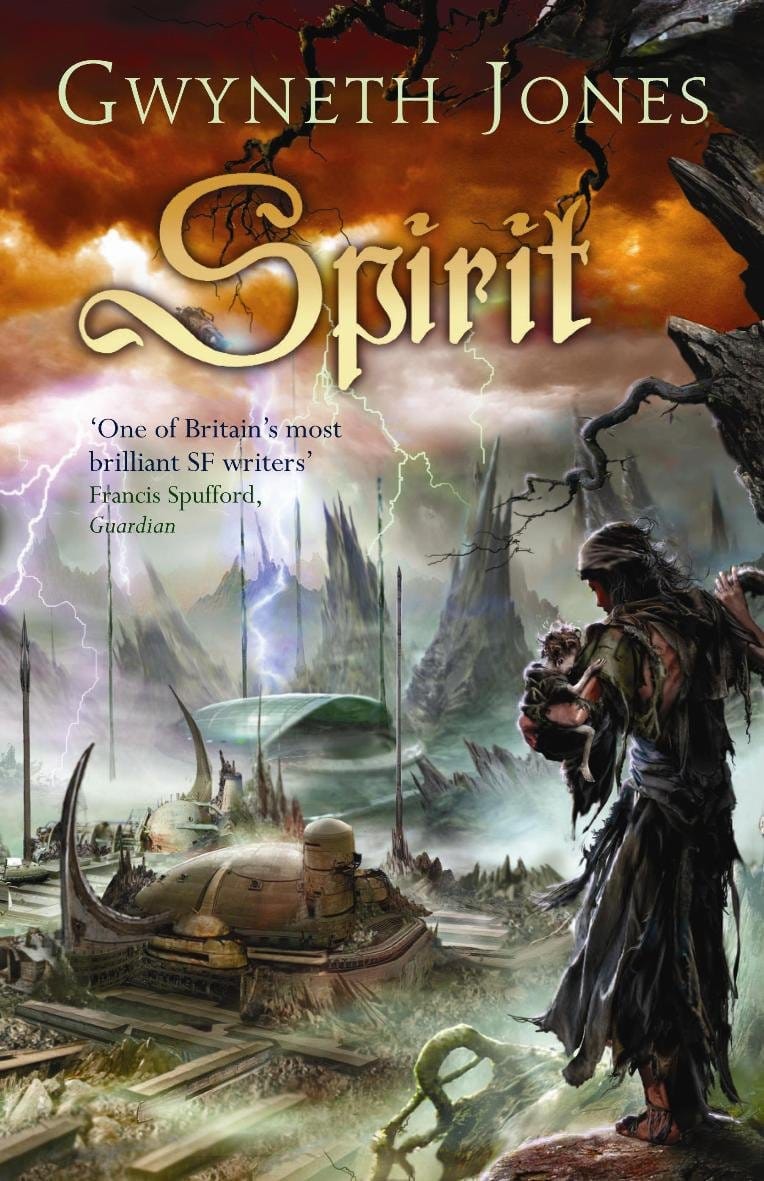
Jones is very much a writer who makes you work for it: you need to be paying attention, not so much because she’s setting out a puzzle for you to solve, but rather because she makes the negative space of story (and, thus, the reader’s imagination) do so much of the work. It is not always entirely clear what has happened in a Jones story, which I take to be a reflection of reality: after all, we are not always clear what has happened to us, and the retroactive storying of our experience is in many ways the essence of what it is to be a person.
It’s definitely not an inadequacy of technique, either—quite the opposite, in fact. Jones tends to use a narrative POV that has become extremely rare, and not just in genre fiction: I think of it as a multiple or mobile third-person mode. Beginning writers are often advised to keep third-person narration close to one character at a time, whether at the scale of the entire story, or at the chapter level, or even just at the level of scenes. This is good advice, because moving from one POV to another mid-scene without confusing the reader takes an extraordinary degree of control over not only the prose but also the characters and the events they’re experiencing. Jones makes this look easy; in my own experience, at least, it is anything but.
It can also be hard to read, though I think that’s down to lack of experience. (There’s a sample passage on Jones’s still-very-Noughties-vintage website, which will give you a feel for it.) As Ursula Le Guin notes in Steering the Craft—which I recommend relentlessly as the best bang-for-buck book on writing that has ever been published—the “omniscient” third-person POV (which Le Guin preferred to call the involved narrator) is perhaps the oldest and earliest of all narrative modes, but has all but disappeared since the Victorian era, when wildly popular authors such as Dickens could use it by default without any expectation of losing the reader.
The question of why it fell out of fashion can be left for another day; suffice to say that it’s rare, and the affordances of narrative are learned through direct encounter. Unaccustomed readers may find it hard, and all writers start as readers; if you never see a technique used, you’re unlikely to use it yourself. And if you’ve heard a technique be repeatedly traduced as inherently patriarchal and/or oppressive, you’re even less likely to read it, let alone try using it.
No one would ever dare accuse Jones of being a patriarchal author—or at least one would hope so. (These days, I’m rather harder to surprise than I once was in this regard.) But perhaps more to the point, her “omniscient” narration doesn’t really partake in the authorial side-barring that came to characterise the mode and (not entirely without reason) led to its slow cancellation. What she keeps from the mode is that free-floating style, the POV moving from character to character, giving us as readers a depth of scene and story than might be analogous to the use of multiple cameras in cinema—another technique which is hard to do well.
Jones hasn’t has a novel put out by a publisher since Spirit, which I and others regard as a genuine tragedy for the genre, and for literature more broadly. Perhaps this is due to the difficulty of her work—its technical difficulty, as discussed here, but perhaps also its political difficulty; Jones is a staunchly feminist writer, but not at all a consolatory or wishy-washy one, which makes her a poor fit for the scene as currently constituted. Perhaps it’s a deliberate decision on her own part to quit the field; I have no idea. What I know for sure is that there are few writers whose sheer technique I admire more, and whose capacity for wrestling with the moral complexities of technologised human experience without reaching for pat answers and ideological catechism is perhaps unmatched.
Yes, you’ll have to work to get the best out of her books—but few things worth having are easy to acquire. Spirit might be a bit of a deep-end option if you’re new to her work; given it’s now available as part of the Gollancz Masterworks list, I recommend starting with Life.
(The Gollancz website says it’s sold out, but I bet you can find a copy in a retailer’s warehouse somewhere in the world. Spirit seems to be OOP, sad to say.)
lookback
The end of April meant bringing a whole bunch of projects, deliverables and bid documents in to land at roughly the same time, and I’m pretty pleased that I hit all my marks without dropping any balls—but I’ve been running on the fumes for a little while.
All the better, then, that May Day falling on a Friday meant I got a three-day weekend as my first proper break from work for what must be around a month and a half. After taking advantage of the glorious weather to clean my windows, I spent Friday out and about with friends; I spent Saturday listening to music and doing some tidying and sorting in my studio; and once these weeknotes are done, I plan to have a nice afternoon of reading for pleasure, before clambering back into the saddle on Monday.
It’s surprising how hard it can be to carve out that space when you’ve done a long run of continuous work; habituation happens fast, and even as I type I can feel myself thinking “well, I should probably do my advance planning and admyn today, rather than leave it for tomorrow”.
But in that direction lies burn-out, and I’ve learned that the hard way! Monday’s work will be better for today’s downtime—and I don’t know who else might need to hear that, but if it’s you, please take it as permission to down tools and do something just for yourself.
ticked off
- Eleven hours on PROJECT MUNICIPAL. (Deliverables: delivered!)
- Seven hours on PROJECT ADRIATIC. (Grant application deadline: met!)
- Five hours of admyn. (Company books: kept! Clients: invoiced!)
- Three hours of art activity. (Studio: partly tidied!)
- Three hours on these here weeknotes.
- Two hours of networking.
- And ten hours of undirected writing and reading, as always.
Right, I’m clocking off. I hope all is well with you, wherever you may be.
This has been the Worldbuilding Agency weeknotes for Week 18 of 2026. Thanks for reading! If you've enjoyed them, it's free to subscribe. If you are already subscribed, please send to a friend!


Comments ()