

week 16 / 2026: language and longing
It’s language all the way up and down, if you ask Alan Moore—which throws an interesting light on the rolling “post-literacy” debate, and on the tech elite’s increasingly open grasp for magic as something more (and less) than mere metaphor. Plus Bruce Sterling speculates on cybernetics...

“Something clicked in my mind / incredibly clear / with all the time to arrive / when we were already here…”
 Amplifier
Greetings from Malmö, where the local cherry trees are days away from bursting into bright colour, but not quite there yet. Welcome back to WEEKNOTES at Worldbuilding Agency, where we’re discussing the magic of language very literally indeed.
OK, then—grab your grail and your athame, and let’s get this ritual going, eh?
among the pixels
I’m going to start with a brief clip from an interview with Alan Moore, not because it’s a particularly good interview—why people who count themselves fans of the man’s work persist in asking him about books that he has very famously disowned is enduring mystery—but because it contains a concise metaphysical statement that tracks pretty closely to my own feelings on the issue:
Do you believe language describes reality, or do you think it generates it?
I think that it’s both, a bit like M.C. Escher’s two hands that are drawing one another. I agree with Wittgenstein in his contention that nothing truly exists of a thing, person or event other than the words we use to describe them, and I would also agree with Count Korzybski, the Einstein of semantics, that the entirety of human experience is composed entirely of language. If you like, I see myself as a piece of language that is somehow generating other pieces of language.
In other words, Sapir-Whorf has a posse. IYKYK.
Next up is Sam Kriss putting his own stamp on the burgeoning post-literacy discourse:
I don’t think these people are wrong to fear an undemocratic post-literate future. You can already see it taking shape, and it isn’t pleasant. For a while, in an earlier phase of social media, it looked like everyone would be getting their worldview from frantic contextualized six-second soundbites. What’s actually happened is much worse. The most influential political figures among young people are now streamers: people like Nick Fuentes or Hasan Piker, who talk extemporaneously about politics into a webcam, sometimes for sixteen hours a day. It doesn’t matter if you notionally agree with one of these people; if you’re accustomed to written language, everything they say will sound aggressively stupid.
I find myself surprisingly sanguine about the prospect of post-literacy, in part because it’s a reversion to the mean rather than a breach of the supposedly inevitable arc of progress, but also because of what Moore says above. A post-literate world will not be an illiterate world; rather, it will be much in need of magicians, shamans and monks—custodians and craftspersons of the logos. I think Kriss is right regarding the hubris of the reactionary tech elites, who assume that they are the priesthood elect: they make the same error that many readings of McLuhan make, namely to forget that new media subsume earlier media, rather than destroying them or making them obsolete.
Literacy will not disappear, but rather become infrastructural—more infrastructural, in fact. The self-referentiality of computer science, particularly in its current fixation on a very particular notion of artificial intelligence, seems to delight in pretending that it pulled itself aloft by its own bootstraps. But writing, and the thought that writing expresses, are its foundational precondition. Reading these people is like watching someone in the midst of a manic episode trying to prove they can levitate by setting light to the floor.
That said, to describe such people as delusional is not to dismiss them, nor to diminish the very real damage that their delusions can cause. Here’s Shira Chess riffing on that hardy perennial, Clarke’s Third Law, to argue that they’re working with a different sort of magic:
Crowley’s definition of magic — “The Science and Art of causing Change to occur in conformity with Will” — is the best articulation of this. Crowley’s definition suggests that if the powers-that-be functionally cause our Will to change to their Will, then magic has occurred. But if stage magic is about trickery then actual magic is about power. And, as with the Netflix campaign, one can easily design stage magic to obscure the real.
This is a real issue, though I would note that a) I read Clarke’s Third in a somewhat different way to Chess, and that b) the techno-maguses are, as noted above, working on a foundation that they not only misunderstand but also assume themselves to have already transcended. They’d do well to pay attention to Crowley’s oft-repeated warnings to work “without lust for result”… but that’s the bit that people who long for power always skip over. The risk isn’t that you don’t get what you work for; rather, it’s that you get it, and it destroys you.
Worrying about collateral damage is likewise anathema to these folk, and given their success thus far, the consequences of their comeuppance are likely to cause social-scale splashback. All the more reason, then, to follow Moore’s path instead: the tech elite have staggering individual power, but the rest of us have the numbers. Reality is a story, and we can—and should—tell it differently.
Last but not least, here’s Bruce Sterling giving a talk a couple of years back to the Research Network for Philosophy and Technology, which I somehow missed when it first went out. (Looking at the viewing figures, it seems I may not be the only one.).
Invited to speculate on a possible future of cybernetics, he starts off with a typically gleeful trashing of the Gartner hype cycle; marks the distinction between cybernetics and the current artificial intelligence paradigm as being a matter of analog versus digital, respectively; pegs them both as fundamentally metaphysical fields, despite all foundational claims to the contrary; depicts the second wave of cybernetics as a tragedy, in the literal and literary sense of that term; and makes a fairly spirited argument for art as the most pertinent mode of enquiry for cybernetic questions.
Seasoned Sterling followers will not be surprised to find he ends up talking about multitools! You can find out more about that particular obsession in my interviews with the man:
 Paul Graham Raven
 Paul Graham Raven
between the pages
I’m currently reading The Homing Instinct by Bernd Heinrich.
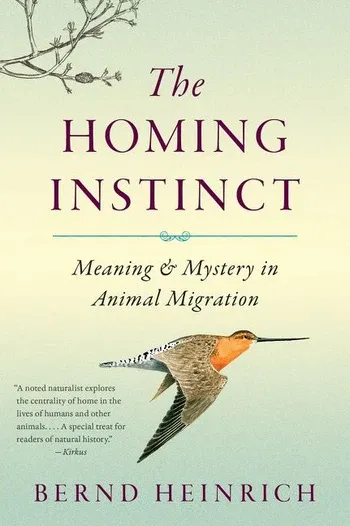
I’m somewhat familiar with Heinrich, thanks to his having written one of the great books on corvid intelligence from a position of solid expertise and research. The Homing Instinct starts with an admission on Heinrich’s part that he’s writing some way outside of his specialisation, which is a refreshing thing to encounter at the front of a book, but also a bit deflationary of everything that follows, which is a mix of Heinrich hanging out with other people while they do research and his own syntheses of the literature, plus some fairly vague speculations into the spaces left thereby.
I may be reading somewhat unfairly, though, because my tolerance for strictly evolutionary explanations of the world has really dropped away from its peak during the era of New Atheism. To be clear, I am definitely not denying natural selection as an important engine of environmental and organismic formation, but I increasingly find it inadequate to the task of explaining the rich strangeness of the world—not least because, even in the case of a scientist like Heinrich who clearly delights in the “natural” world, it can feel like the explaining is also an explaining away.
The book that first really brought this home to me was Brian Boyd’s The Origin of Stories, which is an evo-psych explanation of the importance of narrative to human existence. Again, it’s not that I think Boyd is wrong, but that his explanation is woefully incomplete; it was shocking to realise that someone could have a clear love of literature, as Boyd does, but also assume it pretty much all boils down to reproductive advantage expressing at a social scale. It’s the same with Heinrich: the shocking realisation that not only had you always assumed (albeit without realising it) that there is more to the universe than science can hope to reveal, but that reductionism-determinism is actually a hugely comforting belief system for so many people.
(If these are questions that exercise you, too, you might enjoy J F Martel reflecting on what he sees as the false dichotomy between fate and chance in the work of Lord Dunsany.)
lookback
A rather lighter week in terms of raw hourcount—but a bunch of those hours were spent facilitating workshops online, and if you think that discussing things in breakout rooms is an oddly draining experience, well, you should try holding the space for those discussions while also trying to get everyone to work through the method! It’s enjoyable work, to be sure, but good lord, is it tiring; not necessarily more so than doing the same thing in-person, but differently so.
For that reason, I defended my weekend with great fortitude, and spent pretty much all of Saturday out of the house and out of the studio. Next week is pretty tightly scheduled, too, so I want to keep the ol’ battery topped off.
ticked off
- Twelve hours on PROJECT MUNICIPAL. (See above)
- Five hours on PROJECT ADRIATIC. (This is only a bid at this stage, rather than an actual project, but it’s requiring enough documentation work that I’ve assigned it a label of its own already.)
- Four hours of talk preparation. (Getting ready for my Rogue Union Spark Session this coming Thursday—not too late to sign up and dial in!)
- Four hours of reading for research.
- Three hours on these here weeknotes.
- Two hours of buff and polish on the courseware for my forthcoming online fiction-for-futures course.
- Two hours of admyn and bizdev.
- One measly hour of art practice.
- Plus ten hours of undirected writing and reading, as always.
Right, then—I’m gonna take a few hours to address that shortfall of artistic labour, I think. Thanks for reading, and I hope all is well with you, wherever you may be.
This has been the Worldbuilding Agency weeknotes for Week 16 of 2026. Thanks for reading! If you've enjoyed them, it's free to subscribe. If you are already subscribed, please send to a friend!


Comments ()