

week 44 / 2025: hermit walks the dunes
I'm running a three-day course on fiction-for-futures in January! In-person, on-site, and strictly limited to no more than ten participants...

“The ghost arrives at his bitter end / to the promised land then the dog descends...”
No essay this week, but an announcement. In January 2026 I’ll be running a three-day course on writing fiction for futures work, right here in not-so-sunny Malmö… and registered readers of this journal (i.e. you) are eligible for the concession price!
Running from Tuesday 20th January to Thursday 22nd January 2026, the course will be held at—where else?—Media Evolution City in uptown Malmö, Sweden.
It’s tailored for professional practitioners, researchers and scholars in foresight and futures-adjacent roles, who want to know how to turn scenarios into fictional narratives. You will also:
- build skills and competence in the translation of futures between different media and forms;
- learn how to open scenarios up to engagement and creative collaboration with others; and
- gain confidence in creating exciting, memorable outputs that bring future challenges and opportunities to life.
Places are strictly limited—maximum ten participants!—to ensure quality learning and maximise one-to-one mentoring time, both during and after the course itself.
You can find out more, and book a place, over here on my canonical website. If you were a registered subscriber here at Worldbuilding Agency before 2nd November 2025, I’ll let you register at the concession rate—but don’t leave it too long, this is a strictly first-come-first-served set-up. (Concessions are also available for registered postgrad students, and for employees of non-profit or charitable organisations.)
Yes, it’s in-person and on-site only, I’m afraid. If you’d be interested in an online version, drop me a line and let me know; if there’s enough interest, I’ll give some thought to how the course might be adapted to such a format.
reading
The most recent pick at my book group was John le Carré’s The Constant Gardener, which I’m around three quarters through at time of writing.
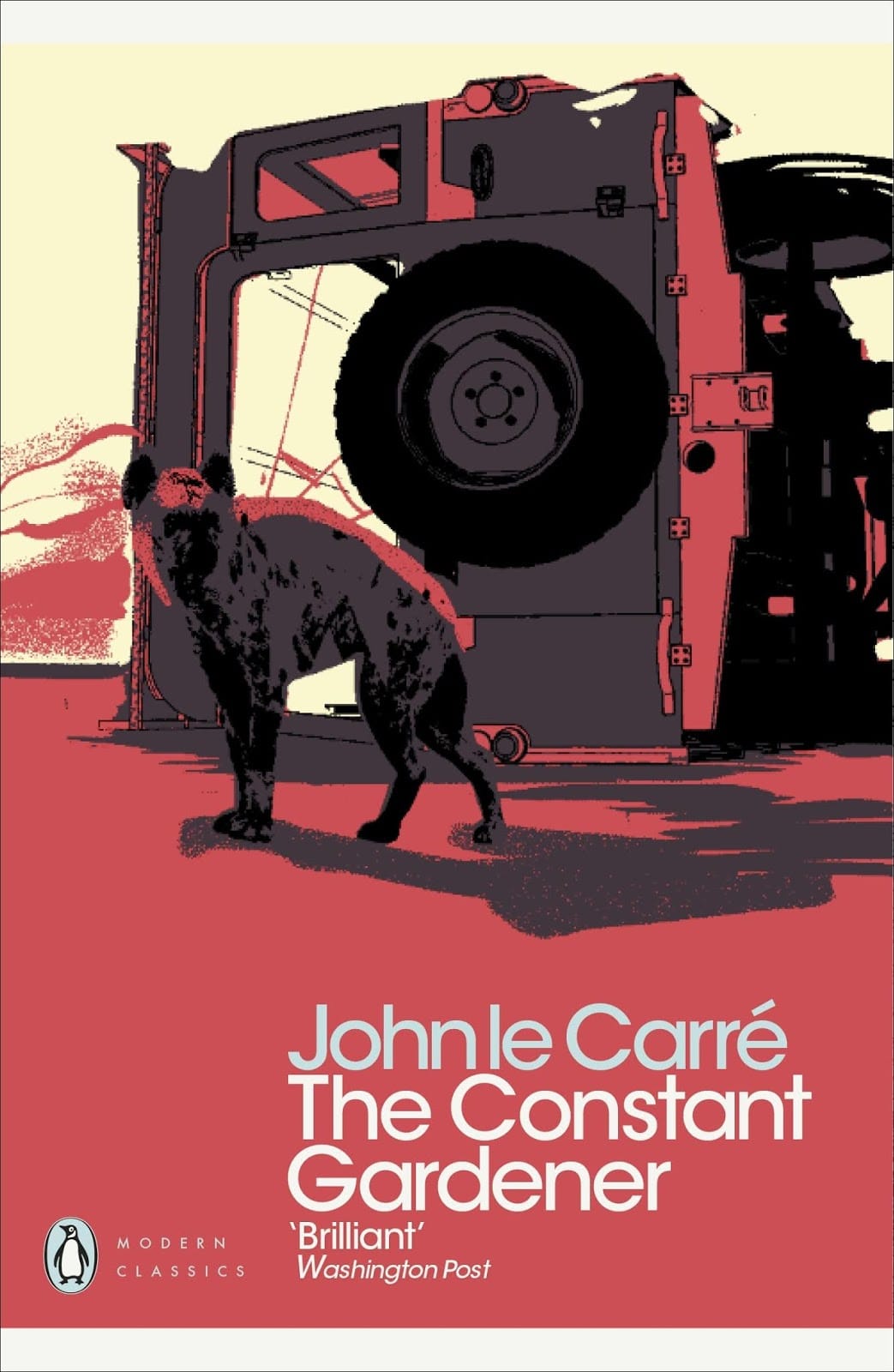
If I’ve ever read le Carré before, then I do not recall doing so—which is somewhat shocking, really (particularly given I’ve been reading his son, under the pen-name Nick Harkaway, for close to a couple of decades). However, I have seen a number of TV and movie adaptations of some of le Carré’s other books, so I came in to this one with expectations that have not been disappointed.
The story starts with the murder of a young British aid worker and activist in Kenya, and follows the increasingly furtive and fugitive attempts of her husband, a mid-tier member of the diplomatic service, as he tries to find out who killed her, and why; this is clearly connected to the dodgy pharma firm that she’s spent years investigating, but the whole business turns out to be a satisfyingly nasty and international tangle of geopolitical intrigue, replete with the sorts of moral monstrosities that perhaps only a former empire could ever have considered its brightest and best.
I’ve no idea how standard a device it was across his oeuvre, but I’m very impressed by le Carré’s handling of the narration, which varies between, at one extreme, a fairly standard limited third person in the past tense, to something that’s almost but not quite a first person present tense in moments of reflection. It’s his variant on “free indirect speech” or stream-of-consciousness, I suppose—which is less a specific technique than a space of technical possibility, highly dependent on the writer’s style and dexterity—and it gives you a real in-their-heads sense of the swirling thoughts and sense-experiences of characters in moments of stress, confusion or trauma—which, in this book, are the majority of moments.
Narrative strategies like this demand close attention, but I haven’t found The Constant Gardener a slow read. For me at least, that attention pulls you closer to the focal characters—but you couldn’t do this sort of thing in fiction for futures, really, because there you’re aiming for an easy immediacy that is not very compatible with high literary values. The friction of writing like le Carré’s is one of the reasons we aficionados—or should that be a-fiction-ados?—read such writers for pleasure: we are obliged to work a bit, and we are rewarded for our efforts by the unfolding of interiority and the cumulative construction of world and plot.
Of course, not everyone reads fiction for that particular sort of pleasure—and some people don’t read fiction for pleasure at all! Which is why one is best advised to stick to a clear, stable point-of-view when writing material that’s meant to be widely read, as in a foresight project. For someone from the literary side of the fence, this can feel like a diminution of hard-won craft and skill... but really, it’s a skill all its own.
a clipping
This has been a fairly good week for clippings, but if it comes to picking just one, there’s no contest whatsoever: Dean Kissick’s “The Vulgar Image” is a must-read.
The 21st century is afflicted by a tyranny of good taste and deadening refinement culture. There’s far too much good taste: too many white designer logo T-shirts and monogrammed goods, knockoff patterned Goyard handbags, Marc Jacobs tote bags that say “TOTE BAG,” bakeries approaching perfection, never-ending coffee-shop playlists, white-walled gallery shows of very large painted pastiches of modern art. Culture has been cultivated and refined to the point of maddening blandness, and the Vulgar Image is a reaction against such tasteful mediocrity. A popular meme format, the Bell Curve, is bookended by two stock characters: a drooling simpleton on the left, in the low-IQ idiot swamp, and a mega-brained nerd on the right, in the genius zone. Both are in agreement with one another. They discern the truth for very stupid or very clever reasons respectively, unlike all of the reasonably intelligent people in-between that cannot. The Bell Curve signifies contempt for the middle and the ordinary. To thrive in the new world with all its accelerating complexity and overproduction, it suggests, one must either be a genius or a braindead, unthinking moron – and, by the same token, to make the most brilliant and sophisticated artworks, or the dumbest, most off-putting content possible. Bad taste is a way of standing out when there are too many images. It is also a way of changing the trajectory of aesthetics.
It is very much of a piece with the essay itself to note that I read it using the “reader mode” of my browser, which had the effect of stripping out most of the example images that Kissick includes. Having just skimmed the full-fat version to grab that quote, uh... well, be warned, I guess? Here be monsters.
Or perhaps you’re already accustomed to, while nonetheless exhausted by, the omnipresence of the Boschean horrors of slop imagery? Perhaps the most interesting thing about Kissick’s catalogue of the internet grotesque was my realisation that, much like Alan Jacobs, I have actually seen hardly any of it, and heard about it only peripherally, like reports of war or decadent atrocities in some distant country. The consequences of that cultural ferment have, of course, lately been leaking out of the virtual in worrying ways… but for those of you for whom it seems ubiquitous, I come bearing good news: you really can get away from it! Slop is over—if you want it.
“Ah,” you say, “but it’s just not that easy, Paul. Network effects, sunk costs; I can’t leave [platform] because how else would I keep in touch with [person / group / demographic / market]?”
And that’s true enough, I suppose—though it’s worth saying that it’s also exactly what the people who designed the dopamine casinos want you to think. My life has definitely become more monastic as I’ve disconnected from them over the years—and yes, “monastic” might be, at least in part, a fancy way of saying “lonely”.
But when I read a piece like Kissick’s, and I see those images, I find myself thinking that the eremitic urge is perhaps the only sane response to an insane culture. So if anyone needs me, I’ll be out in the desert, flagellating myself and sermonising to lizards.
ticked off
- Sixteen hours on PROJECT FLATPACK. (Crunch time on this one, which has naturally fallen at a time when a lot of other things also need doing on a tight deadline… which is why I’m working on the weekend again.)
- Eight hours of admyn. (Bits, bobs.)
- Seven hours on PROJECT MALACHITE. (Prepping for my facilitation role at next week’s Green Transition Hack in Lund. Quite looking forward to this, actually; for all the appeal of hermitude, sometimes it’s nice to get out and spend time with people.)
- Four hours on PROJECT MORPHOSIS. (Thinking my way into this one, poking through the research base, looking for story hooks.)
- Three hours on PROJECT PONTIF. (Poor PONTIF has been mostly left by the wayside this week, but that’s the way it goes when there’s deadlines to meet.)
- Two hours up at STPLN. (A useful lecture on the writing of press releases, from someone who has spent a good deal of their career reading them every morning.)
- Two hours of admyn specific to Fiction4Futures. (A lot of the last month of admyn has also been specific to F4F, but I was keeping it in stealth mode until we had all the dates and logistics sorted out.)
- Three hours on these here weeknotes.
- Ten hours of undirected writing and reading, som vanligt.
Busy week again… and next week is more of the same. Onward!
That’s all for now, I think. I hope all is well with you, wherever you may be.
This has been the Worldbuilding Agency weeknotes for Week 44 of 2025. Thanks for reading! If you've enjoyed them, it's free to subscribe. If you are already subscribed, please send to a friend who you think might also like it!


Comments ()