

week 37 / 2026: time and motion
In this instalment, we examine the perceived acceleration of time’s passing, tour the tawdry campus of a failed secular techno-guru-cult, and poach processes from a wide range of writers. Plus: Iain Banks, Charlie Stross and the history of space opera!

“We’ll go somewhere you ain’t ever been / kick the engine to overdrive / run faster than a laser beam / got a universe to sail across and across, ’till the day I die...”
Greetings from Malmö, where the grey, damp weather presages an autumn that’s already stood in the hallway, shaking the mud from its shoes and muttering about the ongoing election. This week is a bit of a post-travel grab-bag, but if you want to find a theme post facto and tell me what it should have been, please be my guest…
Are you ready? Then let’s get to it…
among the pixels
This piece at Noema goes after the well-established truism that time speeds up, and the accompanying observation that the rate of acceleration is itself accelerating, particularly in the years sine the Covid pandemic.
The basic sense of acceleration has been around for some time, both at the societal or individual level. The more recent ramping-up, meanwhile, gets blamed on a lot of things, screen-based technologies not least among them—but Mariani’s essay wants to share the guilt around a bit more widely. In so doing, he takes us on a whistle-stop tour of theories and experiments aimed at understanding the psychology of time, and concludes that the causal culprit is memory formation, or rather the lack thereof.
Of course, this actually puts screens back in the frame, albeit in a more deniable way that shares similarities with my own argument that “it isn’t the phones, but it isn’t not the phones”: screens become a sort of rosary for a socially pervasive sense that leave one’s mind unoccupied is the most terrible sin of all.
If people were more comfortable with intervals that lacked so-called productivity — quiet longueurs, spells of boredom or periods of aimless reflection — they might stand a better chance of expanding and enriching the way they experience time. “It’s in those calm moments where we see a unique pattern of activity in the part of our brain responsible for helping to make our memories,” Hyman said. Those still, empty stretches are when we contemplate our immediate pasts, integrating them into the larger arc of our lives.
We know, however, that these states have been largely vaporized this decade — and only a seismic shift in our values and ideals stands a chance of reclaiming them. In Ogden’s eyes, the dilemma hinges on a simple question: “How do we get people back to being comfortable with doing very little and believing that doing little is not an indication of laziness?”
I’m not sure that our collective fixation on productivity can be so cleanly separated from the technologies that exploit it, but I agree with Mariani about the necessity for “a seismic shift in our values and ideals”. However, that would be a break with not only the last decade or so, but rather with a paradigm of efficiency that stretches back centuries—which I do not deem impossible, by any means, but which I would expect to be tumultuous, as were earlier examples. It is sobering to consider the sorts of events that it took to trigger those historical shifts—and it is more sobering still to consider the list of candidate cataclysms currently auditioning for the role.
The Point has become a real must-read venue for me in the last year or so, and Sam Venis’s piece on Balaji Srinivasan’s now-defunct Network School is a pretty decent example of why. Srinivasan is basically the Network State guy, with Network States being one particular iteration of the techno-libertarian urge to rewrite the Galt’s Gulch fantasies of Ayn Rand for an age of silicon rather than of steam.
Srinivasan’s whole schtuck seems to share a great many characteristics with the charismatic grifter-cults of the post-Sixties boom, lacking only the superficial veneer of spiritual enlightenment that used somewhat to fig-leaf the hero worship and pyramidal dynamics.
For over a decade, Srinivasan has fixated on the media backlash to the growing power of tech. “They are basically going to try to blame the economy on Silicon Valley,” he said of the media establishment, when introducing the network-state concept in 2013. They would argue that “it was the iPhone and Google that done did it, not the bailouts, the bankruptcies, and the bombings.” Since then, he’d started claiming that “anti-tech violence is ramping up” and that when Democrats are “torching” self-driving cars “the message is: today it’s the car, tomorrow it’s you in the car.” “Technology is a class,” Srinivasan wrote on X, and most of the violence in the twentieth century “was on the basis of class.” “That’s what communism was,” he wrote: “mass murder of the capitalist class.”
It was a Herculean act of psychic inversion: having spent so much time fighting the politics of identity, he’d incorporated its ideas to manufacture an origin story of violent oppression. It was a story in which the billionaires were the oppressed and the libtards were the mob and the journalists were the Stasi and the newspapers were the Church. The technologists were the Jews and the Democrats were Hitler and it was only a matter of time before the Third Reich would begin. And so Balaji was Herzl and he was also Ben-Gurion, and soon he’d lead the people into the promised land. Zion was a ghost city built by China. It was called the Network School.
As someone who grew up reading about the long and troubled cultural legacy of the Sixties, I find myself sitting with a strong sense of “first as tragedy, then as farce” when it comes to these echoes: even the failure-modes of these postmodern cults are somehow more tawdry and shallow than thise of their antecedents, ending not with a bang or even a whimper, but simply a re-submergence into the massed ranks of hustlers who either still await their moment in the spotlight, or have already had it.
The only thing that still retains the power to shock is the sheer number of them, and the spectacular shortness of collective memory that permits them to get away with it time and time again.
Last but not least, for the writers in my audience: here’s the latest from Lincoln Michel, in which he rounds up a selection of unusual approaches to composition that draws upon César Aira, Do DeLillo, Vladimir Nabokov, Kazuo Ishiguro and more. I’ll not excerpt anything, because at this point you should really just be following him by default rather than waiting for me to coat-tail his efforts!
between the pages
Much like last week, most of my dead-tree reading has been directed toward Donna Haraway’s Staying With the Trouble, so I’m keeping my powder dry for my in-development Deep Read essay.
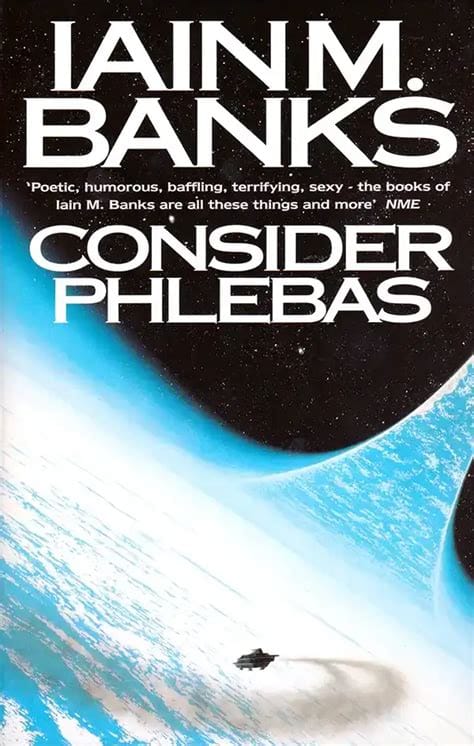
However, I am (as of last night) a few chapters into a re-read of Iain M Banks’s Consider Phlebas. I’m not sure how long ago I last read it, but I’m going to assume that it’s quite a while back, as while I recall the basic shape of the story fairly well, but a lot of the detail is proving rather less familiar. This can to some extent be put down to my being a much more sophisticated reader than I was back in the late Noughties, when my appreciation was directed first and foremost toward what we might call the spectacle (or the sensawunda) of science fiction.
I still appreciate that aspect of the genre, of course—and Banks’s reputation for his mastery of it was fairly earned—but it is a much smaller part of what the genre means to me at this stage in my life. I wonder, though, whether that’s at least in some degree a more general phenomenon. In both my academic career and my foresight practice, I’ve conjured with the notion that the science fiction spectacle has lost its capacity to charm, as has the liberal technological progressivism for which it often, albeit unconsciously, propagandized for. We have learned, if you will excuse one of my favourite Gibsonisms, to distrust that particular flavour.
Back in the late Noughties, John Clute was already writing about the demise of “the old sf”, in which “the reward for saying ‘yes’ was the future”. It looked then as if we might have been going to get something sharper of tooth as its successor—perhaps some more nimble evolution of the New Weird. But instead we have endured a retreat into the current cul de sac of coziness, to the extent that sf as a distinct and economically sustainable genre may actually be over, eclipsed by various consolatory flavours of fantasy. Or, to put it another way: what we used to think of as sf, at least in the literary sense of that term, has lost both its novelty and its appeal now that we feel like we’re living in the world it was trying to prefigure, which turns out to be less fun than the stories promised it would be.
I have many thoughts about the work of Banks in this regard—indeed, I’m re-reading his oeuvre in order to write about this—but it’s worth considering him as an inflection point in the long tradition that is the space opera. And so, in lieu of anything more substantive from me, here’s Charlie Stross (re)thinking his way through the history of that tradition from a more authorial perspective…
lookback
The past week looks a little light on hours as seen from the ledger, but that’s because I spent a lot of it participating in a workshop for the INSPIRI project, and a related and not inconsiderable amount of time travelling to and from the Stockholm archipelago in order to do so.
In one way, then, you could see this as having been a kind of contextually imposed holiday—and I certainly had a great deal of fun, and met some very interesting people! But while it was a fine time in many ways, it was not particularly restful, and that’s why I did very little over the last few days: I was knackered, so I took a break to recover.
ticked off
- Sixteen hours of workshopping.
- Four hours of essaywork.
- Three hours of art practice.
- Three hours of admyn.
- Three hours on these here weeknotes.
- Two hours of networking.
- And ten hours of undirected writing and reading, just like every other week, because routines keep you on the rails when things get busy.
Right, then—that’s all for this week. Don’t forget we’re deep-reading Haraway this week coming! In the meantime, thanks for your attention, which is always appreciated. I hope all is well with you, wherever you may be.
This has been the Worldbuilding Agency weeknotes for Week 37 of 2026. Thanks for reading! If you've enjoyed them, it's free to subscribe. If you are already subscribed, please send to a friend!



Comments ()