

week 36 / 2026: revise and reassess
In this instalment, three things merit a second look: the impact of three- and two-wheel EVs on oil demand; Francis Fukuyama’s “The End of History?”; and—much as it pains me to admit it—Stewart Brand’s “pace layers” model.

“From the first to the last / well, the wave is waiting / for the rubies and diamonds / that are slipping through your fingers...”
Greetings from Malmö, where NGBG Festival has just celebrated its tenth anniversary with a two-day run which, given its extraordinary proximity to my apartment, has really not been conducive to my having a restful weekend.
Well, selah—I had my years as a noisy young reveller; it’s only fair that I endure the noisy revels of others with as a good a grace as I can muster.
Before we start the usual routine, I have a message from my good friends Scott and Susan of Changeist, who are running one of their industry-leading horizon scanning workshops online on 17th and 18th September, between 13:00 and 16:30 CEST both days. They’ll be giving hands-on demonstrations and explanations of the practices that they use themselves, and promise that by the end of the second session you’ll know how to:
- design scanning systems tailored to your organization;
- distinguish meaningful patterns from noise and hype;
- extract strategic insights from clustered signals;
- translate weak signals into actionable strategic options;
- build sustainable practices that support a futures-oriented culture;
- use AI tools effectively while maintaining critical assessment and judgment.
A huge chunk of my own approach to practical foresight has been shamelessly cribbed from Scott and Susan over the years, because I share their belief in the importance of specificity and nuance, and because they’ve been consistently ahead of the curve on pretty much every major development of the last decade. What others promise, they deliver.
When the chance arises, you should learn from the best in the business—and opportunity is knocking for you right now, dear worldbuilders! There’s a couple of spaces left on the course, and if you use the discount code WORLDBUILD26 when signing up, you’ll get 10% off the regular rate. So make with the clicky, and get yourself schooled.
OK, get on your board and start paddling...
among the pixels
The loose theme of this weeks clippings is reassessment: looking again at things we thought we understood, and seeing where we might improve our understanding.
This can be hard, because we’re often working with information that’s been filtered through a number of biases and assumptions before it even reaches us. Case in point: the displacement effect of electric vehicles upon oil demand. Take it away, Susan Su:
BNEF actually downgraded their EV outlook due to a slowdown in the Chinese and US markets. But this assessment has a big omission: it’s only looking at cars. In fact, despite their own numbers demonstrating the predominant role of electric two and three wheelers, BNEF’s entire report is dedicated to analysis of the electric car segment.
If you’re reading this from North America or even from Europe, then it’s likely that everything you have ever read about EVs has been about Tesla and BYD, with maybe a couple of mentions of the F150 Lightning, Rivian’s R2 sales, or how inefficient the charmingly un-aerodynamic Volkswagen ID Buzz is.
Instead, the real workhorse of the climate transition is a $1,500 electric scooter zipping around the streets of Jakarta, or a $400 Yadea ebike making deliveries across Shanghai.
I recommend reading the whole thing, which is as much about western journalistic blind-spots as it is about EV economics. I’ve had half an eye on this dynamic for a while now, though I should concede that I was clued into it by a Dan Hill essay on smaller electric vehicles in eastern cities (which, I regret to report, is now apparently behind a sign-up wall); so much of the way we think about mobility and logistics is shaped by tacit assumptions and expectations which, in other parts of the world, are either absent or less prevalent. To put it more generally (and bluntly): if you’re trying to see where things are going, you may want to look beyond your own neighbourhood.
(As a side note, the reduction of demand that Su is reporting is much to be celebrated, but while we should be looking to concrete shifts in practices such as those she describes, we also need to watch the big picture as dispassionately as possible. Electrification and the rapidly falling price of renewable energy generation is likewise very much to be celebrated, but we’d do well to remember that total energy demand is still growing faster than renewable generation, and fossil fuels—particularly natural gas in the US, but also coal elsewhere—has the advantage of being not just cheap but embedded in the existing infrastructural set-up. We are a long, long way from peak fossil, and I recommend following Cold Eye Earth as a way of keeping yourself appraised of the wider energy situation.)
Of all the things I learned in academia, perhaps the most important was that the common understanding of what a particular thinker, book or essay has to say is often an embarrassingly long way from what that thinker, book or essay actually has to say. (Indeed, this is one of the motivations behind my new Deep Reads project here at Worldbuilding Agency.) This is true both of those who cite a particular theorist or theory in favour of their own argument as those who cite them to undermine others; for instance, it turns out that the version of Adam Smith cited by free-market fundamentalists, such as those who work at the institute that bears the man’s name, is almost as much of a simplistic caricature of his ideas as the version brandished by anti-capitalist agitators.
Francis Fukuyama’s 1989 essay “The End of History?” had the rare but dubious distinction of coining a phrase which escaped its rather wonkish origins in political philosophy, but very much at the cost of becoming a hollow signifier. I should admit that I did not read it when it was published—in my defence, I was twelve years old—and that I, too, have been known to joke about the period between the fall of the Berlin Wall and the fall of the World Trade Center as having been “the so-called end of history”.

But that’s the thing: it was so called. It’s just that those who called it that hadn’t read what Fukuyama actually wrote—or, if they did, they didn’t understand it.
The man himself has a new book out, which is concerned with trying to correct the misreading and reassess his original idea:
The problem, as Fukuyama sees it, is a 37-year-old misunderstanding – one that took root as soon as the essay was published. Thanks to that simple, memorable phrase – “the end of history” – people assumed that Fukuyama was arguing that, with the cold war winding down and the Berlin Wall about to fall, human conflict, even human events, were drawing to a close. That all the big arguments had been settled, there would be no more war, and the entire world was about to live under US-style liberal democracy. As he puts it in his new book, In the Realm of the Last Man, it was taken to be an expression of “naive liberal triumphalism, and I have been asked several times a week over the past three decades whether I wished to recant my argument. I have written thousands of words and given dozens of interviews seeking to answer this question.”
There is not space or time to revisit Fukuyama’s writings here—though I think I’ll be putting some of them in the next semester of Deep Reads. But among those taking a fresh look at his work in recent years, it has become popular to quote from the original essay’s final paragraph (the whole thing can very easily be found online). I’ll include the pertinent part, as I think it makes the case for re-examination very clearly:
“The end of history will be a very sad time. The struggle for recognition, the willingness to risk one’s life for a purely abstract goal, the worldwide ideological struggle that called forth daring, courage, imagination, and idealism, will be replaced by economic calculation, the endless solving of technical problems, environmental concerns, and the satisfaction of sophisticated consumer demands. In the post-historical period there will be neither art nor philosophy, just the perpetual caretaking of the museum of human history. I can feel in myself, and see in others around me, a powerful nostalgia for the time when history existed. Such nostalgia, in fact, will continue to fuel competition and conflict even in the post-historical world for some time to come.”
Almost prophetic, wouldn’t you say?
Last but not least, I’m including some revisitings which I know I should take as reason for a reassessment of my own.
My instinctive response to the work of Stewart Brand does not reflect very well on me as a scholar or a human being; he’s by no means wrong about everything or all the time, but the particular ways in which he is wrong—and the blithe self-confidence with which that wrongness tends to be delivered, which is basically the Californian ideology made flesh—pushes a whole lot of my buttons at once.
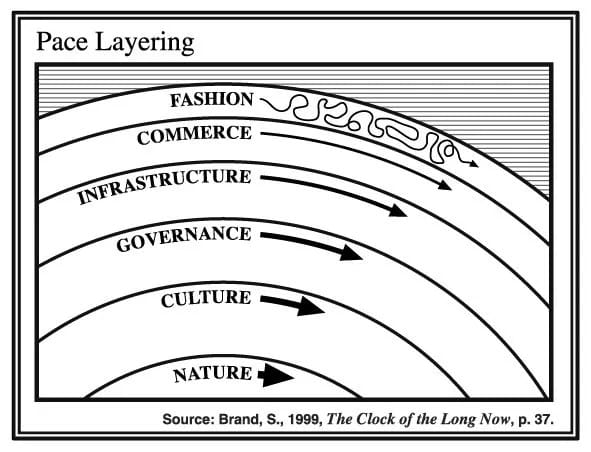
Brand’s popular “pace layers” model has long been a particular target of my ire, but a couple of people whose work I really respect are taking a longer look at it, and I’m being obliged to admit that I may have been excessively dismissive. For instance, Andrew Curry has unearthed an interview between Brand and the futurist Paul Saffo, as well as a Journal of Design Studies paper that gives a far fuller account of the underlying theory than the many drive-by citations that one might find online.
(John Willshire has been engaging with the pace layers model, too, though quite what he’s doing with it has yet to be revealed to me. We can thank John for the image of the model reproduced above, which he made after being told he couldn’t use the original in an academic publication he’s been working on… a refusal which is doubly ironic, given how widely said image has been reproduced all over the internet for two decades, and given the undercooked “information wants to be free” sympathies of the model’s originator.)
I’m not sure I’ll ever be able to get away from my instinctive irritation with it, which (ideological enmity aside) is related to having spent five years doing doctoral research on infrastructure, and as a result having very different ideas to Brand regarding the meaning and relationship of concepts such as infrastructure, governance and “nature”. Then there’s the notion of these layers being in any way coherent and analytically distinguishable, and furthermore their being assigned a “clock speed”, as if we were still engaging in the mechanistic blind-watchmakerism of late-Victorian deist techno-progressives… which, of course, is exactly what we are still doing.
* takes deep breath, counts to ten *
BUT, it’s just a heuristic—and as the old George Box line goes, “all models are wrong”; what matters is whether they’re useful.
Sometimes we discard a tool that doesn’t seem to fit our work, and that’s fine. But when we see it being picked up by people whose work we admire, we should at least be willing to take a second look.
between the pages
I’m still wandering the streets of Revachol in my evenings, so I still have no fiction reading to report on, I’m afraid.
(I am re-reading Donna Haraway’s Staying With the Trouble… but if you want to hear what I have to say about that, you’ll have to wait until Wednesday 16th September, when it will be the subject of my first Deep Read of the semester.)
lookback
This has been a rather more varied week than the last, doing lots of little bits and pieces. Weeks like this make me glad for my habit of ledgering my hours, because it’s weeks like this where I find myself thinking that I’ve hardly done anything; something about the switching of modes and tasks makes me feel like the time has simply slipped through my fingers. I think it’s probably fair and true to assume that I don’t work as effectively when I switch modes a lot, but that’s hardly unique to me!
But it’s in the nature of the job—and it helps a lot to be able to look at the ledger and see that I put in a good week’s work, and thereby to recall that, actually, I got a whole bunch of things done.
I’ll have to wait a little longer for a return to fuller focus, as next week sees me heading up-country to the archipelgo north of Stockholm, where I’ll be taking part in a three-day workshop on desirable futures for the Baltic Sea, convened by the Stockholm Resilience Center.
On which note: if anyone reading this is based in Stockholm and would like to grab a coffee (or a beer) around 4pm on Thursday 10th, drop me a line; it’d be nice to squeeze in a chat before the long train ride home!
ticked off
- Five hours of admyn.
- Four hours of essaywork.
- Three hours of research.
- Three hours on PROJECT RADBURN.
- Three hours of fiction mentoring.
- Three hours on these here weeknotes.
- Two hours on PROJECT CASTOR.
- Two hours of academic peer review.
- Two hours of training.
- Two hours of art practice.
- One hour of blogging.
- One hour of networking.
- And ten hours of undirected writing and reading, because all of the above is made possible by the habitual cultivation of my messy but fecund mind-garden...
So, that was the week that was. Thank you for your attention, which is always appreciated, and I hope all is well with you, wherever you may be.
This has been the Worldbuilding Agency weeknotes for Week 36 of 2026. Thanks for reading! If you've enjoyed them, it's free to subscribe. If you are already subscribed, please send to a friend!



Comments ()