

week 9 / 2026: intentions and inversions
Reading round-up: what the Citrini scenario tells us about the tremendous power (and danger) of fictional futures; why the best novel of the Culture might actually be the most overlooked of the set.

“Open your eyes, they say / it’s all full of stars…”
 lifestepvan
Greetings from Malmö, where the air is fresh and the sky is mostly blue, and the rest of the world seems far away and terribly immediate all at once. Welcome back to WEEKNOTES at Worldbuilding Agency.
Let’s get rolling, shall we?
among the pixels
In something of a break with tradition, I’m not actually going to link or clip the item I want to discuss. You can surely search out the 2028 “Global Intelligence Crisis” scenario (published by Citrini earlier in the week) of your own accord if you feel the urge, assuming you’ve not encountered it already; I just hope you’ll approach it as what it is, namely a work of fiction.
That’s not at all to dismiss or belittle it! The reason I want to discuss it—and the reason a number of readers have written in about it—is that it’s a work of fiction whose impact served to shave off a significant chunk of value from the stock markets. On one level, that’s a demonstration—facile and terrifying all at once—of the power of narrative prototyping: next time someone tries to tell you that stories can’t change anything, remember this moment.
(Indeed, you should remember this week more broadly, as there are other very real and consequential actions being taken right now that are absolutely driven by and in service to a dying narrative whose benefactors are willing to do almost anything to try to sustain it.)
Despite protestation to the contrary, I assume that the Citrini scenario achieved its basic aim—though whether its authors intended the exact extent and direction of its effects is rather harder to judge. We are living through a contestation of narratives around “AI”, which has become a proxy front for an increasingly heated contestation over “tech” more broadly, which in turn is deeply entangled with a transitional moment in politics and economics (and much else besides). While it may seem like the question of climate change and the shifting infrastructural base of energy generation and distribution has been sidelined in recent months, this is a deliberate illusion: those questions are more vital and pressing than ever, and the people throwing bombs and rattling sabres are very aware of it.
It’s particularly messy because the media environment in which it is unfolding moves so very fast, and is so easily and cheaply flooded with fictions of a much lower fidelity than that of the Citrini scenario; the “fog of war” is on the other side of the glass screen of your phone, and the more you swipe, the thicker it gets.
But the Citrini thing is particularly interesting, because it is a fictional weapon that went off within the confines of another fiction. To describe the stock markets as an essentially fictional construct is not at all to dismiss their importance or power; rather, it’s a reminder of just how much of our world is driven by stories, and our shifting belief in them. If that doesn’t scare you at least a little, it really should: what Keynes described as the “animal spirits” of the market are far more influential on the other aspects of our lives than they were in his time. In a typically insightful remark, friend-of-the-show Jay Springett observed to me that “traders are just 2001’s apes at the monolith”; if you recall how that scene plays out, you’ll realise that he’s not trivialising the issue at all.
Merely understanding that this is a contest of narratives is not enough. It should also be obvious that simply pointing out that fact isn’t going to make anyone wake up from the nightmare; consciously or not, everyone knows it already.
What remains to those of us who would build a better world in the ruins of the one that’s currently crumbling is to find a better story. Much as it galls me to say so, the forces of reaction have done a vastly better job of not only understanding and capturing the newest media systems, but also of portraying a concrete future to encourage action and support. That future is a fearful place, and scared people will hide behind someone who promises to protect them from its threats, whether real or imagined. Hence the escalation of the nightmare.
You’ll note, I hope, that I have described this as a contestation of narratives, rather than a war. The words and concepts we choose to work with are the foundations of our stories; language is a map of the territory. When we concede to the language of an opponent, we tacitly agree to play the game on a map of their choosing. If we describe this as a war, then we have already lost—because war is the game in which might makes right. We cannot hope to win that way.
But there are other forms of contest. To resist is not the same thing as to attempt to conquer those who would conquer you.
Much of the fearfulness of the reactionary future comes from its being populated with Others. It’s a hard lesson to take—the one that keeps me awake at 3am—but if we would see that narrative defeated, we must resist the temptation to engage in Otherings of our own. With apologies and great respect to the late Audre Lorde: the master’s tools will never dismantle the master’s house.
We must do all we can to love those who have been taught to hate and fear us. That better world we want must be built for everyone, or it will never be built at all.
Normal clippings service will be resumed next week. Thanks for indulging me.
between the pages
My impromptu and unplanned revisiting of the Culture continued this week, when I turned to Inversions.
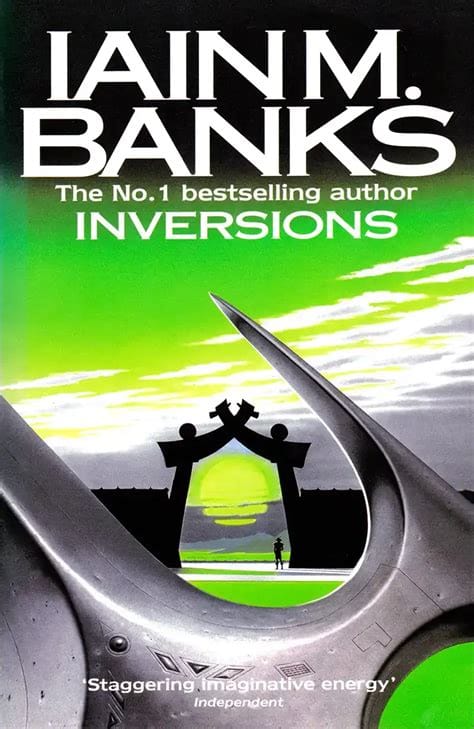
In both my personal recollection, and in what I recall of the general consensus on the Iain Banks fan forum which was my first real “home” on the internet, before the rise of MySpace et al, Inversions was a sort of pendant to the Culture canon: a cute bauble, a science fictional side-quest deliberately disguised as a secondary world fantasy, and thus inferior almost by definition to the “real” Culture books. If you were going to write in the Culture, why choose a setting where you can’t write about Minds and Ships and Culture citizens doing all the casually crazy post-scarcity stuff they do?
On rereading it, however, I think you could argue that Inversions actually offers the purest exploration of the dilemmas posed by the Culture’s status as a liberal interventionist utopia, as has been discussed here in earlier weeks. The focal characters of the two mirrored skeins of the story are quite clearly set up as avatars of the two main perspectives on interventionism: pacifistic and hands-off, or (to repurpose a ship name from another book) “this will hurt me more than it hurts you”.
For the avoidance of doubt, when I describe the Culture as an interventionist utopia, I do not mean that Banks was positing interventionism as fundamentally utopian. While the political philosophy under examination may perhaps be less radical than those usually associated with the form, Banks was very much engaged in the practice of critical utopia, which I have described elsewhere as “the depiction of a utopian project in the process of undergoing its inevitable failure”; it is utopia not as blueprint, but as thought experiment, the sort of test where you go to the edge to see where (and how) the model breaks down. Perhaps more so than in any of the other Culture novels—and in particular contrast to Look to Windward, as discussed a few weeks back—in Inversions we actually get to see things on the ground in the societies being intervened upon (though our POV characters are in neither skein of the story exactly “everyday people”). In that sense, it may actually be the most ambitious of the Culture books, from this political perspective.
I’m also find myself thinking it might actually be the most formally ambitious of the Culture books. This accolade is usually reserved for Use of Weapons, and not without reason: effectively the first Culture novel in terms of its time of original conception, the structure of Weapons was so ambitious—requiring, as it did, that the climax of the story actually appear in the very middle of the book—that Banks actually shelved it for a number of years until encouraged to try again by his close friend Ken Macleod. The double-skein of Inversions is much simpler, but the mirroring of the events that unfold in each one (the titular inversions) are demanding in a different way, and much less showy.
It is perhaps the quietest and most understated of the Culture novels, but I’m now quite taken by the idea that it’s actually the closest to the essence of the entire project.
lookback
This has been a very network-y, kinmake-y sort of week, at least by my hermitlike standards: I’ve had some super conversations with friends and colleagues old and new, been out to dinner with some local friends, and been to see Lynch’s Mulholland Drive with yet another.
It’s also been a week in which time has been devoted to the care—or at least the maintenance and adornment—of the body: I’ve had the first of three dentist appointments aimed at a long-term solution to the busted molar problem that emerged back in December, and I spent most of Tuesday getting my most recent tattoo project finished. The shift in weather and temperature means I’ve been out on foot and bike rather more than has been the case in recent weeks, which also feels good.
As such, the ledger for the week is a little low, numbers-wise—but that’s fine. The freelance life ebbs and flows… and while I wouldn’t go so far as to count myself a particularly adept sailor just yet, I seem mostly to have gotten my sea-legs. (Or, to over-crank the metaphor a bit: I don’t seem to be barfing over the railings anywhere near so often.) Better yet, a new project has just been onboarded, and there are a bunch of other prospects on the horizon, some of which look quite promising. A good week, for all its seeming slowness.
ticked off
- Ten hours of admyn, of which four hours specifically accounting-related stuff. (It’s the time of year when Swedish businesses close their books and file their annual reports, so I’ve been working on that with my new accountant, and getting some helpful advice along the way.)
- Five hours on PROJECT CHAPERONE. (I have a structural outline for this chapter which means I should now be able to just crank out a long draft without getting diverted too easily.)
- Four hours of networking and kinmaking.
- Three hours of reading for research.
- Three hours on these here weeknotes.
- Two hours of internal tech support. (I was kindly gifted an old but perfectly functional printer-scanner combo last week, and getting the thing rigged up required some spelunking in various Linux-focussed fora. Somewhat ironically, the problem with printing on Linux is now almost exactly the opposite of what it used to be: fifteen years ago, you’d struggle to find drivers and support for any printer made within the last five years, but now it’s getting hard to work with anything more than a decade old. The things we do to save a bit of money, eh?)
- Two hours of blogging.
- And ten hours of undirected writing and reading, as always.
(I also spent four hours after last week’s weeknotes giving my studio a proper and much-needed spring-cleaning, but I don’t think I can fairly count that as work in the terms of this ledger.)
There we go, then. Thanks for dropping by, and I hope all is well with you, wherever you may be.
This has been the Worldbuilding Agency weeknotes for Week 09 of 2026. Thanks for reading! If you've enjoyed them, it's free to subscribe. If you are already subscribed, please send to a friend!


Comments ()