

week 7 / 2026: timelines and mailbags
Reading round-up: the straightening of time by Victorian science and philosophy; the formation of the earliest international communications infrastructures; and the ironic-in-hindsight interventionism of Iain M Banks's Look to Windward.

“At the edge / looking up / shifting focus onto a majestic void…”
 v 0
v 0
Greetings from Malmö, where an unfamiliar orb of fire is rolling slowly around the rim of sky’s blue bowl… and welcome back to WEEKNOTES at Worldbuilding Agency.
Spread your wings, and fly right into the light…
among the pixels
I’ve been sat on this Aeon piece from Emily Thomas for a few weeks, but it’s too good not to post, on the off-chance that you’ve not seen it already. Thomas begins by noting how totally normal it seems for us to think of time as fundamentally linear, and then proceeds to show that it the representational dominance of the linear model is actually a fairly recent phenomenon.
Cyclical and linear conceptions of time thrived side by side for centuries, sometimes blurring into one another. After all, we live through natural, cyclical seasons and unrepeatable events – birth, first marriage, death. Importantly, medievals and early moderns didn’t literally see cyclical time as a circle, or linear time as a line. Yet in the 19th-century world of frock coats, petticoats and suet puddings, change was afoot. Gradually, the linear model of time gained ground, and thinkers literally began drawing time as a line.
The story of this shift is a Grand Tour of Victorian-era thinkers and ideas, which finally debouches into the literary tradition that would come to be known as science fiction, in the form of the work of H G Wells.
I spend much more time than is normal or healthy thinking about how we think about time, and articles like this are a very good illustration of why I do so: the conception that feels to us most natural and obvious is in fact entirely contingent and socially constructed. The consequence is the realisation that we could think futurity very differently to the way we do—we could, and indeed we should.
More recent arrivals here at Worldbuilding Agency may not be aware that my foresight practice and theoretical framework was strongly shaped by my PhD work, which was aimed squarely at questions of infrastructure—a term that I interpreted rather more broadly than some of my colleagues, many of whom were civil engineers or urban planning scholars.
Very briefly: I assume infrastructure and medium to be synonyms: thus “television”, as the term is most generally used, identifies an infrastructure rather than a simple device, and “electricity grid” denotes a medium. This has a lot of interesting and challenging implications, which I will mostly avoid unpacking here right now—but one of the most consequential is that you can productively apply media theory to infrastructural systems. This turns out to be a very illuminating thing to do! (It also turns out to make some civil engineers quite angry.)
This preamble serves to justify this week’s second clipping, which is from a piece at the LRB on two relatively new books of history, one of which deals with the establishment of the earliest formal postal systems in Europe, and the other of which looks at the emergence of what we now think of as “the news” as a category of information. These two systems were neatly connected, and not just by the whims of the reviewer:
States struggled to work out their role in these rapidly changing systems. Private mail presented different problems: should couriers working for state-funded postal services be allowed to carry post on behalf of paying customers? For the states that underwrote postal systems, this was risky – it increased the risk of robbery since private mail often included money and valuables – yet attractive: an efficient postal service subsidised by private clients would be less of a drain on state resources. Controlling the carriers of private mail also made surveillance simpler. As time went on, the price of sending a private letter fell, so that more ordinary people were involved in the flow of mail and news: ‘What had started as a state privilege had become a preferred public service.’ Crucially, by the second half of the 17th century, the postal stagecoach had become the essential vehicle of European travel, carrying passengers at the same speed as it delivered the mail. The machinery of the post – its itineraries and printed guides, inns as relay stations, couriers with local knowledge – adapted seamlessly to facilitate a new era of tourism and would form the backbone of the Grand Tour. The infrastructure of posts and couriers that served states and merchants laid the foundations for a revolution in communications.
This is particularly interesting in light of current events: Denmark has very recently killed off its state postal system, for instance, and any encounter with the notionally arm’s-length service provider Postnord (which also handles something that you could just about call a mail service here in Sweden) should be sufficient to disabuse you of the lingering fiction that Scandinavia is defined by its social democratic set-up.
Physical mail for the purpose of communication is simply not of interest to states any more—although as borders and tariffs become the new normal, physical mail for the purpose of shipping goods is going to be of increasing concern: most smuggling now takes place through incredibly complex and highly automated logistical infrastructures, and the management of these “borders” is largely outsourced to the private firms that run those systems. It’s too expensive and complicated for states to “take back control” in this space—and that’s a contributing factor to the theatrics around “taking back control” in other areas which, while more visible and loudly discussed, are far less consequential economically.
As for information control, well—this is a big part of why states are running around like headless chickens whenever someone says “AI”, because one of the functions conveniently hidden by that increasingly overburdened label is “mass digital surveillance of communications at scale and in real-time”. Which means that the most secure way to send information across a border nowadays is probably to put it on some sort of physical medium and send it as a parcel; hiding signal in noise is always a good strategy.
See, trains of thought like this are just one of the reasons that people who work with futures should read a lot more history than they generally do...
between the pages
I found myself drawn back to Iain M Banks once again this week, which is almost certainly a sort of comfort-reading instinct expressing itself. But as I mentioned a few weeks back, after re-reading Excession, it’s been longer than I’d realised since I last engaged with Banks’s books, and that temporal distance is generating a whole lot of interesting new perspectives.
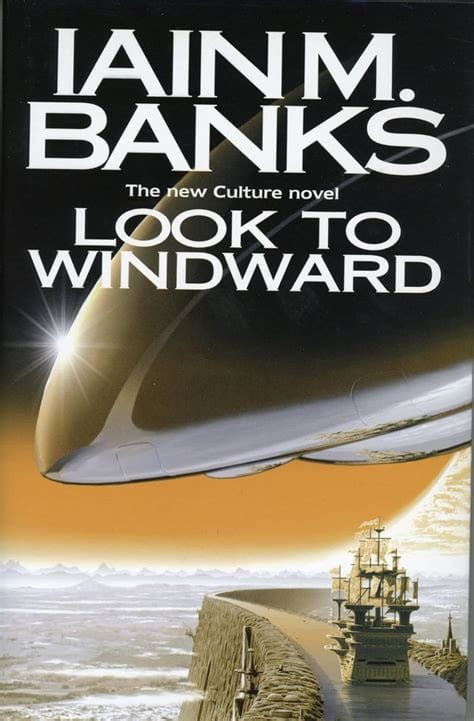
In that earlier post I mentioned Alan Jacobs’s theory that, far from being the socialist utopia that sf fandom still tends to take them as, the Culture novels actually depict a distinctly liberal utopia—and Look to Windward, which is dedicated to “the Gulf War Veterans” is perhaps the best illustration of that hypothesis.
This is a story in which the Culture is hugely regretful of its error in having meddled with a civilisation that it quite clearly designates as less advanced than itself, and having prompted a civil war by trying to eradicate that civilisation’s caste system; but while they regret the outcome, the bad handling of the intervention and the unnecessary war (and millions of deaths that resulted from it), they do not regret the intervention in principle. Meanwhile, certain parts of said less advanced and more faith-oriented civilisation—with the assistance of an never-revealed agitator civilisation, of presumably similar or even superior advancement to that of the Culture—decides to revenge its dead for what are essentially religious reasons.
My full thoughts about this are busily assembling themselves into a proper essay; for now, suffice to note that Windward was published in the year 2000, which gives this theme of the book a certain tragic irony in hindsight, to say the least.
So let this be a reminder: science fiction is never about the time in which its events are ostensibly set; rather, it is always about the time (and the place) in which it is written.
lookback
This week’s tally probably speaks pretty clearly to the current state of the firm: lots of admyn and bizdev means there’s not a huge amount of client work on the desk right now. However, we do have the activation of PROJECT CHAPERONE—which is currently fairly small in scope, but may later balloon somewhat, if we’re lucky? Guess we’ll see.
Note also the loss of the best part of a day to doing some academic peer review; there’s another of these overdue, as well. As noted elsewhere, I’ve turned down three other requests to do peer review since the start of the year, primarily because the journals in question were not willing to negotiate on turn-over time. I’d like to keep doing this stuff, making my contribution to the scholarly commons—but in the absence of a faculty salary, I’m afraid that you don’t get to insist that I file a review within a fortnight of assigning it to me. (Honestly, I think that’s a bit much even for someone who does have a faculty salary; the further I get from academia, the more easily I understand why stress is so endemic there.)
Still, the days are perceptibly lengthening, and a couple of them in a row have come with clear skies. That means lower temperatures, of course—but if coldness is the price of natural light and no snow, then I’m happy to take it.
Five weeks till the spring equinox…
ticked off
- Twelve hours of admyn. (Looking at a rebuild of my current schedules and time-management systems. The time management literature rarely acknowledges the time lost to attempted refinements of time management, does it?)
- Twelve hours of bizdev. (I know it’s not helpful psychologically to observe how much I dislike the “finding the work” dimension of being freelance; “argue for your limitations, and you get to keep them”, &c &c. But nonetheless...)
- Five hours of writing and blogging. (Working on the Windward thoughts, among other things.)
- Five hours of peer review. (See above.)
- Four hours on PROJECT CHAPERONE. (This is, or rather will be, a book chapter.)
- Three hours on these here weeknotes.
- Three hours of reading for research.
- And ten hours of undirected writing and reading, as always.
Living the dream, wot? Anyway, that will do for now. I hope all is well with you, wherever you may be.
This has been the Worldbuilding Agency weeknotes for Week 07 of 2026. Thanks for reading! If you've enjoyed them, it's free to subscribe. If you are already subscribed, please send to a friend!


Comments ()