

week 51 / 2025: tearing away the caul
Reading round-up: the performative shaming of “performative reading”; the post is the product; the illusion of inevitability; and maximalist manga-monster steampunk-fantasy strangeness.

“Junebug skipping like a stone / with the headlights pointed at the dawn / we were sure we’d never see an end to it all...”
Mellon Collie and the Infinite Sadness by the Smashing Pumpkins turned thirty years old a few weeks ago and we’re just going to listen to the song above without even starting to consider how old that makes us feel, okay? Okay!
Okay—on with the show, because I dare say those of you still reading this week have other things to be doing.
among the pixels
I’m aiming for a sort of hopeful arc with this week’s selection, though it might not feel like it as you read this thing at the New Yorker about “performative reading”, which is apparently a new concept through which to shame and humiliate men for having the temerity to read physical books in public.
No surprises for guessing this is a social media thing—and perhaps also a particularly USian thing? That nation does rather seem to be speedrunning the whole fall-of-empire routine, and “segmentation and hectoring of people partaking in activities considered to be beyond consensus morality” is apparently on the bingo-card for both sides of the political fence.
Here Brickner-Wood makes what feels like an important point about the mediation of this and other such shame campaigns:
In this view, the performative-reading phenomenon appears less like a newfangled way of calling people pretentious and more like an odious reflection of society’s increasing deprioritization of the written word. Reading a book is antithetical to scrolling; online platforms cannot replicate the slow, patient, and complex experience of reading a weighty novel. [...] The only way that an internet mind can understand a person reading a certain kind of book in public is through the prism of how it would appear on a feed: as a grotesquely performative posture, a false and self-flattering manipulation, or a desperate attempt to attract a romantic partner.
The socnets are populated by people desperate to be seen, and simultaneously terrified of being seen in the wrong way. This seeking out and monstering of “performative” behaviours outside the system is hard to interpret as anything other than projection, and the sort of dynamic that once led to witch trials: avoid attracting accusations by being a vigorous accuser.
The discursive flywheel underlying that phenomenon is worth considering, though—because it’s not something one can blame entirely on some essential “human nature”. Here Ruby Justice Thelot traces the history of transgressive and made-to-shock media, and connects the phenomenon of online “ragebait” directly to Victorian-era “penny dreadfuls” via the cynical industrialisation of outrage by C20th newspapers:
In a very Debordian way, this means that we are slowly retreating into the realm of pure spectacle, where for the launch of software, like Cluely (the cheat-on-everything AI) or Friend (the AI partner necklace), the thing that is actually sold, the thing that is actually marketed — in the words of Nick Susi — is our attention. That’s actually the product: it’s the attention. It’s not the software, it’s not the hardware, what the launches indicate to the market is the ability for these companies to capture our attention. Say it with me: the post is the point.
After noting that tech-company marketeers have fully understood this principle and successfully weaponised it, Thelot concludes that in an “economy of symbols”, the only path of resistance is full disengagement with any and all material that seeks to manipulate your attention purely as a means of propagation. (I hope you’ll not think it immodest if I note that I came to a similar conclusion myself earlier in the week.)
This is also very much in line with what L M Sacasas has been writing about for well over a decade: the very deliberate construction of a narrative of technological inevitability, and the courage required to not just resist but refute it:
I should acknowledge that while there is no inevitability, agency and responsibility are unequally distributed. Thus, it is worth noting that the strategy of manufacturing inevitability has the effect of obfuscating responsibility, especially on the part of those who in fact have the greatest agency over the shape of the techno-economic structures that order contemporary society for the rest of us.
“I thought this was going to be a hopeful arc, Paul?” Yeah, yeah, fair call—but I would argue that the growing number of people writing stuff like this indicates a growing awareness of (and distaste for) the tone of not just “the internet” (whatever that term means at this point) but culture more broadly. That this is showing up in open resistance to visible manifestations of the information-technological-complex is causing some commentators great distress, wringing their hands and worrying that “the Luddites” want to “take us back to the stone age”.
For my part, I wish there were more people acting like the actual Luddites acted! But even if there were, it would only be the corrective swing of enantiodromia, the rhetorical excesses of the passing peak of the cycle. Very few people sincerely want to go back to the stone age, or even to the technological affordances of the 1980s, but it seems that increasing numbers of people are starting to ask not just what machines and devices and services they want in their lives, but why they’re there and who they actually serve.
Which brings us to Dougald “Dark Mountain” Hine, who—cheered by news of mounting resistance to new data centers—says:
There’s a rumour here worth spreading, the rumour that the spell of inevitability might be breaking. We’ll still be deep in trouble, even if that’s true, but we’ll be able to look at that trouble with different eyes, see different paths worth taking through it.
Amen to that. What Hine and Sacasas and others label “inevitability” is much the same as the thing that I label “The Future”. We must claw our way out of its rotten corpse if we want to rediscover futurity.
between the pages
The tenth volume of Marjorie Liu and Sana Takeda’s graphic novel sequence Monstress finally dropped this week.
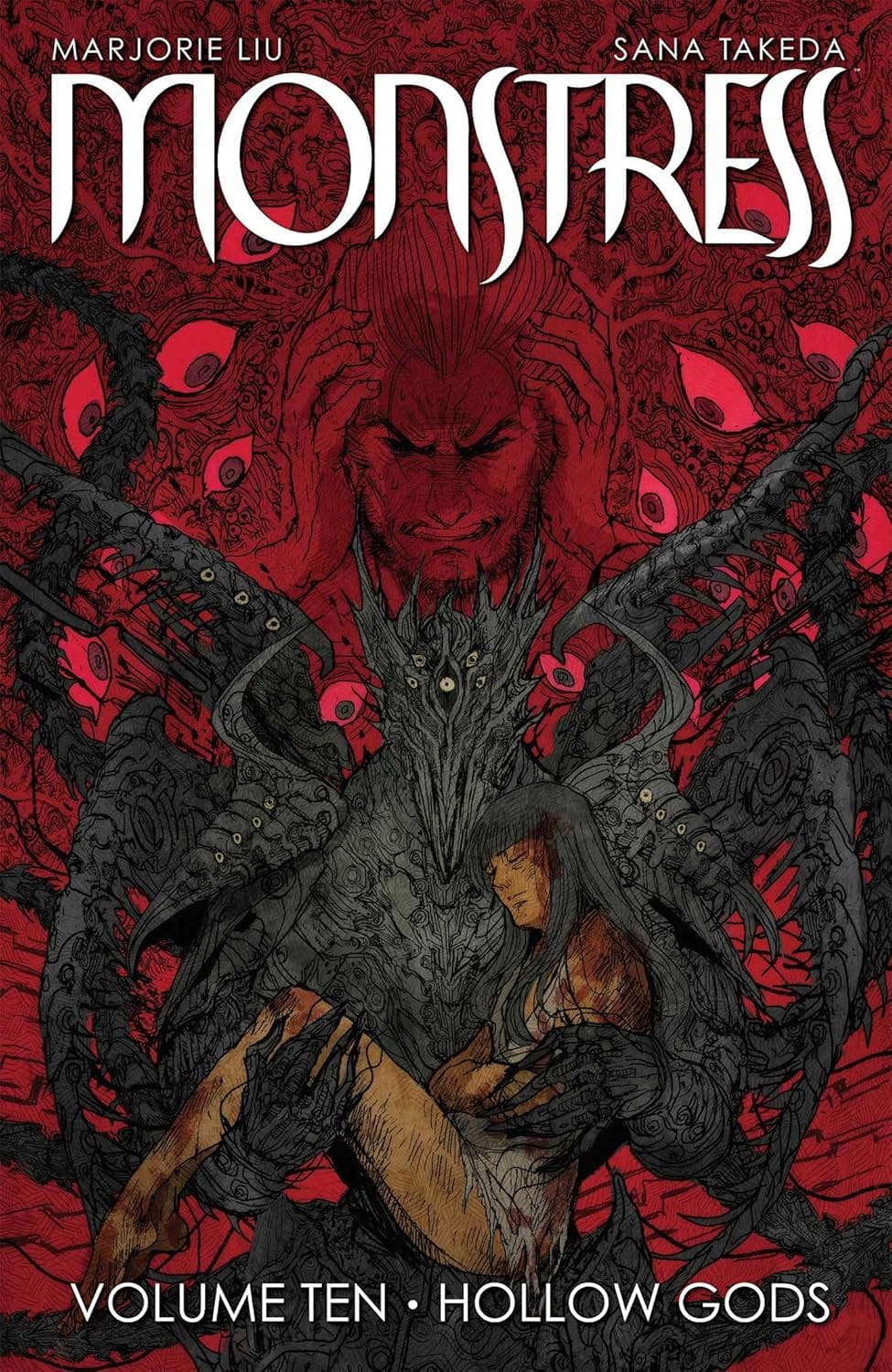
I’m always a bit hesitant when writing about comics, because it’s not my “home” medium, and I’m very aware of my ignorance. For that reason, but also for others, my recommendation of Monstress is sincere, but also cautious and caveated. Clearly I like it, as I’ve bought and read all ten volumes so far—but if I were to try to explain what exactly I like about it, I’d probably resort to saying “maximalism”. Both the worldbuilding and the art style are crammed, in a way that reminds me somewhat of Rudy Rucker’s notion of “eyeball kicks” as a crucial part of the cyberpunk aesthetic—but here the genre is manga-monster horror-fantasy with a side of magical steampunk, with a vast cast and lore that seems bottomless.
Therein lies the problem, however. This may be something to do with the slow publishing cycle of graphic novels: once you’re caught up with the back issues, you’re getting one book per year, and unlike the old superhero stuff, there’s zero attempt to catch you up or remind you of earlier events at the start of a new instalment. When the story and world are as full as they are here, it’s frankly disorienting! And that’s compounded by the way that the numerous interdimensional “old god” monsters, which frequently possess or merge with other (mortal) characters, all share a Lovecraftian-mass-of-eyes-and-tentacles-and-teeth form; Taneda has gone to great effort to make sure that they all look different, but remembering exactly which murderous nightmare is which—not to mention who or what it was most recently allied with, and/or in the process of betraying—has proven a considerable challenge as the series has advanced. Throw in frequent shifts between various locations, some of which are other worlds or dimensions or timelines, others of which are the mindscapes of main characters, all of which are constantly being invaded or intervened in or liberated by various other characters, monsters and shifting political factions, and… yeah. This is why I have not provided a plot summary.
It’s also why I’ve promised myself that one of the things I’ll do over the coming holiday season is just mainline the whole run over a day or two, treating it as one long book or a multi-series TV binge-watch. I don’t think Monstress is ever going to win prizes for clarity or simplicity of narrative, but I don’t particularly prize those qualities over others. Perhaps it’s the sort of work in which one has to fully immerse oneself, if it is to be fully appreciated. I guess we’ll see.
lookback
Having had a few weeks of decompression after a long run of report-oriented client work, it finally feels like my capacity to write under my own direction is coming back online.
Any sizeable writing project takes up not just a portion of one’s immediate thinking capacity, but also occupies an amount of persistent mental space. I’m not a fan of computing as a metaphor for the mind, but on the understanding that this is strictly analogy, I guess the distinction I’m trying to make here is between available CPU flops (thinking capacity) and extended RAM (collected materials and structures that the thinking is working with. Closing a big application or two quickly frees up flops, but—depending on the quality of the software you’re using, and of the operating system beneath—it can take a while for the RAM to clear; sometimes you’ll have to do a full reboot to flush it properly.
This is a good headspace to be in at the end of the year; to be in it before the holidays proper is better still. There are various small projects I want to nail down before the new year starts, and planning to be done around the execution of other things already in the schedule. It’s not most people’s idea of a merry Christmas, certainly, but I’ve long tried to take advantage of the social silence of the last few weeks of the year to get myself straight without any external interruptions or obligations. This year, it feels like the circumstances have arranged themselves in such a way as to allow that to happen with relative ease. Sometimes the gift you get is the one you needed most.
ticked off
- Seven hours of blogging at VCTB. (Been treating this as a way of spinning up the short-form writing-as-thinking faculty, but also as a way to return to a more regular blogging practice. It eats a fair bit of time, but there’s a pay-off in terms of a more connected relationship between things I read and think about over the short to medium term. Quite where the sweet spot between those tow factors is to be found remains to be seen—but that’s another point in favour of this tracking system.)
- Six hours on PROJECT HORNIMAN. (This one has been fallow for a long time, for an assortment of reasons. It’s not a colossal job in terms of the required output, but it’s conceptually huge, and getting back into that headspace is taking some time. But it feels like new perspectives and approaches are emerging, which is good.)
- Five hours of copyediting. (It ain’t the most glamorous work, but it’s still very satisfying—and another nice relief from big writing projects. If you need someone to bring some clarity and sparkle to a website or report or academic paper in English, do please drop me a line!)
- Six hours of admyn. (Bits, bobs.)
- Four hours on these here weeknotes. (Weeknotes aren’t supposed to take more than an hour or so, but I’m putting a bunch of added-value stuff into these, so I don’t mind giving up a few more hours—particularly as it mostly involves me reconsidering and connecting things I’ve read and want to talk about! Click rates suggest that you folk out there in reader-land are appreciating the effort, at any rate.)
- Three hours of fiction writing. (There’s a competition with a fairly tight deadline that I want to take a run at. I thought I’d try a more spontaneous approach, rather than plotting the thing out in advance; seems to be paying off so far.)
- Three hours of networking. (Out and about, exchanging ideas, making plans.)
- Three hours of styrelse admyn. (Migrating domains, altering DNS records, setting up services, waiting on support tickets… I remember clearly why I stopped doing this for a living! But the trick bits are done now, and as a result the operations of the board should be much more easily managed in 2026.)
- Ten hours of undirected writing and reading, som vanligt.
That’s everything, I think, except to wish you all a happy holiday of whichever denominational flavour (or lack thereof) most suits your preference; do what brings you contentment. I hope that all is well with you, wherever you may be.
This has been the Worldbuilding Agency weeknotes for Week 51 of 2025. Thanks for reading! If you've enjoyed them, it's free to subscribe. If you are already subscribed, please send to a friend who you think might also like it!


Comments ()