

week 49 / 2025: against the supposedly inevitable
Reading round-up: the end of The Line; socially constructed technological inevitability; the crusade against empathy; the Noughties as the Before Times... and the attentional friction of poetry.
“Mother / can you keep them in the dark for life / can you hide them from the waiting world…”
Welcome back to WEEKNOTES at Worldbuilding Agency. Let’s get right to it, shall we? A wise person suggested a table of contents might make things easier for those of you who only want to read certain parts, so have at it:
- among the pixels (web clippings)
- between the pages (books)
- lookback (reflections)
- ticked off (work ledger)
among the pixels
I’m going to start this week’s selection with a big ol’ slice of schadenfreude pie.
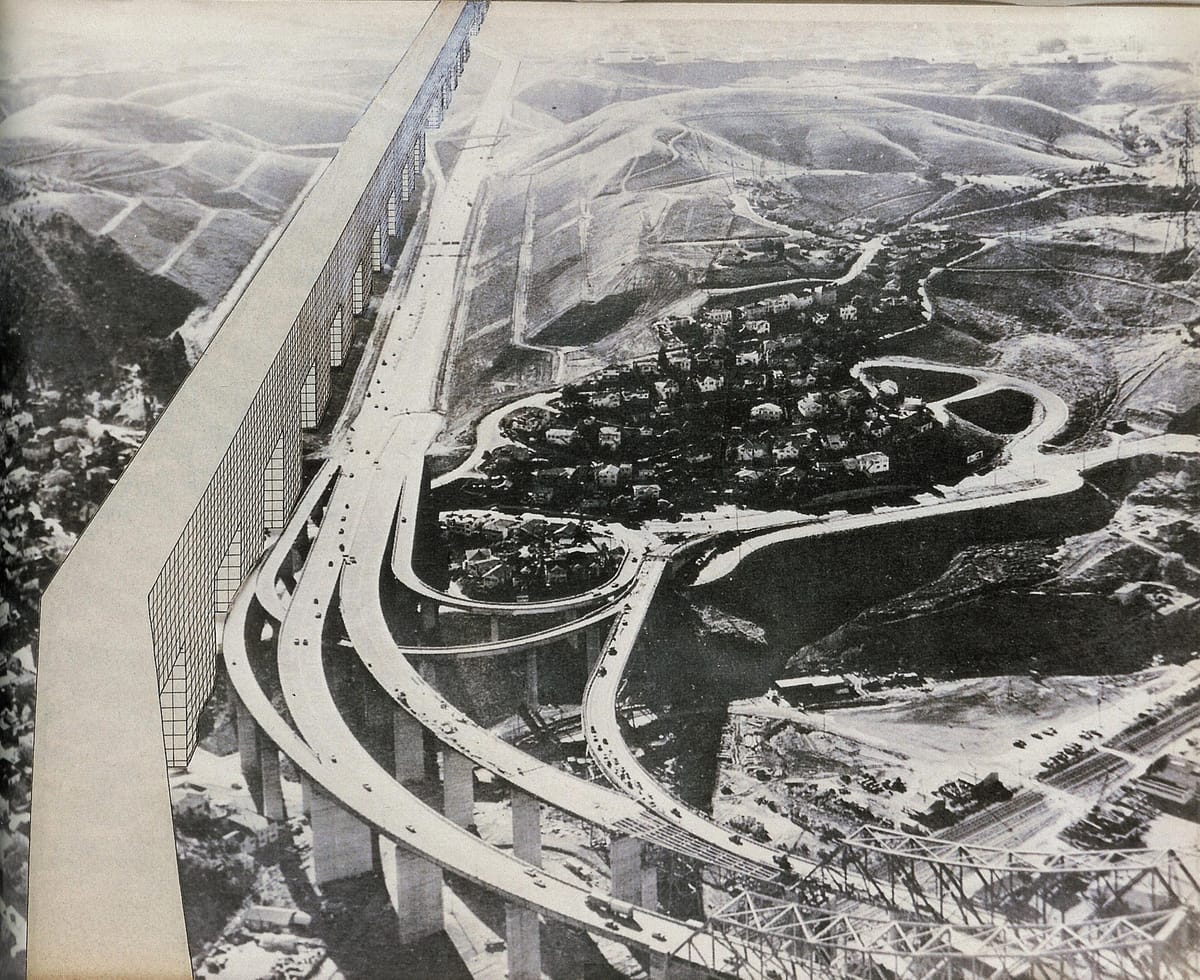
I won’t link the FT’s glorious obituary of The Line, the Saudi dynasty’s unfinished, impossible and unintentionally Ozymandian monument to its own hubris, because if you’ve actually got a subscription you’ve likely read it already; nor will I link any of the (admittedly few) people who seemed surprised to hear that the whole sham/scam has fallen apart. Instead, I’ll link Sam Holden’s response, and admit happily that I’m doing so because he seems to share my satisfaction:
Future histories of these unreal times will need to include a paragraph on The Line. It was the ultimate embodiment of the spirit of our age, when crypto grifters co-opt nation states, billionaire boys fling their toy rockets to the heavens, and tech CEOs predict data centers will soon smother the Earth. Somewhere out in the Saudi Arabian desert, a mad prince with a bottomless sovereign wealth fund actually carved a 150-km gash in the sand, and exclaimed that he would build a 500-meter tall, mirror-glass-clad linear city and fill it with 9 million people.
(And while I’d be the first in the queue to say, while wearing my most serious face, that “foresight isn’t about predictions”, I’m also gonna point out that I called out this particular bit of performative skiffy bullshit when it first emerged, a little over three years ago. You’re welcome.)
One might be left wondering how such a ridiculous idea lasted as long as it did. The answer—at least at the top of the pile—is money: the vanity of those who have enough of it to buy people who will tell them what they want to hear, and the fawning of those who’ll take that job.
Down here among the rest of us, the answer is a socially constructed sense of inevitability—which is a function of money, modulated by marketing. Tell people something enough times, with enough budget, and they’ll eventually assume it to be true, no matter how grudgingly.
Which is why, according to Rohan Grover and Josh Widera at TechDirt, the USian public seem to just suck up a bad and worsening data privacy situation:
As scholars of data, technology and culture, we find that when people are made to feel as if data collection and abuse are inevitable, they are more likely to accept it – even if it jeopardizes their safety or basic rights.
I am very grateful that I live somewhere with far better regulations around this stuff—but I include this piece because the Big Tech lobby-mob and various other Knights of the Revolving Door are currently doing their level best to convince the EU to gut the GDPR, and the usual suspects are giving it serious consideration because *checks notes*, uh, something something innovation something growth something?
A bunch of people are making a bunch of noise about this, thankfully, and for all its flaws—which I freely concede to be manifold and serious—the EU does have a track record of managing to cock-block stuff like this before it gets over the line, so fingers crossed. But the main point here is to remind you that, next time you hear someone talking about how very important it is that you consent to giving up your data, even though that data is (so they’ll say) almost negligible in its utility, you’re being lied to.
From there, we can leap to the latest missive from the mighty mighty Erik Davis, where he writes about the USian Christian right’s ongoing war on the concept of empathy, which he suggests can be seen as a valid (though co-opted) response to the slickly sentimental affect of most liberal-coded media in that nation:
With the emergence of surveillance capitalism, social media, and refined affective technologies, we have reached a point where feelings are not just targeted by political messaging, but subconsciously manipulated alongside flows of information. Affect in our environment is not just politicized but explicitly polarized.
(The back half of his piece reframes the whole issue through the lens of Philip K Dick’s fiction, because Erik Davis gonna Erik Davis, and that’s why we love him.)
The last piece in the batch is from Drew Austin, in which an old lime-green iMac gives him a senior-Millennial madeleine moment, and prompts some looking back on the early Noughties:
I rarely think about AIM today, despite the huge role it played in my life as a teenager. And when I saw the lime green iMacs I realized I never think about those anymore either. Napster endures in memory as an inflection point for media consumption and the music industry. But overall, that era will increasingly seem like a transitional phase, more difficult to place as time passes and history is divided into two parts, before and after the internet.
I’m a little older than Austin, so the Noughties are perhaps a little more stable and historical in memory for me than they are for him. (The Nineties, rather less so—for, uh, reasons.) But his identification of that period as one of “a transformation […] that we’re firmly on the other side of” is important, because it’s a reminder that, while the technological inevitability discussed above is just a story—albeit one we’ve been told relentlessly for the past two decades—stories have the power to reshape reality, not only in the present but the past.
between the pages
Having finished with Crowley’s letters late last week, and being also a little burned out on long-form writing, I have turned to video games and poetry for my evening entertainment this week.
I’m not going to write about the former, except to note that Octopath Traveller 2 is my first JRPG (so I have no idea if they’re all like this), and it’s just dumb enough to occupy my mind without engaging it overmuch, while just cute enough to paper over the hokey cliches of the characters and stories.
I think I’ll also avoid engaging in poetry critique here at WA, though it’s perhaps worth making a more general point about my experience with it this week.
I used to read (and write) poetry a fair bit, I’ve been out of the habit for quite a while. Much gets made of the struggles of contemporary readers to engage with works of any significant length, and I know enough people on the pedagogical front lines to be convinced that this is a real and serious phenomenon. Now, I haven’t noticed any increase in difficulty with, say, reading novels myself—other than those related to a diminishment of spare time in which to do so, perhaps—but I’ve definitely found some friction in poetry.
This might seem strange, given that poetry is for the most part a short-form medium, and thus presumably well-suited to a foreshortened attention span. But what I think is happening here is that the brevity of focus is balanced by its intensity: you might be able to read a poem in a few minutes, but to actually get something from it you need to read it closely, sounding it aloud in your head, considering the images and tracking the rhymes, etc etc. At first I found that I was trying to read them like I used to read Twitter: treating each stanza as a terse, stand-alone nugget with a potentially witty or insightful payload, and quickly scrolling on from anything that didn’t give me an immediate hit.
Spoiler alert: this is not a great way to read poetry.
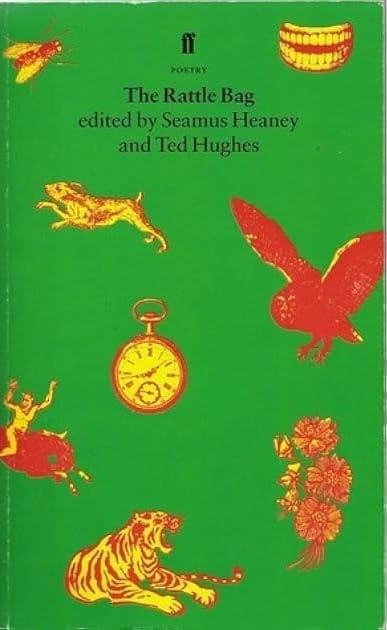
The good news is that I found myself slowing down as I got further into Heaney and Hughes’s classic anthology The Rattle Bag, but I’m chagrined to report that I made it through nearly a hundred pages in a few hours before realising that I hadn’t actually taken anything in at all. As mentioned above, we tend to focus on the decline of durational attention, and not without good reason—but the paradoxical slowness and intensity of focus required for shorter material is perhaps being overlooked as a result.
I’m tempted to make some sort of gym metaphor, here: long-form reading is endurance training, while poetry is more like burst training? Mostly I’m glad to have noticed my having weakened in this way: the best way to address is it surely to read more poetry, and as prescriptions go, that’s pretty agreeable.
lookback
The last month of the year inevitably prompts those “where did the time go?” sort of feelings, but as this has been my first full year of doing weeknotes—and keeping the records that inform them—I find that I actually have answers this this time.
Those answers can all be rolled up into a meta-answer along the lines of “the time went into working, d’uh”, and it might be surprising to know how pleasant it is to arrive at that conclusion—unless, of course, you’re also the sort of person who has unfairly internalised a sense of their own laziness. I’m in a much better place than I’ve been for a long time with regards to my mental health, and while there’s almost certainly a range of factors feeding into that, no longer being able to beat myself up for “not having done anything” is surely one of them.
On the flipside, it’s much harder to hide from your own operational inefficiencies when they’re right there in the data. I’m burning a lot of hours on admyn, which isn’t uncommon for one-man-band businesses, but I feel like it shouldn’t be taking more than 20% of my bandwidth, including desk-based marketing and networking activities. As such, I’m thinking it may be time to get a lot more hardcore about batching and timeblocking, which in my case looks like setting aside one day per week in which I do all the non-emergency administrative stuff in one sustained session. In theory, this should improve the quality of the time spent on the actual work, too.
In case it isn’t obvious, this sort of thinking is incredibly alien for me, and carries an enduring taint of wrongness. I’m artist enough to not want to have to plan and analyse; I just want to do the work! But without the plans and analysis, the work won’t come along reliably… so plans and analysis it is.
ticked off
- Twelve hours of admyn. (See what I mean?)
- Eight hours at STPLN. (An all-day workshop/seminar on “internationalisation”, i.e. building the sorts of networks and competencies necessary to accessing EU funding for creative projects. This was much more interesting and useful than I expected it to be.)
- Five hours on PROJECT FLATPACK. (Mop-up and internal documentation phase. Done and dusted.)
- Four hours of fiction writing. (I was ambushed by a story idea that wouldn’t let me be; been a while since that happened, so I decided to go with it.)
- Three hours on these here weeknotes.
- One hour of tarot reading.
- One hour of admyn specific to my position on the board of my bostadrättsförening. (Somehow I have ended up in the position of being “the IT guy”, which is not a role I would have sought out, having spent years wrangling domains and hosting services for other people. But either I do it, or we pay some other person to do it… and given I know how easy it is, it’s hard to swallow the price of outsourcing.)
- Ten hours of undirected writing and reading, as always.
That’s everything, I think. Thanks to all the people who got in touch with feedback on the new format, which was generally positive. It’s nice to get email from readers, so don’t hold back if you feel the urge! In the meantime, I hope all is well with you, wherever you may be.
This has been the Worldbuilding Agency weeknotes for Week 49 of 2025. Thanks for reading! If you've enjoyed them, it's free to subscribe. If you are already subscribed, please send to a friend who you think might also like it!



Comments ()