

week 3 / 2026: pulp and pith
Reading round-up: the long game of fashion brand narratives; hints of a revivalist Romanticism; the magickal power of naming things; and the creation of history through the storying of the dead.

“It’s a thousand pages, give or take a few / I’ll be writing more in a week or two...”
Welcome back to WEEKNOTES at Worldbuilding Agency. Come on in, make yourself at home… where would you like to start?
among the pixels
I’m teaching my fiction-for-foresight course over the coming week, so my clippings selection is perhaps more strongly oriented than usual toward narrative matters... though I guess it depends on how you frame them. (It’s been suggested to me that I can find a narratological angle in pretty much anything, and I know no reason nor grounds to argue against that accusation.)
I’ll start with this short piece at the FT, where the narrative connection isn’t where you might initially assume. The core of the story is the recent trend for high fashion houses to bankroll art-house and non-blockbuster cinema:
According to Thomaï Serdari, professor of marketing at NYU Stern, creating films is a way for brands to provide an alternative to constant but fleeting social media noise. “Luxury fashion wants to play in the field of timeless communication, narratives, and concepts,” she says. The price of luxury goods has skyrocketed lately. Movies are a way to strengthen those narratives as customers reassess a fashion brand’s value in the cultural marketplace.
So the narratives of interest here are brand narratives. What’s particularly interesting to me is the idea that a brand like YSL isn’t interested in a simple advertising set-up: they’re not expecting the sort of people who will go and see the new Jim Jarmusch flick to start impulse-purchasing blazers with a four-figure price tag. (Or so one must assume.)
Rather, they’re interested in the association with stubborn artistic outsiderdom—with authenticity, in other words. And given that everyone has spent the last decade and change saying that authenticity is a dead scene, that strikes me as a very interesting weak signal indeed.
(Somewhat related, then, would be Ted Gioia’s continued claims for a renaissance of cultural Romanticism—which I take to be at least in part a kind of conscious and deliberate project of hyperstition on the part of Gioia and others, but which I nonetheless recognise and sympathise with.)
The stories we tell have the power to shape the world around us, but it’s important to remember that the names and metaphors we choose to give to the things at the center of those stories end up shaping the stories as a whole. Strategist Zoe Scaman runs long and hard with this idea, and—by namechecking Hebrew mysticism, magickal practice and Ursula le Guin—gives me a reason to break my own (admittedly somewhat leaky) embargo on articles predominantly concerned with Those Two Letters:
Name it an “assistant” and you’ve licensed a certain kind of dependency while disclaiming responsibility for it. Name it a "tool" and you've already decided who's responsible when it goes wrong (you are, not them). Name it an “intelligence” and you’ve opened the door to corporate abdication - “the AI decided” - while triggering regulatory paralysis about rights and consciousness.
The ancient practitioners of naming magic knew that a misapplied name creates a misapplied relationship. Call a thing by the wrong name and you misjudge what it can do to you, what obligations you have toward it, what it might become.
Not content to simply make the point, Scaman then goes on to explore sets of alternatives derived from four different conceptual “territories”. A really strong piece, with a message that’s much more broadly applicable than might be immediately apparent: as le Guin was fond of saying, to name a thing is to have power over it; to accept the name given by others is to lose that power.
Looking in the other temporal direction, here’s an old-ish piece by the late Hilary Mantel, based on a lecture she gave about the art of historical fiction.
To my shame, I have yet to actually read any of Mantel’s novels, though I have read a bunch of her essays over the years, and they speak of a quiet brilliance and piercing insight. This piece starts with Mantel reaching back into her own family history to discuss the cultural relationship we have with the dead, but close to the middle she pivots to a discussion of fiction and narrative and history more generally:
As soon as we die, we enter into fiction. Just ask two different family members to tell you about someone recently gone, and you will see what I mean. Once we can no longer speak for ourselves, we are interpreted. When we remember – as psychologists so often tell us – we don’t reproduce the past, we create it.
Over the last few years it has been a risky business to claim publicly that truth is made rather than found, particularly in the US—and more particularly on the US left, where the hope must have been that repeatedly quoting an imaginary rulebook might somehow reverse the unsatisfactory outcome of the game.
But the fact of the matter is, as Mantel explains, that we create our pasts, our presents and our futures in a rolling act of contested, collaborative interpretation. On almost every issue of consequence, the political right—in the US, and almost everywhere else—has done a far better job of framing the circumstances, and writing voters into their story.
Perhaps, like me, you don’t much like that story? Well, then—you need to learn how to tell better ones.
between the pages
This week I motored through an old favourite in just a few days.
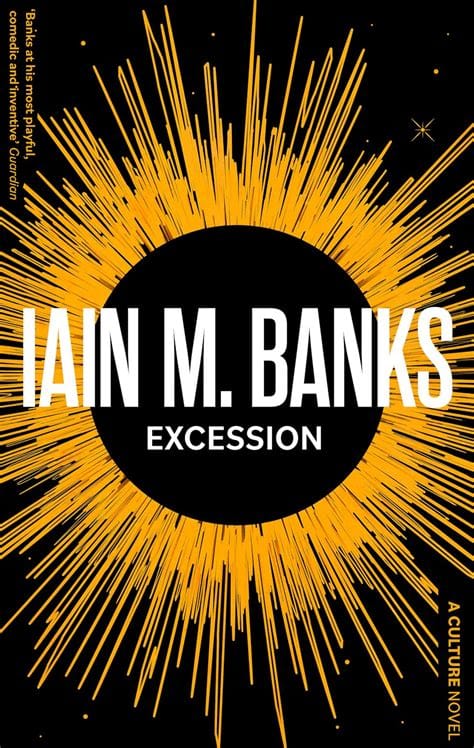
It’s been a while since I last read Iain M Banks’s Excession; perhaps even a couple of decades? I’ve re-read most of the other first-phase novels of the Culture (i.e. the ones that were written in the C20th), particularly Consider Phlebas and Look to Windward (which bookend that particular run, at least in terms of date of publication), but I think most of those re-reads were during my Banks honeymoon in the early to mid-Noughties.
Going back to Excession now makes me realise how much of an impression those books made on me as a neophyte writer. I’ve never denied Banks as an influence, and surely never will, but it seems that his clearest legacy in my work is pure prolixity: Banks revels in a verbose narrative style wherein a half-page paragraph might well comprise just a single sentence, buttressed by liberal deployment of semicolons, and it’s easy to see that it left a serious impression on me, to say the least.
(I also borrowed this book’s title as the name of a concept in the theory of sociotechnical change which was part of my PhD, though I think the notion of excession—along with a lot of other ideas!—was edited out as surplus to requirements. I should dig out my notes...)
While I can’t be sure when I last reread this or any other Culture novel, I can be fairly confident it was before I encountered this essay on the series by Alan Jacobs, which changed the way I thought about Banks’s best-known creation. It’s still to this day a canard of science fiction fandom that the Culture is a socialist-anarchist utopia, but as Jacobs makes clear, it’s actually a liberal utopia: the Culture is shamelessly interventionist, and most of the stories in the series come from the conflicts generated by it imposing its morals onto civilisations that it judges to be reactionary or worse.
Furthermore, it’s very obvious that Banks knew this to be the case, which makes the continued claims for its socialist *bona fides* all the harder to justify without recourse to wishful thinking. Jacobs doesn’t mention Excession, but given its core plot—a conspiracy among Minds aimed at drawing an aggressive and retrograde competitor civilisation into a major hot conflict, which would justify the Culture imposing a highly corrective and heavily enforced peace settlement—it’s paradigmatic. It’s also uncanny how well it presages the more mainstream anxieties about interventionism that emerged as a result of the so-called War on Terror.
Excession is not the best route into the Culture for a newcomer; it’s heavy on Mind-to-Mind dialogue, which can feel a little like reading an email exchange between rather hammy actors. My starter suggestion is usually Consider Phlebas, for the reader who has some experience with space opera as a genre, or Player of Games, for the reader who is perhaps a little anxious about space opera as a genre.
(Don’t sleep on Banks’s non-sf books, though. I’m assuming The Wasp Factory has been retroactively cancelled, though as debut novels go, it’s a doozy. The best place to start here, however, would be with The Crow Road, which has one of the best opening lines of any novel in any genre.)
lookback
This has been a rather difficult and unfocussed week, and I’m not entirely sure why. My rather elderly cat isn’t well, and that’s eating up a degree of brain bandwidth, for sure---but I wonder if I haven’t picked up some low-level bug that’s blocking my best efforts. An all-day tattoo sitting on Tuesday likely hasn’t done my immune system any favours, either... I’m sure I read somewhere that a tattoo is basically equivalent to a first-degree burn in terms of the load it puts on your healing capacity. (Which, in turn, may explain why it’s always easier to get a tattoo booking in the depths of winter.)
But hey—you can’t win ‘em all! Main thing is to keep showing up to the games, right? Right.
ticked off
- Eight hours of admyn. (Mostly correspondence, actually, which I may start breaking into its own category for analytical purposes.)
- Five hours of kinmaking. (Conversation, as distinct from written correspondence. I wanted to hit the ground running on this front in 2026, and this is a good start! Now I just need to maintain it. Would you like to talk with me about futures and narratives? Go ahead and book yourself a meeting!)
- Five hours of prep toward my Fiction4Futures course. (Putting together slides, making notes. Much of the course will be fairly informal, because I don’t think fiction writing can be taught in a formal, top-down manner—but nonetheless there’s some big picture stuff that needs setting out, which is a form of storytelling in its own right.)
- Five hours of blogging at VCTB. (Using the old blog to develop ideas and think out loud; it feels good, like an old leather jacket you’ve not worn for years.)
- Three hours of fiction writing. (Finishing off and submitting that story I mentioned last week. Now just gotta wait for the results of the contest.)
- Three hours of reading for research.
- Three hours on these here weeknotes.
- Two hours of IT wrangling for my Brf. (Every week I tell myself it’s all nailed down; every week, a new bubble appears under the metaphorical lino. Who’d be an IT support worker, eh?)
- Two hours of art practice. (It’s a mark of how unfocussed the week has been that I couldn’t even piss around with pens and paper without drifting off into a thought-fog.)
- Plus ten hours of undirected writing and reading, as always.
Now this is exactly why I make a point of tracking and tallying my hours, because when I started drafting these weeknotes, I was of the opinion that I’d done very little this week—but it turns out that I actually put in a lot of hours, even if they weren’t perhaps the most effective hours ever put in. Would I perhaps have been wiser to have done fewer hours, and thereby increased the quality of the ones I did? I don’t know—but now I can experiment and find out.
Right, that’s all for now—I need to put some more time in on this courseware. I hope all is well with you, wherever you may be.
This has been the Worldbuilding Agency weeknotes for Week 03 of 2026. Thanks for reading! If you've enjoyed them, it's free to subscribe. If you are already subscribed, please send to a friend!



Comments ()