

week 14 / 2026: states and status
Science fiction isn’t about predicting things, but I’m not going to miss an opportunity to point out that one of my stories predicted a thing. After that, we can settle down to a long hard look at liberalism’s nemesis, the “teleological regime”.

“I fear God because everything dies, babe / got a gun in the back of my car / a spasm of good sense is making my eye twitch / I’ve had enough of all your consolation...”
Greetings from Malmö, where some of us have been working right through this early Easter weekend, because the deadlines fall like dominoes and you’ve gotta keep on top of it all. Welcome back to WEEKNOTES at Worldbuilding Agency, where a modicum of boasting will quickly give way to a consideration of the fate of liberalism and its opponents...
OK, back to our regularly scheduled programming. Don’t touch that dial!
among the pixels
I can’t resist starting with a little self-congratulation—or is it self-aggrandisement? Via 404media, here’s a story about a group of researchers who have tweaked the genes of tobacco plants in such a way that they produce a variety of entertainingly psychoactive compounds.
... this research could pave the way toward—as one example—tomato plants that contain microdoses of psychedelic cocktails in each fruit. However, the study’s authors emphasized that these modified plants would need to be limited to medical use in clinical settings, and should not be accessible to consumers for recreation.
This was basically the main “novum” of my twice-anthologised short story “Los Piratas del Mar de Plastico”, first published in MIT Technology Review’s Twelve Tomorrows anthology in 2014.
By way of redress for the humblebrag, I will include this insightful zinger from good buddy Sjef van Gaalen:
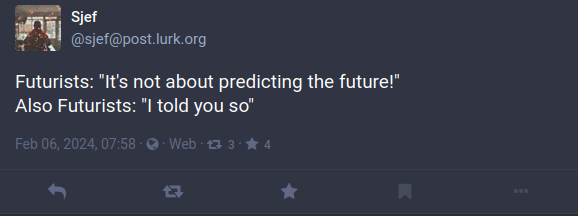
Further big-ups, not just for myself but for other good buddies Scott Smith and Susan Cox-Smith of Changeist, who were in town last week to run a “business LARP” workshop featuring yours truly as a diegetic character. (For those who actually read all the way to the end of my weeknotes on the regular, this was PROJECT PROSCENIUM.)
Their write-up of the session will expand your sense of what can be done with a one-day workshop aimed at developing not just futuring skills, but also futures culture:
It was not a lecture about futures methods. It was not a strategy session. It was something closer to a case investigation: participants arrived as independent panel members convened to review six fictional regional organisations, looking back seven years from 2035. These organisations had been tasked with building futures capacity with the support of an equally fictional regional bureau. Some of what they attempted had taken hold. Much of it hadn't. The panel's job was to find out why.
Look out for an interview with Scott and Susan here on WA some time in the next week, in which we dig in on the debrief and discuss the role of worldbuilding in this sort of work, as well as the use of LLMs for managing the multiple “artefacts” such a session requires.
This week’s food-for-thought longread comes from one Alexandre Lefebvre, who springboards from his research on the Fidesz regime to invite us to consider contemporary Hungary—and, by extension, other “illiberal” and/or autocratic regimes such as China and the MAGA scene in the US—as what he calls “moral states”, or "teleological regimes".
I propose a different label: Hungary under the Fidesz party is best understood as a teleological regime, one ordered toward a substantive vision of the good life. It is, in other words, prepared to use state power to rank and promote those forms of life it deems worthy of honor. And it does so not only to ensure Hungary flourishes collectively, but also because it believes this is the best way for individual Hungarians to thrive.
Before your hackles get too high, Lefebvre is at pains to point out that the corruption and hypocrisy of these regimes is very real. Indeed, he’s coming from a much more staunchly liberal position than myself: what he’s trying to do is understand the appeal of these movements, and the declining appeal of liberalism. What makes his work unusual is his attempt to treat those regimes in good faith—to take them at their word, rather than to traduce them as fraudulent edifices of insincerity.
This is noteworthy because it goes so against the grain of political discourse in recent years. The liberal center has for the most part tried to deal with the growth of such movements by slagging off not just their figureheads, but also—crucially—their followers. The intensity of this paradigm seems finally to be fading somewhat, but while there may be room for debate on the ethics of such an approach, it’s hard to escape the conclusion that, pragmatically speaking, it has failed quite spectacularly.
Lefebvre is not defending the programs or the methods of these “moral states”, and I hope it would go without saying that I’m not defending them either: again, the corruption and hypocrisy are pretty clear to see. But one of the threads of Lefebvre’s argument—rather soft-pedalled, admittedly—is that, from the other side of the fence, the “rules-based” liberal order is not exactly short of hypocrisy and corruption either. Which is why railing at their hypocrisy and corruption will make little difference to their followers: the pot accuses the kettle, if you will.
Lefebvre ends by arguing that the task facing liberalism “is to describe our opponents in terms they could recognize themselves in”, if only to the end of “build[ing] a liberalism that isn’t just right, but one that is vital, attractive and good”. I wouldn’t gainsay that conclusion, exactly—though I do not see myself as a defender of liberalism—but I feel like it is very much the top-down political-scientific perspective on the problem, in that it assumes a plastic population that moves around on the political map in response to the external narratives to which it exposed.
That is of course a big part of it, but those narratives have to find feelings to latch onto—and the ghost at Lefebvre’s feast is the void of meaning at the heart of life under liberal capitalism. It is no coincidence that there is considerable (if messy) overlap between contemporary reactionary and nationalist politics and the resurgence of interest in religious and spiritual attitudes, and of lifestyles that a few decades ago we were still referring to as “New Age”.
(If you fancy a side-quest on this tangent, this essay by Toby Shorin on what he calls “body futurism” is worth the time. I’m not sure I fully buy the theory as laid out, but the resurgence of embodiment as a nexus of social relations as a response to the overpenetration of the digital is very definitely a thing, and Shorin puts a lot of interesting pieces on the puzzle-table.)
It is almost impossible to characterise an absence, but it doesn’t seem particularly controversial to suggest that the much-discussed rejection of old forms of authority and expertise is less a yearning for intellectual and philosophical autonomy, and rather a desire for an epistemology that better fits the prevailing ontology, so to speak. It’s an uncomfortable thought, but there are reasons that those liberal models of authority and expertise lost their power, and hypocrisy and corruption are very much among them—and in their absence, the contradictions of capitalism are harder to bear.
Lefebvre’s “moral states” have come up with a different answer to the question “what is the good life?”—an answer which, as he points out, prevailed (in the West at least) for thousands of years before liberalism emerged. The irony here is that liberalism’s claim to self-evidence, once its winning advantage, no longer holds water at that emotional level; people want to believe in something more than it has to offer, and pretending otherwise is just driving them into the arms of reactionaries.
Whether liberalism can successfully reshape itself, as Lefebvre suggests, remains to be seen. Whether the resulting thing would any longer be liberalism as currently understood by mainstream political science, likewise—though perhaps that is exactly the change which is required.
between the pages
I’m now about halfway up Mann’s Magic Mountain, and I am still enjoying it—but I’m also feeling the need to take a bit of a break from the ascent. These have been a busy few weeks, and there are a few more such yet to come, and holding the world and characters of such a big, deep book in my head is proving to be quite challenging under circumstances of constrained mental bandwidth. So I’ve ducked into an alpine hut to snack on some short stories, as the book club of which I’m a member is currently reading John Burnside’s collection Something Like Happy.
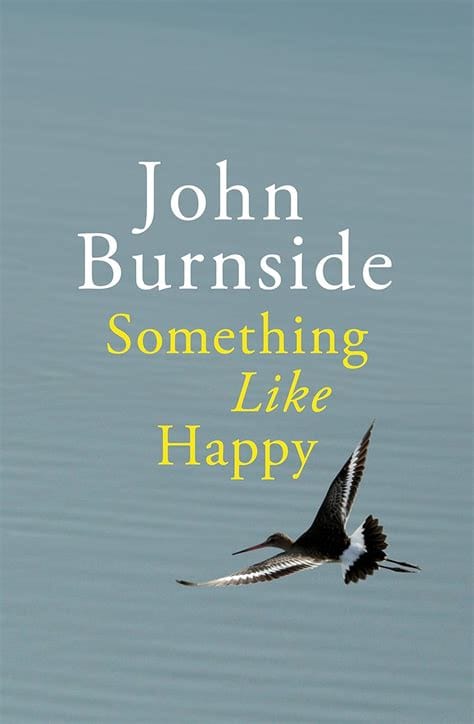
These are… OK? One of the blurbs on my copy positions Burnside’s work as “Scottish versions of the stories of Raymond Carver”, and that feels about right—but in a way that, to my mind, isn’t quite as flattering to Burnside as the reviewer likely intended it. The stories definitely have that Carver-esque extraordinary-slices-of-ordinary-life thing going on, but Burnside lacks Carver’s inimitable gift for narrative voice, meaning that the tales unfold in language that doesn’t feel like it matches the characters using it.
Furthermore, the Carver influence feels a little less lightly worn than it could be; perhaps I’m projecting a bunch of unwarranted assumptions of my own, here, but all these stories of Scottish small-town seem oddly USian in a way I can’t quite explain, but which is nonetheless rather jarring. The problem here may be that on some level I expect authentically Scottish fiction to come across like Irvine Welsh in his early hey-day.
There’s also a sense that, as a genre reader, I am conditioned to expect something different from short fiction in particular—the world-as-character might be a big part of that, but perhaps also a stronger presence of plot. The cliché diss of “literary fiction” is to say that it’s a genre of stories in which very little happens to predominantly unhappy people, and there’s definitely a sense of that here. But that sweeping characterisation is rooted in no small part in the work of Carver as exemplary of the form—and for me, at least, what redeems Carver’s plotless pieces is precisely the power of the narrative voice, the sense that I really get to encounter that unhappy person to whom very little happens. Burnside’s characters understand and explain themselves and their situations far more thoroughly than Carver’s ever do—and yet (or maybe and hence) they seem much less real to me, their little plots somehow emptier for all their comparative excess of event.
To use an artistic analogy: Burnside is the better draughtsman, perhaps, and his compositions are clearer, but Carver’s line and instinct for colour seem vastly more expressive and captivating. None of which is to say I’m not enjoying the book, to be clear—but while I know I’ll want to re-read Carver at some point, I find it hard to imagine I’ll feel the need to revisit Burnside.
lookback
Not much to say here that the ledger doesn’t express just as well: a lot of work on MUNICIPAL (with more to come next week), a lot of work on a project bid which I’m hoping to land, plus a scattering of meetings, the initiation of a new project (LUDIC), and the usual admynistrative bits and bobs. Not particularly exciting, in many ways—but nonetheless I’m pretty pleased to have handled a sudden lurch into high gear without losing control of the vehicle, so to speak
(I am also pleased to see that I’ve managed to make five hours for my art practice amidst the chaos, though it bears noting that half of those hours came immediately after I finished last week’s weeknotes, which is when I reset the ledger count.)
ticked off
- Fifteen hours on PROJECT MUNICIPAL.
- Ten hours of bizdev. (Mostly researching and writing the above-mentioned project bid.)
- Six hours of work on essays and interviews for this here website, plus three hours on these here weeknotes.
- Five hours of art practice.
- Three hours of networking.
- Two hours kicking off PROJECT LUDIC (with more to come this afternoon).
- Plus ten hours of undirected writing and reading, as always.
Right, that’s enough for now—I need to get back to business. In the meantime, I hope all is well with you, wherever you may be.
This has been the Worldbuilding Agency weeknotes for Week 14 of 2026. Thanks for reading! If you've enjoyed them, it's free to subscribe. If you are already subscribed, please send to a friend!

Comments ()