

week 13 / 2026: markets and casinos
Reading round-up: ecomodernism chooses a weird moment to frame climate mitigation as a casino, as prediction markets expose the moral hazard of literally gambling on disaster. Plus: the accusation of technophobia reveals as much about the accuser as about the accused, if not more so.
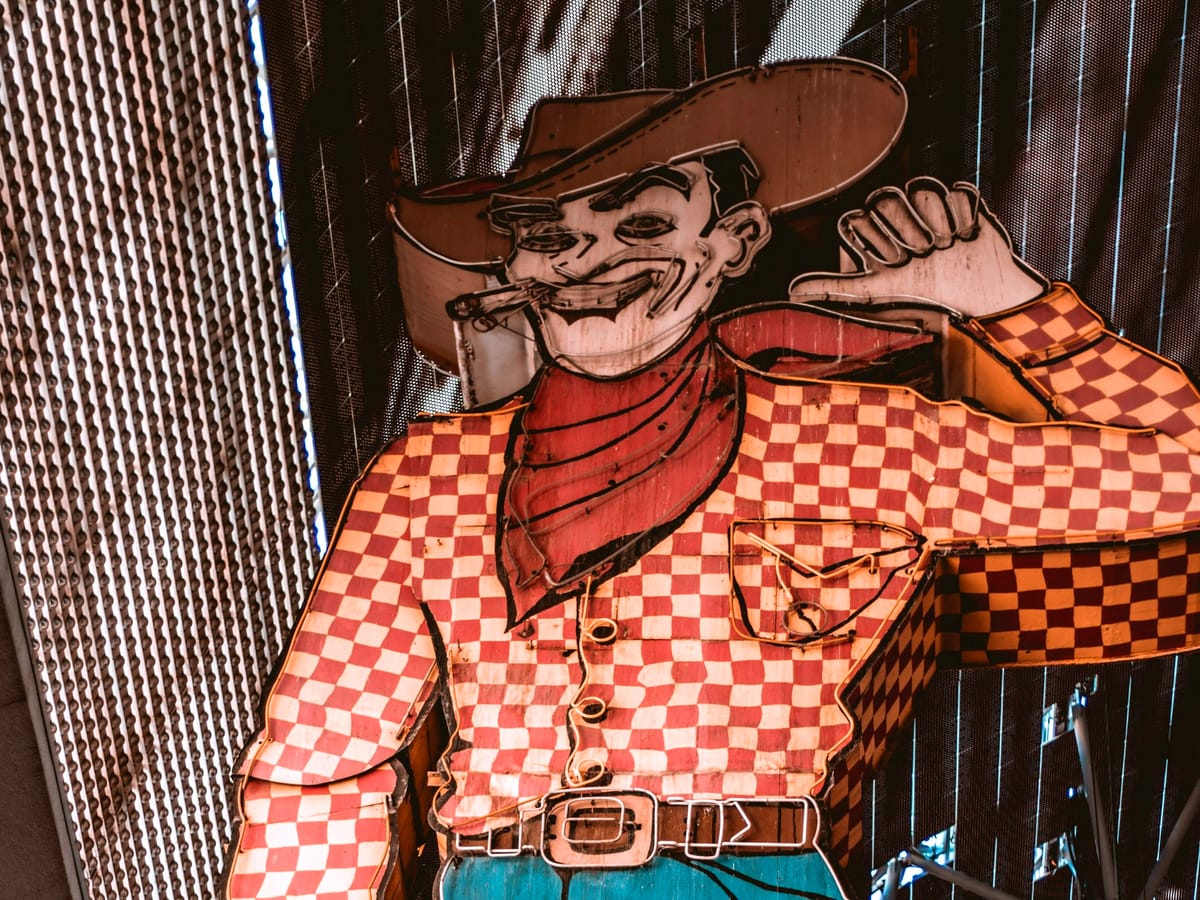
“Liar, lawyer, mirror, show me—what’s the difference? / Kangaroo done hung the guilty with the innocent...”
Greetings from Malmö, where the clocks have sprung forward, and the randy seagulls have stepped into the breach to serve as impromptu alarm clocks. Welcome back to WEEKNOTES at Worldbuilding Agency, where we’ll be looking at risky gambles on the climate crisis.
Put up your parasol, and we’ll stroll on out…
among the pixels
From my perspective at least, this first piece goes straight in the “know your opponent” folder: it makes no bones about its being a clear statement of the ecomodernist position, which takes the uncertainty of future outcomes as its foundation point.
In the conventional understanding, climate change is uncertain. We don’t know how much carbon the human race will ultimately pump into the atmosphere; we don’t know, precisely, how much warming any eventual atmospheric concentration will cause; we don’t know how much this warming will affect sea levels or weather patterns; and we don’t know how well future societies will adapt.
Alex Trembath here performs a neat bit of rhetorical judo by explicitly framing the “the climate movement” as “a teleological campaign against doubt”, and at the same time implicitly framing it as propelled by emotions rather than the cool scientific and economic rationalism of the ecomoderns.
Now, that implicit framing isn’t exactly wrong—if anything, it’s actually truer than the explicit frame. But it’s very much of a part with the broader paradigm of liberal rationalism, in which the line of capital-P Progress bends perpetually toward blah blah blah yadda yadda... or at least it would, if we’d only let “the market” work its magic without interference.
It’s an old routine, in other words, and one that can be traced back at least as far as the Brundtland Report, if not earlier still in somewhat less codified forms. I’ve seen versions of it many times before—and I expect you have too, if you’ve spent even a little time engaged in climate discourses over the last couple of decades.
(Consider this a strong recommend for Lisa Garforth’s Green Utopias, if this is a topical space of interest; you might also be interested in an essay-length review of it that I had published at Vector a few years back, which goes into more detail on a lot of the issues I’m talking about here.)
What’s interesting, then, is how that cool rationality suddenly sounds mismatched to the times, in a way it didn’t during the Noughties and early Teens. For better and for worse, the discursive tenor outside of Davos and the lobbyist sector has shifted in favour of emotion and irrationality, on both sides of the climate debate—meaning that claims like this land rather differently against a backdrop which is less “managed market-driven transition” and more “drill, baby, drill”:
These uncertainties are all the scientific justification we should need to to reduce emissions, invest in more resilient infrastructure, and protect natural systems. We don’t know exactly how dangerous three or four degrees of global warming will be by the end of the century, but we don’t need to know in order to act. There’s a reason that William Nordhaus, who won the Nobel Prize for his work on climate economics, titled his book The Climate Casino: the risk is enough for us to hedge our bets.
In one sense, Trembath isn’t wrong: the uncertainties should be enough justification for us to reduce emissions and so forth. This, after all, is what foresight is supposed to be all about.
But as pretty much anyone involved in foresight work will know, people do not respond rationally to uncertainties, even when they’re given a lot of help to do so; indeed, they don’t even respond rationally to uncertainty in the abstract. The unavoidable fact is that the uncertainties have not produced the results that Trembath suggests they should—and pretending that those uncertainties are essentially binaries (“an increase of 1.5°C would produce catastrophic effects” or“an increase of 1.5°C would probably be fine, actually, and maybe even advantageous”) is as much a misrepresentation of “the science” as any rhetorical moves made by the other side, if not much more so.
This is rationalism’s enduring strategy: its opponents are always positioned as being engaged in rhetorical sophistry driven by emotion, while it is simply responding to the empirical facts with logical reasoning. But to respond to empirical facts with logical reasoning is itself a rhetorical position—and is no longer the mainstream position it once was.
(There’s also a lot to be said about the role of empiricism as the arbiter of a supposedly incontestable truth, but we’ll save that for another day. In short, read some Bruno Latour.)
Trembath’s piece feels particularly poorly timed and worded in light of Jamie Pietruska’s essay on the surging popularity of prediction markets such as Kalshi and Polymarket. Trembath’s line quoted above about responding to risk by “hedging our bets”—which, whether deliberately or not, is much less metaphorical than it may look—hits a little different when we spend a bit of time thinking about the nature of climate outcomes.
Kalshi’s website claims that the yes/no proposition ‘democratises trading’. Everyone has an opinion or can flip a coin, after all. Lopes Lara explained that ‘event contracts [are] meant to be simple and they’re powerful because they are simple … And I think the yes/no question is really the natural form of these contracts.’ But binary event contracts are the wrong way to think about catastrophe. Event contracts reduce disasters to discrete events, but, as scholars have emphasised in Rethinking American Disasters (2023), disasters are not isolated events and must be understood as the result of long historical processes. Event contracts also erase the broader context of ‘cascading’ or interconnected disasters. And the scale and complexity of some disasters defy the very category of event itself.
Contra Trembath, few if any advocates of serious decarbonisation talk in terms of certainty around any particular outcome, but rather around the increasingly strong probability of a range of outcomes which all nonetheless fall in the “bad news for a whole lot of people” zone. Can we be certain that an increase of 2°C or more would produce cascading catastrophes of a particular magnitude? We cannot—but the evidence, whether emerging from simulations or simply cropping up in headlines with increasing frequency every year, seems strongly to suggest it might. “Hedging our bets” sounds like a cool and rational response to that uncertainty, but perhaps much more so to people who are not faced with the most immediate and most likely impacts of inaction.
More to the point, the moral hazards and perverse incentives of prediction markets cast what should be seen as a deeply unflattering light on Trembath’s gambling metaphor, while also fingering the unspoken third pillar of ecomodernism: alongside rational empiricism and faith in the invisible hand of “the market” stands the individualised human subject, onto whom all responsibility and agency is to be loaded.
The biggest loss in online catastrophe markets comes from individualising risk. Catastrophe by definition affects a large group of people. [...] Dashboards indicate one’s own financial risk by displaying the number and value of yes/no shares relative to the crowd in a given catastrophe market, creating the fiction of individual control over complexity and uncertainty. A bettor’s risk is likely far removed from the physical hazard itself and the broader community experiencing it. Catastrophe markets produce individualised financial risk based on collective suffering. At the same time, the dashboard reduces collective human suffering to an event market condition, erasing the identities and experiences of human beings through the datafication of disaster. Individual lives are lost in the disaster and in the data.
None of which, to be clear, is to suggest that we should place no value on data, or indeed on rational approaches to social problems. The point is rather that when we fetishise the rational to the point of pretending that we (and the world in which we live) are no more complex than game-theoretical vignettes, and reduce history to a succession of events produced entirely by conscious decisions made by individuals attempting to achieve optimal self-actualisation, we engage in a sort of certainty far more blinkered—and far more hazardous—than that of climate activists.
Or, more succinctly: I would rather give my attention to someone arguing for a long-term strategy on the basis of their own emotional stake in the future thus produced, than to someone with a bookmaker’s chit in his back pocket. I consider the latter’s motivations to be far more distorted and irrational than the former’s.
Another classic ecomodernist move—one that has metastasised into many other domains—is the accusation of Luddism or technophobia. So I’ll leave you with this brief bit by Thomas Dekeyser on the origins of the latter insult, and the underlying psychology of that stigmatising move:
Techno-negativity becomes a question of a psychological disposition, emerging from within a psyche lacking the capacity for reason. It becomes a case of personal lack, not collective and careful deliberation on the joys and horrors of technological life. In labeling technological critique a case of phobia, critics have effectively rendered its claims and positions unreasonable, and thus, unworthy of rational consideration.
Well, whaddayaknow—it’s all about framing opponents of technology as irrational! But as Dekeyser shows, the techno-rationalist position is perhaps more rooted in a fear of the non-human and the unmanageable than it is willing or indeed able to admit…
between the pages
I don’t know if this has been a slow reading week, exactly, but when you’re scaling the heights of Mann’s The Magic Mountain, there’s apparently a long phase in which the experience of time as mediated by that novel starts to stretch and slip, and all you can say with confidence is that you are simply somewhere in the middle of it.
This is not mere literary witticism on my part, to be clear: the compression and expansion of temporal experience is a dominant theme in the novel—or at least it’s the one that is impressing itself most strongly upon me. (No surprise, perhaps, given my line of work!) But there’s a lot more in there, too—some of which seems very tied to its time of publication, and to the long tradition of the bildungsroman in German literature, but some of which makes it feel almost alarmingly contemporary.
Luckily for me, a German friend who is also an enthusiast for this book has expressed an interest in chewing it over once I’ve finally crested the peak. Perhaps he might be persuaded to discuss it on the record—in which case I’ll be sure to share the results here.
lookback
This week has felt a little breakneck in pace, mostly because the condensed schedule of MUNICIPAL meant we all had to hit the ground running, and yours truly had to make sure he didn’t trip up and fall flat on his face. To overextend the metaphor, this involved clenched teeth and no small amount of windmilling the arms—but it seems like we’re in a good place now, with the interim deadlines of the weeks ahead looking far more manageable than they might have been.
On the subject of clenched teeth, I had a crown fitted at the dentist on Wednesday. After three weeks of having only the metal peg waiting for its porcelain adornment, it felt deeply weird to suddenly have a whole tooth back in that position, as if it were twice the size of the others. I’m pleased to report that this distortion of the sensory homunculus has mostly reverted to normal—but not as pleased as I am to be able to chew with both sides of my face for the first time in over three months.
The week’s other big highlight was delivery day for PROJECT PROSCENIUM, which can now be revealed as my role in co-worldbuilding and roleplay-facilitating an immersive foresight workshop at Media Evolution with Scott Smith and Susan Cox-Smith of Changeist. Scott and Susan have been dear friends for years, and it was super fun to finally get to collaborate on a project with them. The method and materials were particularly unique, and I’m hoping to pin them down for a debrief call in which we can unpack it a bit for public consumption. Watch this space!
ticked off
- Fourteen hours on PROJECT MUNICIPAL. (See what I mean?)
- Ten hours on PROJECT PROSCENIUM. (Six in the room on the day, for in the files ahead of the gig.)
- Five hours of admyn (the majority of which was to do with my still-ongoing application for Swedish citizenship).
- Four hours of art practice.
- Three hours on an essay in progress, and three hours on these here weeknotes.
- Two hours of networking.
- Plus ten hours of undirected writing and reading, som vanligt.
Well, no rest for the wicked; I may be out of the weeds on MUNICIPAL, but there’s still plenty to do. However, I think I’ve earned myself a bit more time at the printmaking table! I hope all is well with you, wherever you may be, and that you’re doing something that brings you pleasure—uh, other than reading these weeknotes, of course.
This has been the Worldbuilding Agency weeknotes for Week 13 of 2026. Thanks for reading! If you've enjoyed them, it's free to subscribe. If you are already subscribed, please send to a friend!

Comments ()