

week 10 / 2026: futures and histories
Reading round-up: defining “interiority” in fiction, and how it works; science fiction (and fantasy) as essentially historical in character; declining “declinism” in the struggle for a new media literacy. Plus a 1993 novel that feels like it was plucked from the fevered nightmares of Elon Musk.

“He promises deliverance / day after day / releasing only pestilence / and festering decay...”
 bjacquet
Greetings from Malmö, where the return of the birds has both its pros and its cons: little borbs are bopping about, babbling happily; the seagulls are practicing their shrieks ahead of mating season. Welcome back to WEEKNOTES at Worldbuilding Agency!
OK, let’s spread our wings and fly into the blue, eh?
among the pixels
I have been saying for a long time that written fiction has an affordance for foresight work that no other media can hope to match: interiority.
But what exactly is interiority? As simply as possible, it’s the capacity to give the reader a sense of what it’s like to think and feel from the perspective of the character(s) in the story—call it the “someone else’s shoes” factor, if you like.
Here’s how the novelist and essayist Lincoln Michel puts it in a recent post on the topic:
In fiction, interiority is relating the internal world of a character to the reader. Their thoughts, feelings, hopes, fears, anxieties, memories, motivations, and so on. This is a simple yet consequential thing. Every one of us lives simultaneously in the external shared world and our own private worlds. These two realities are constantly colliding, separating, and distorting each other, whether that’s something as small as snapping at a friend because you are “hangry” or having a life-altering epiphany at the image of, I dunno, a dove flying over a lake that symbolically completes your character arc because you are a protagonist in a literary fiction short story published in a university literary magazine.
I kid, a bit.
If you’re following along here because you’re interested in understanding how the tools and techniques of writing actually get applied, then I strongly advise subbing to Michel’s newsletter; he’s not talking to foresight applications as I do, but his advice and explanations are both useful and accessible.
(The piece quoted above is something from a follow-on from a previous piece in which he discusses the shortcomings of fiction written by people who watch TV more than they read books; interiority is the essence of the problem, because TV and cinema are fundamentally different media. I’ll be discussing this difference in my Rogue Union talk!)
Talking of unique affordances, here’s a piece by science fiction author and renowned Renaissance historian Ada Palmer, in which she argues that all writers of sf/f are historians.
(Well, what she actually argues is that the writing of certain forms of sf/f involves holding and applying a similar theory of change to that held by historians—but hey, I know what it is to have to pitch a piece that people might actually click through to.)
In SFF, the world usually changes. It may be saved, destroyed, discovered, overrun by zombies, driven mad by faeries, terraformed, irradiated, touched by strangers, or saved from tyrants, but it changes. Often, the story focuses on characters who shape or initiate the change for good and/or ill: plucky rebels, unlikely saviors, shadowy conspirators, ruthless dictators, the king seeking to rule wisely, the king in exile seeking to return, the faithful followers of the king in exile who make it happen. Live on the page, characters win battles, achieve regime changes, create disruptive technologies, release then battle pathogens, found world-shaping institutions, make passionate arguments in the room where it happens, or are placed by fate in the right place at the right time. If it’s a cozy fantasy, they may even popularize a new kind of bread.
All such stories advance claims about who and what has the power to change the world.
The sort of history-adjacent work that Palmer describes here is, I would argue, a thing that mostly plays out at the scale of the novel, rather than the short story (though a suite of stories set in the same world can achieve a cumulative effect); as such, you can’t really hope to pull it off in fictions written for foresight purposes.
But I think Palmer’s case transposes quite easily into an argument for the importance of history, and of a historical sensibility, in the practice of foresight more generally. Particularly when it comes to foresight with a focus on “tech”, the sector tends to be pretty myopic (or perhaps just highly selective in what it chooses to see) when it comes to looking in the other direction—a case made very clearly by David Edgerton (a historian, natch) in his book The Shock of the Old, which I will keep recommending until the unlikely day that every practicing futurist can quote it chapter and verse.
The weakness of prevailing theories of change is not limited to those concerned with “tech”, of course—or, perhaps more accurately, prevailing theories of change are weak precisely because of the tendency to assume that “tech” is the driving force of change. Of course, the things we use have an important role to play in the things we do. But as Palmer explains with typical elegance, the ultimate power to change our world lies with people; our devices and infrastructures may extend our capacity to act (and to be acted upon), but in our absence, it would all just be inert matter.
Staying with the subject of the question of agency in complex sociotechnical systems, this week’s third clipping comes from Carlo Iacono, a university librarian. Iacono argues against what he calls the “declinist” take on literacy, wherein an excess of engagement with screen-based devices is eroding the capacity to concentrate on long-form text:
The declinist position rests on a category error: treating ‘screen culture’ as a unified phenomenon with inherent cognitive properties. As if the same device that delivers algorithmically curated rage-bait and also the complete works of Shakespeare is itself the problem rather than how we decide to use it.
Consider a simple observation. The same person who cannot get through a novel can watch a three-hour video essay on the decline of the Ottoman Empire. The same teenager who supposedly lacks attention span can maintain game focus for hours while parsing a complex narrative across multiple storylines, coordinating with teammates, adapting strategy in real time. That’s not inferior cognition. It’s different cognition. And the difference isn’t the screen. It’s the environment.
I actually found this essay a bit irritating, because it tries to have its cake and eat it, too. I have a lot of sympathy with what we might call the media-ecological argument, which is what Iacono is gesturing toward when he mentions “the environment” in the quote above; as he notes, the majority of media consumption happens at the interface end of algorithmically-managed platforms which have been “deliberately engineered to fragment attention in service of advertising revenue”. He also notes that moral panics around new forms of entertainment media are a long-standing phenomenon, and often reflected a concern among the ruling classes about the corrupting effects that might manifest in their inferiors.
That’s true enough—but given this is an essay which is at least in part about bias within and toward media, I feel it reasonable to raise a somewhat sceptical eyebrow at Iacono’s decision to cite the legendarily market-fetishistic Cato Institute, especially when his conclusion is that the design choices which create the afore-mentioned media environment “can be challenged, regulated, reversed”. And as we reach the end of the piece, it turns out that his disagreement is less with the observation of declining capacity to handle a saturated media environment than with a sort of moral fatalism that assumes that decline to be inevitable.
Long-term readers will know I’m a staunch opponent of technological determinism and its narratives of inevitability; in that sense, Iacono and I are very much on the same page, and I too am more interested in fighting the decline than eulogising a mythical golden age of literacy. Where we part ways is the point at which Iacono turns instead to eulogising a multimedia futurity in which different ideas move through multiple different media systems in away that supports and broadens comprehension and accommodates different cognition and learning styles.
As Gandhi supposedly said when asked what he thought of British civilisation: it sounds like a good idea! How exactly it is meant to be achieved, however—in the face of the unprecedented political and economic dominance of the companies who own and design and profit from the the media environment as currently conceived—is largely left unanswered.
It is exactly here, in the meso-scale messiness where media and politics and economics intersect, that imaginative yet critical foresight work is most urgently needed. Iacono’s utopian urge is very much to his credit—but until the realisation that things could be better is followed by a concrete exploration of how that betterment might be achieved, his technological optimism is less a counter to the declinist lament than its inverted mirror image.
between the pages
To talk of vintage science fiction novels as “prescient” is among the collection of cliches I’m doing my best to banish from my writing, but sometimes there’s just no other way of putting it.
To be clear, to claim a novel as prescient is not quite the same as claiming it to have “predicted the future”. Yes, there are a number of novels whose depicted futures seem, in hindsight, almost prophetic—but regard them as actual prophecy is akin to regarding a one-spin roulette winner as having predicted the number where the ball would come to rest.
(It also bears noting that the sf-as-prophecy model tends to conveniently overlook the possibility of feedback between the prediction and the present. This is why it’s much more useful to think of science fiction as a form of prototyping, even if that was not its author’s intention—or as prefiguration, if you prefer.)
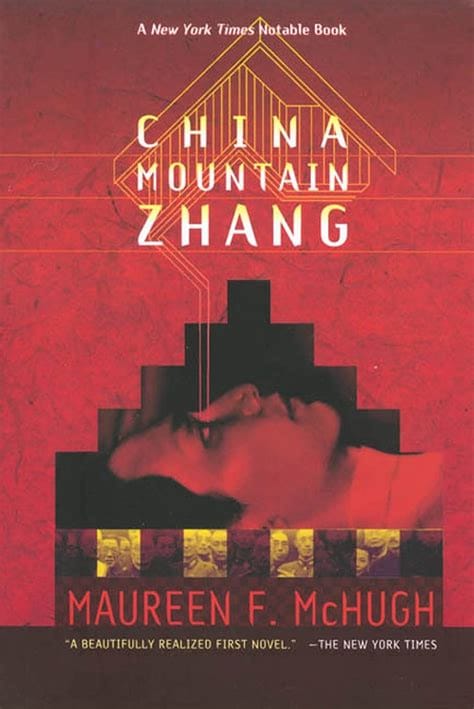
The sense in which Maureen F McHugh’s 1993 novel China Mountain Zhang is prescient is less in its details than in its overall weltschmertz—a property it shares with William Gibson’s earliest novels. For example, in both fictive futures, people “jack in” to hardware and networked systems as a matter of course, but in both Gibson’s Sprawl and McHugh’s C22nd, the cellphone (let alone the smartphone) is conspicuous by its absence, at least to a modern reader.
But there’s a lot less punk in McHugh’s cyber than in Gibson’s: characters control machines with their minds and work in virtual environments, but there is no glamour to it. Quite the opposite, in fact—she successfully portrays this wired world as being banal to its inhabitants, which is quite the achievement when you consider it was published during the second great surge of cybernetic utopianism in the early 1990s.
What makes it a fascinating read in 2026, however, is the big-picture worldbuilding. This is a world in which, after the Second Great Depression, the United States underwent a communist revolution, and is now a sort of boondocks client state to an economically and culturally dominant China; where climate change has hollowed out the USian midWest into an all-but-uninhabitable corridor of desiccation; where there are colonies on Mars, but they’re run as direct-democratic communes rather than freewheeling libertarian sand-steads. It is, in other words, a sort of prototype for the nightmare that haunts Silicon Valley and the US government in the present—albeit presented less as nightmare than as a plausibly flawed situation whose inhabitants are for the most part ambivalent to it.
For Zhang, the main focal character, the C22nd New York where he lives is far from utopian, but it’s not so dystopian that he doesn’t decide to return there after getting the life-changing chance to study advanced engineering in China. To readers in 1993, it may have seemed a possible future; to us in the present, it probably reads more as a paleofuture (because how could it not?) But to Zhang, it’s just his present—and that’s what makes it engaging and memorable.
Returning to a book like this and trying to see what McHugh “successfully predicted” is a pointless intellectual exercise. However, returning to a book like this to see what McHugh understood about the human experience is hugely valuable, particularly in times of flux. The novel’s emotional motif is that of characters realising that “wherever they go, damn, there they are”; for all that their world seems a complete upending of the world in which it was written, what matters to them are the same things that have always mattered to people—and will always matter.
lookback
As the ledger indicates, this week has been absolutely off the charts in terms of networking and kinmaking. That said, I don’t want to make it sound like that was too much of a chore: some of these encounters were more traditional business-y zoom calls, but the majority of the hour count actually represents long, rambling in-person conversations with friends and colleagues new and old. It’s quite synchronicitous, really, given the arrival—or at least the drawing-near—of spring: a coming out of hibernation, if you like. And it’s been very enjoyable… but damn, my introvert battery is in serious need of a recharge. (Which is why I spent a big chunk of Saturday squirrelled away in my studio making things, and why I’ll be doing much the same this afternoon once these weeknotes are finished!)
New projects are starting, and others are going up on the slate for the weeks and months ahead, which also feels good. What feels less good is looking back on the tallies of admyn hours accrued over the last couple of months, and seeing how little was achieved with them other than keeping the boat afloat, so to speak; to put it another way, I have spent a lot of time making plans, but very little putting them into effect. I’m hoping that some of the insights picked up at a self-leadership course earlier this week may go some way to addressing that shortcoming, but while it was very helpful, it was also a reminder that, deep down, I know what the problem is.
To paraphrase Le Guin’s translation of Lao Tzu: one should do big things while they’re still small. Planning is a fine thing, but it can easily become the ultimate displacement activity.
ticked off
- Fifteen hours of networking and kinmaking. (I know, I know!)
- Seven hours of admyn.
- Four hours of art practice.
- Three hours of training (see above).
- Three hours on these here weeknotes.
- Two hours on PROJECT CHAPERONE.
- Two hours of blogging.
- One hour on PROJECT MUNICIPAL. (Kick-off meeting, innit.)
- One hour on PROJECT PROSCENIUM. (Ditto, sort of.)
- Plus ten hours of undirected writing and reading, as always, because that’s how we do things downtown.
OK—I have a date with a gel plate, a pile of paper, and a rainbow of newly-acquired acrylic colours; I’m outta here. I hope all is well with you, wherever you may be.
This has been the Worldbuilding Agency weeknotes for Week 10 of 2026. Thanks for reading! If you've enjoyed them, it's free to subscribe. If you are already subscribed, please send to a friend!



Comments ()