

chocolate-covered mushrooms: an interview with Joost Vervoort
Games are the leading edge of worldbuilding practice, where we find the most interesting applications—bringing challenging futures to life with a sense of agency. I spoke to Joost Vervoort about climate-activism sim All Will Rise, and the overlooked importance of gaming in contemporary culture.
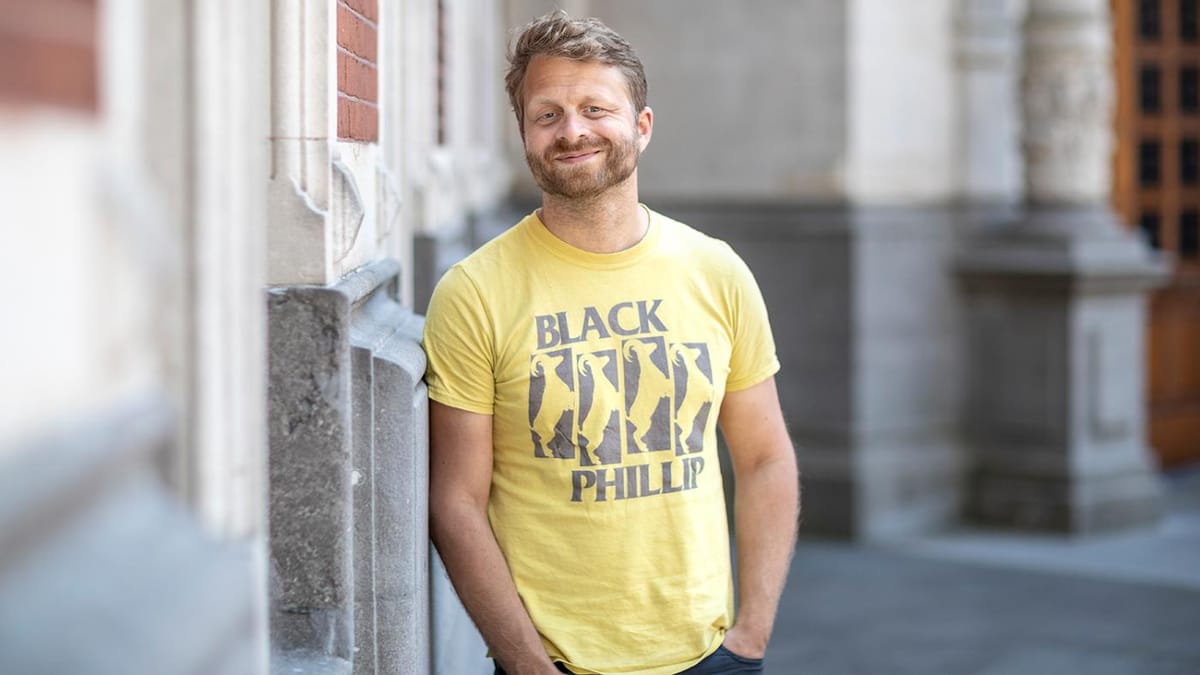
I’ve been trying for ages to have a proper chat with Joost Vervoort, but it’s been something of a challenge, given I’m competing for his attention with not only the demands of a deservedly successful academic career, nor merely his work on climate-focussed computer games, but also his role as frontperson of the black metal band Terzij de Horde.
But when the game for which he’s the “director of scientific impact”, All Will Rise, hit its funding target on Kickstarter, I grabbed my chance and pinned him down for a quick lunchtime interview. We discussed the new game, and the earlier games from which it draws inspiration; the productive tension between game mechanics, narrative and worldbuilding; the place of climate futures and politics in games and gaming culture... and why he’d rather feed you magic mushrooms than broccoli.
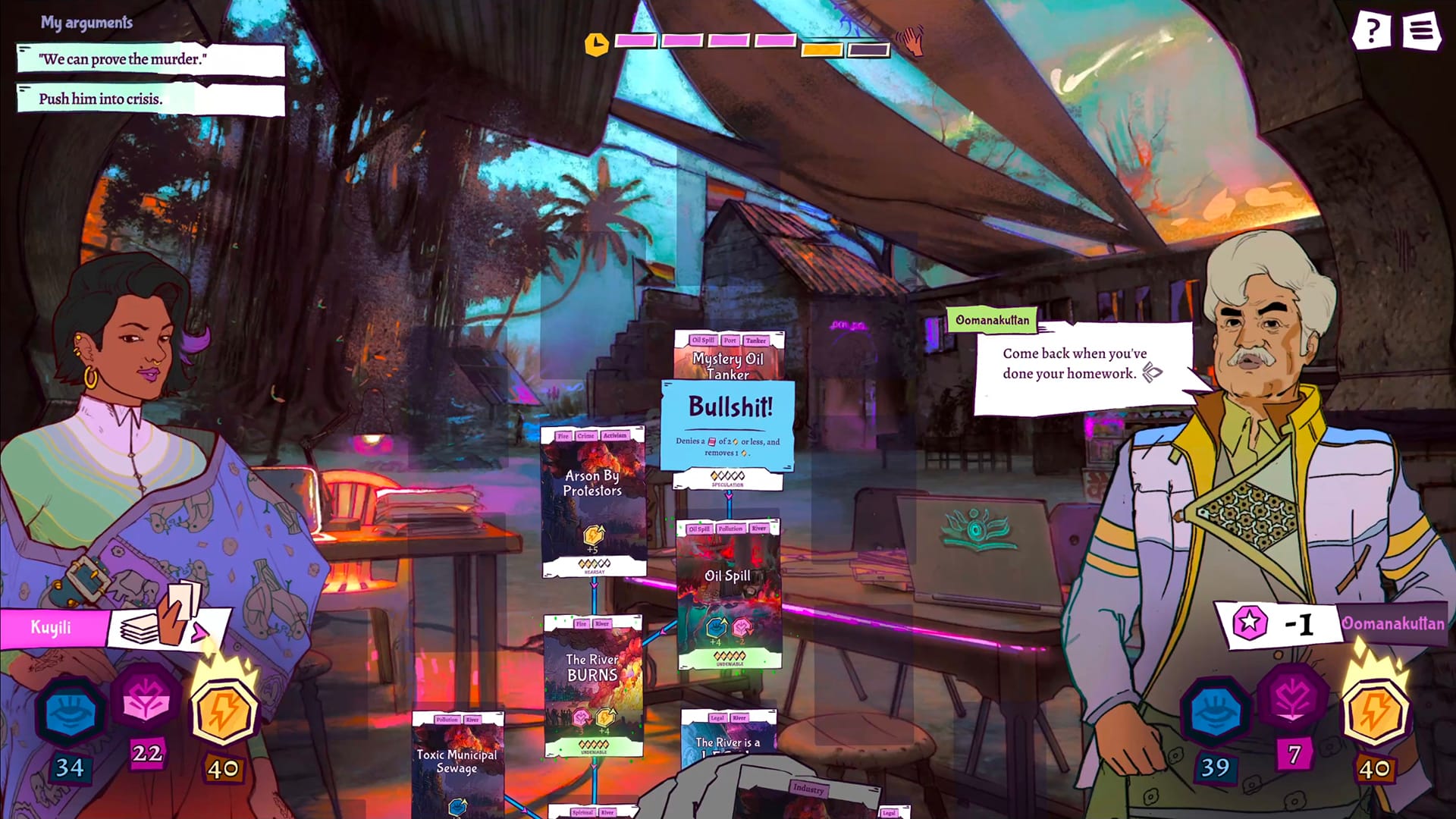
JV: All Will Rise is a role playing game set in Kerala, India, or in a speculative version of that state. It’s about taking a billionaire to court for destroying a river. The river is on fire at the beginning of the game.
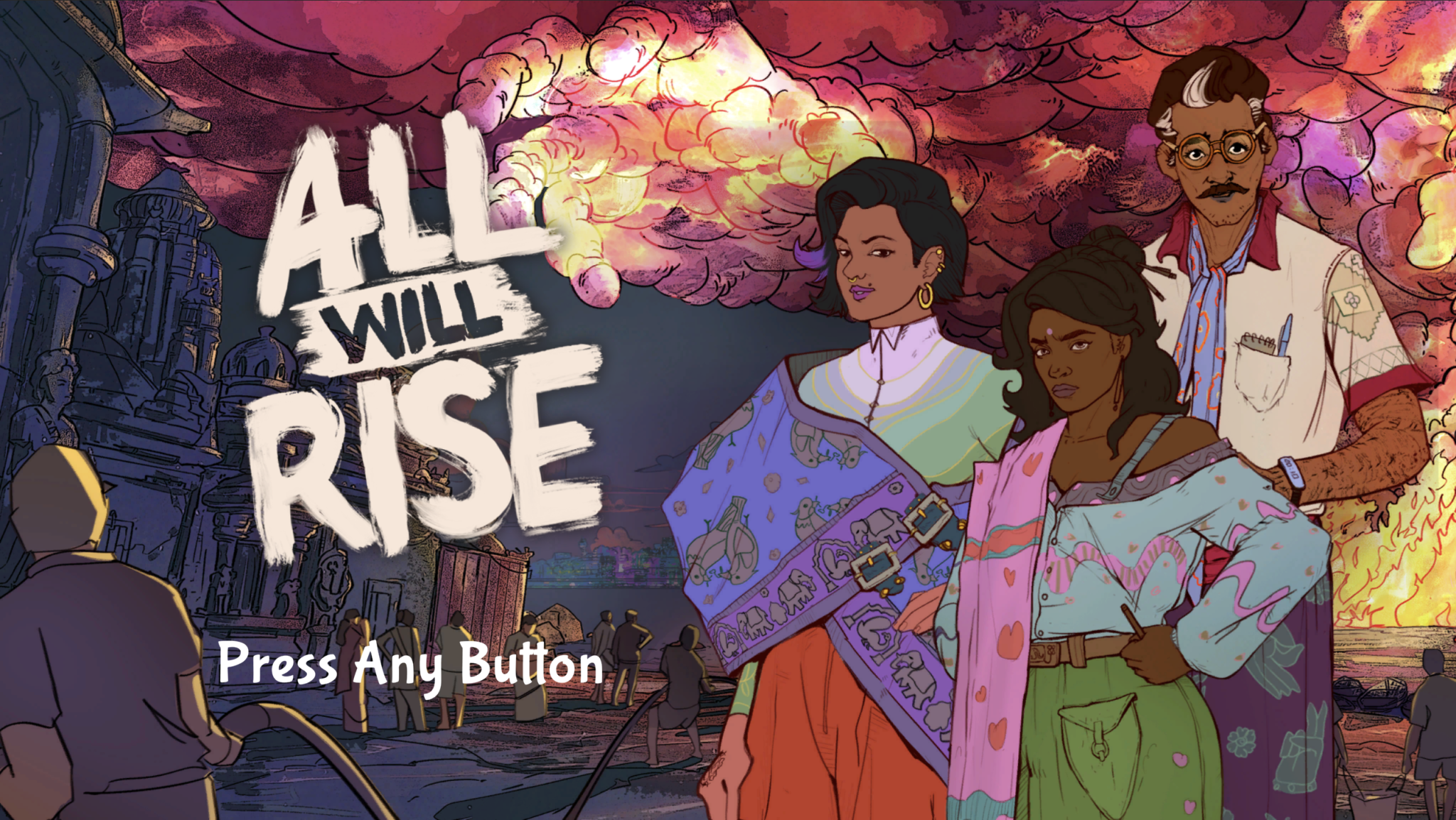
It’s basically like a small social movement simulator in a way. You run a small group of people: investigators, a lawyer, their support. They have just won a case, or they’re just winning a case at the beginning of the game where you grant legal personhood to the river that’s flowing to the city of Muziris, where the game is set.
And that’s all well and good, but four months later the river is on fire. So you are going to be using the legal person rights of the river as a basis to start a case to take the murderers of the river to court.
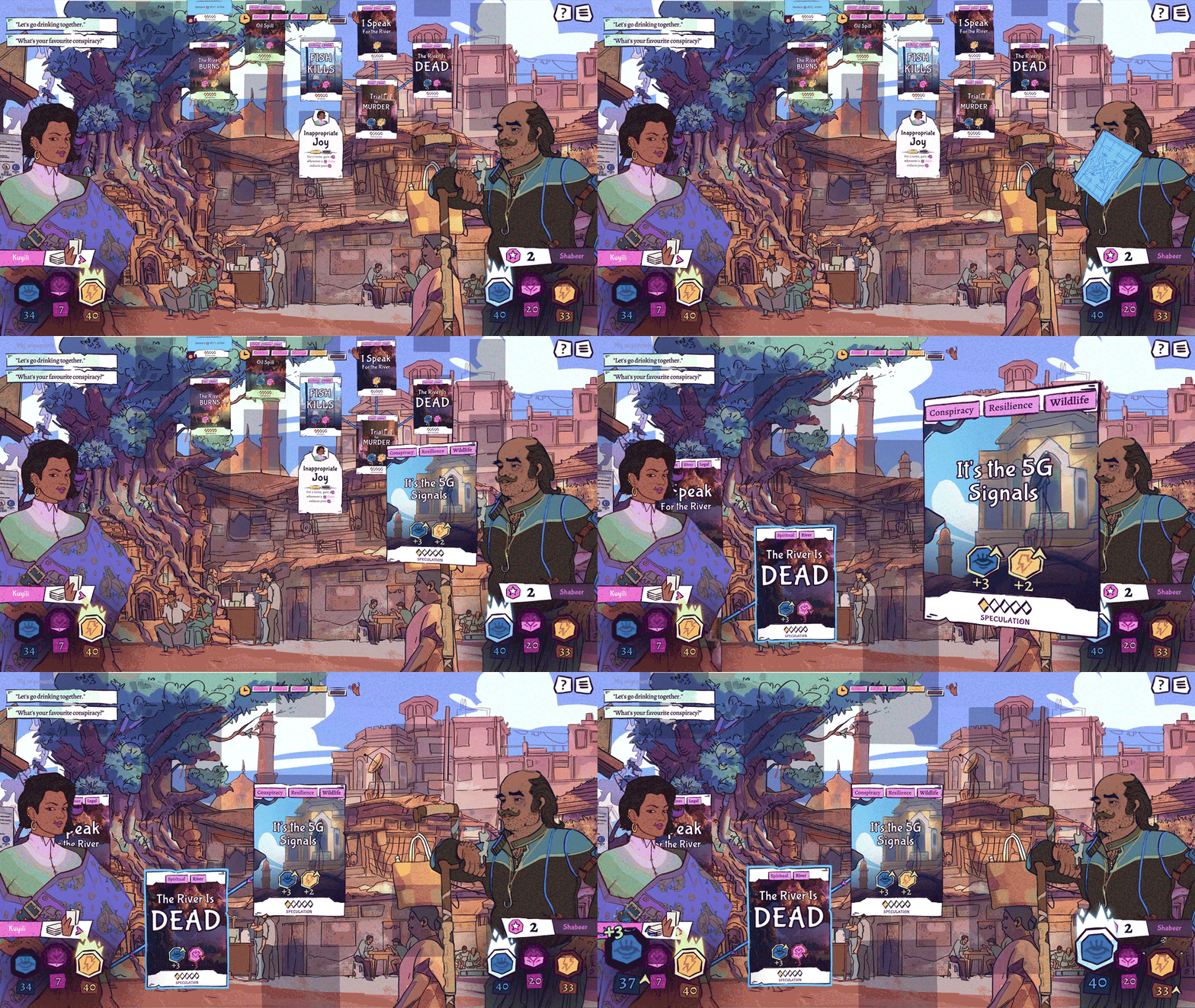
That’s the premise. It’s a role playing game with team-building mechanics and deck-builder mechanics—so you’re getting digital cards in the game that you collect from doing missions and sending your team out on quests, and you use them as arguments in conversations. So when you talk to someone important who might be antagonistic to you or somehow difficult to talk to, you get to play these cards that are either evidence cards or they’re emotional strategies. Your opponent also plays these cards, so you have this sort of conversational card battle that then yields more cards, more insights and so on. And you build all that up to the court case.
PGR: Okay. You say opponent—are you playing against the game or do you play against another player?
JV: It’s a single player game. So you’re playing against or with various characters.
A nice way to put it came from a game designer and activist called Aric McBay who played the game, he said it’s like you’re doing something between a duel and a duet. So, sometimes the conversation is antagonistic; sometimes it’s more co-constructive; the modes can switch depending on the person, and depending on how the conversation goes.
PGR: So what was the inspiration? I suppose there’s two sides to that question, the first of which is: what’s the real world situation that inspires it?
But also, secondly, you’ve been working with games for a long time. This project is clearly influenced by certain experiences in that regard. We’re already talking about the technical stuff, so: what inspired the mechanics? What sort of games might be touchstones here?
JV: In terms of the mechanics, first of all, what we wanted to do with this game is make something that hits all the things that people love about great role playing games. Because there’s a lot of games about environmental issues and so on that are quite boring, that are very managerial and sort of limited in that sense.
We wanted to make something that’s engaging, that’s human, that’s emotional, that’s magical and mystical, and so on. So we looked at games that do that.
Disco Elysium is a famous role playing game that creates a beautiful world, very deep writing, and it’s amazing. The format is very different [to All Will Rise]: you’re a little guy walking around the world, like you would in Baldur’s Gate or something like that. But the writing and the characters are... I mean, we’re in a different setting, the tone is different, but the sort of depth and the originality of that [game] is what we’re trying to hit.
And luckily, now that the demo is out, players are telling us, unprompted, that that’s the game they think of—which is great. But it’s not really an influence in terms of mechanics; more like role building and characters.
In terms of mechanics, it’s a little harder to say. There aren’t that many games that do really this integration of dialogue and cards. It’s like a discourse simulator, you know, in that sense. That’s quite rare. There is a game called Signs of the Sojourner that has conversational card battles, but it’s more like you have a conversation and the card play happens alongside it. In our case, it’s really integrated. So you play a card and the card leads to a comment about that card, and it leads to an effect, a mechanical effect, like someone’s emotions are riled up that have to do with the card. So the integration between story and game system is a lot stronger—and in that sense, not really reflective of anything that’s out there, I would say.
PGR: I’ve played Disco Elysium; it’s really interesting how that game dropped a rock in the pond of games design. Everyone is referencing it in one way or another, which I think is a really important thing; it’s really changed how roleplaying works.
But in terms of the story you’re dealing with, there’s clearly some history there. Can you unpack that quickly?
JV: In terms of writing, all our writing efforts are helmed by Meghna Jayanth, who is a writer from India but lives in London most of the year. She has a really storied and impressive background in game writing. She wrote a game called 80 Days, that’s sort of like a playfully decolonial take on Jules Verne; very cool game, very popular. Lots of people have played that. And she worked on Sable, which is sort of like a strange sci-fi game.
Her last game is called Thirsty Suitors, which is about a South Asian woman in the US, dealing in a very humorous way with the pressures of romance and relationships, and having to sort of emotionally battle all her exes in a sort of Scott Pilgrim Vs. the World kind of way.
Meghna is also a big voice among anti-racist, anti-capitalist, decolonial perspectives in the games industry, and that’s how I know her. That’s how we got in touch. She has her own very specific, humorous, playful, subversive writing and world building.
But the Disco Elysium reference, it’s only one of many ideas. Other games are in the lineage, like Citizen Sleeper as well. The tone also connects to Ace Attorney, which is the original inspiration for a game—that’s [where] the court battles [come from]. Very different mechanics than ours, it’s a lot more light and funny and absurd.
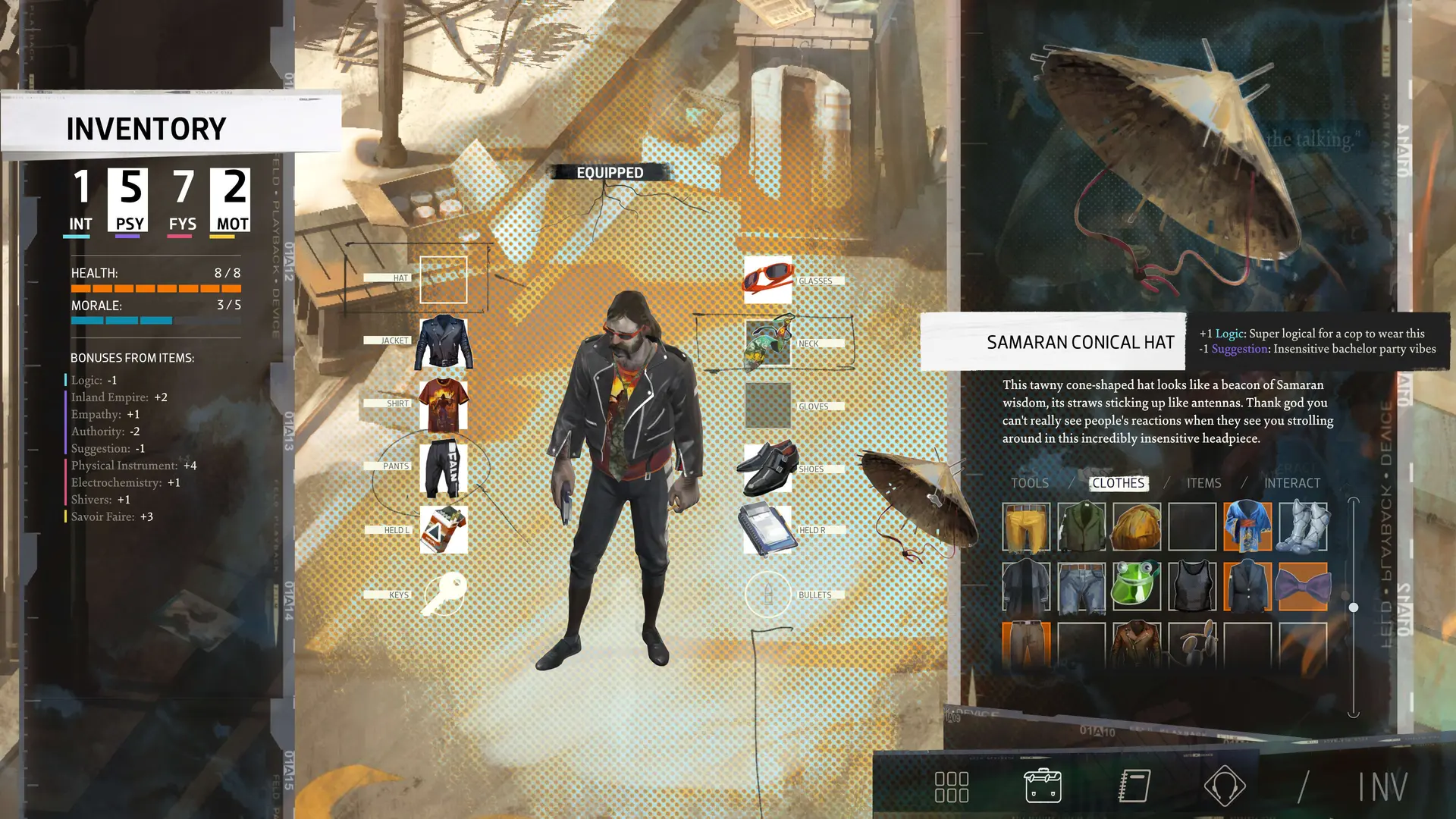
But I think the stone in the pond that Disco Elysium dropped is really about texture and structure. It’s like really structured worldbuilding, almost like sociologically informed ideas about how do people develop ideologies. We had a professor, Max Haiven, visit us last week, and he said the thing that he found so impressive about Disco Elysium is that you see people develop an ideology by their actions and their everyday doings. They say a few things, they take a few actions, and then later they justify them by suddenly recognizing that they’re part of an ideology, which is really interesting. So if you do a bunch of racist stuff, at some point the game asks you, “right, do you want to take this further? Do you want to learn more about being a racist?” And it’s really interesting. The multi-leveled-ness of how the personal, the intrapersonal, the psychological ecology in a person, the relational and the systemic and societal are constantly interacting... it’s really powerful in Disco Elysium, and that’s definitely an inspiration for us as well.
PGR: OK, neat. So, you’ve kind of touched on this briefly already, but I want to loop back to it. I think we first met at the Oxford Futures Forum in like 2014, I think, and you’ve been on the Serious Games beat, as we were still calling it then—or at least some people were calling it—for at least that long. So that’s twelve years now, and in that time, a lot has changed in the world of games, but also the world in which we’re trying to do things with games that isn’t just entertainment. How have attitudes changed to the use of games to these sorts of ends in that last decade or so?
JV: I feel like the big thing that I think has changed is the social media around games: the Twitch streaming and YouTube video essays and the Discords and everything else has had a massive impact, right? I mean, I think if we think about 2014, that was the year that Gamergate started—a sort of massive organizing of misogynist and far-right people not in the games industry, but among players, and against progressive forces in the games industry. And so, in a way, the culture war started in 2014, and hasn’t stopped since. We are still talking about certain games becoming targets of the culture war and so on.
So I think that there has been a much better understanding, at least among game scholars and media scholars and cultural scholars and people in the industry itself, that games are a cultural force that can easily be hijacked for very malicious ends. But I inhabit the space of sustainable futures, and I think in that space there’s a real lack of understanding.
People don’t understand that the games are the biggest medium, at least when you compare it to film and music; they are a gigantic cultural force.
I feel like there’s sort of like a weird split in society over games, more than with film or music. Everyone listens to music; everyone watches movies. But games—it’s like people will very easily say “I’m not a gamer”, you know? And sometimes they’re deceiving themselves because they play The Sims all day or they play mobile games all day or something like that. But then there’s also this identity politics thing where people say “I am a gamer”, gamer culture, blah, blah, blah… that’s old hat by now, a little, but that sense of people feeling like they’re part of a culture and a movement, which then feeds into right-wing politics; you still see it. There is this guy, Asmongold, the biggest streamer online at the moment, and he plays games, but he talks about right-wing politics a lot. It’s very entangled, and I think that’s the biggest change.
But again, I think that the people who work on so-called serious games, who are building little academic games that you use for helping people optimize their crop production or something, don’t understand this world at all.
PGR: My friend Jay Springett talks about this all the time: the invisibility of that wider landscape of games to people who either are not or do not believe themselves to be involved with is massive. As a cultural space, it’s just uncharted territory for so many people.
So, as you know, I’m a writer by background. I wouldn’t identify as a gamer, but I’ve definitely played games! I was playing games back in the 80s, obviously of a much more basic sort. But so from a creator and practitioner point of view—as a writer of normal fiction, if that’s a useful term—what really interests me is the tension between the narrative and the ludic.
How does that tension inform a game like the one you’re working on? You’re not doing serious games exactly, but there’s definitely a didactic and inspirational aim behind All Will Rise. What trade-offs do you have to make between the narrative and the ludic to pull that off?
JV: It’s a good question. We try to keep narrative and ludic very close. My favorite games are games that have a strong procedural rhetoric, which is another one of these [academic] terms: they speak through their systems. So that’s why we have the card battles being arguments and so on.
I would say what we try to do with All Will Rise is not to have the typical serious games thing, which is make people aware of an issue or something like that. What we want to do is to give people a space to practice with social organizing.
What does it feel like, in a day-to-day setting, to organize, mobilize social movements, fight against huge sort of powers and so on?
And that can be fun! There’s a lawyer that I’ve talked to a bunch, a very friendly contact in India, who said that if you want to be a lawyer in India, you have to have great appetite for chaos. I think with All Will Rise, what we want people to get is an appetite for chaos, and to get excited about getting involved with the mess of society, you know? And we do that by making that messy, chaotic stuff the actual gameplay.
I guess when it comes to the stretch between… you know, the ludonarrative dissonance, as the term goes? I think we try to keep it as closely packed together as possible. I mean, I guess it’s possible to do stuff that goes entirely against your narrative sensibilities when you’re playing. But it’s not easy. We try to keep it densely, densely together, I would say.
PGR: Okay, cool. So, I’ve done a lot of work around sustainability and climate, and on other topics as well, you know—engaging people with future possibilities, whether positive or negative. But I came to it as a writer first, and this other thing later. As such, I’m imagining that you either have or will encounter some of the same criticisms of this work that I have experienced.
And they tend to fall into two categories, right? On the one hand, you’ll get people saying, well, you’re just trivializing the issues. You’ve made a game out of out of climate change, oh, well done! Very helpful.
On the other hand, you’ll get almost the opposite thing. They’ll just say, well, the issues just get in the way; if you want to make a piece of art, you know, keep your issues out of my entertainment.
JV: Which was the whole sort of line of argument of GamerGate: keep your politics out of my games.
PGR: Exactly. Which of those two critiques would you take harder, and why? Which would you find more hurtful?
JV: Oh, none of them. [laughs] I feel like that’s like the core discussion, you know. I don’t want to make light of stuff that really matters deeply to people! But I feel like we don’t do that. I work with this concept of deep seriousness and deep playfulness, and I think that that informs what we’re doing. I mean, in real life, activism and these sorts of politics can also be deeply hilarious; you see real life activist groups be very funny, you know, and use humour and playfulness.
And of course, the right has really done this well. Now the left is also learning, you know, using humour and irony and so on as a weapon.
On the on the topic getting in the way of fun: it can, of course, happen. But in our case, I feel like it’s a false contradiction because I think the topic—a burning river, the ecology of a city, the lawsuits and so on—is the source of the fun. That’s where that’s where the juicy power dynamics are, where all the difficulty and the darkness and the struggle is!
There’s this term that I’ve learned from my colleagues at the Utrecht University of the Arts where they teach game design, “chocolate covered broccoli”. It’s the assumption that when you make a serious game, you’re trying to turn something that’s not tasty, that people don’t like to eat—like kids don’t like to eat like broccoli—and you try to make it somehow more palatable by putting chocolate on it.
Which of course doesn’t necessarily taste very good! You know, you get neither: you don’t get the nutritious broccoli, but also you don’t get the nice chocolate. You get a crap thing that’s a hybrid of both. And I’ve been thinking like, there’s an assumption that I want to feed people vegetables, you know, something boring that they don’t want to eat. But I don’t!
The way that I’ve written about it before is actually I want to feed people magic mushrooms.
Like get them in a psychedelic space, essentially, where you examine your own identity and your relationships, your felt relationships to the world and so on. And there are plenty of people who are selling chocolate covered magic mushrooms... so it’s much more viable, I think.
PGR: [laughs] Might be tricky to bring up at your next kind of academic career review, if you phrase it that way!
JV: I was just in my academic career review just before I came here, actually. One of the good things about being at Utrecht University is they appreciate such aspects!
PGR: Yeah, I mean, your base of other activities probably prepares them for that, I suppose.
Just to wrap up, can you recommend maybe two or three other creative works that engage with climate issues and explain what you admire about them, why you think they’re important, why you recommend them?
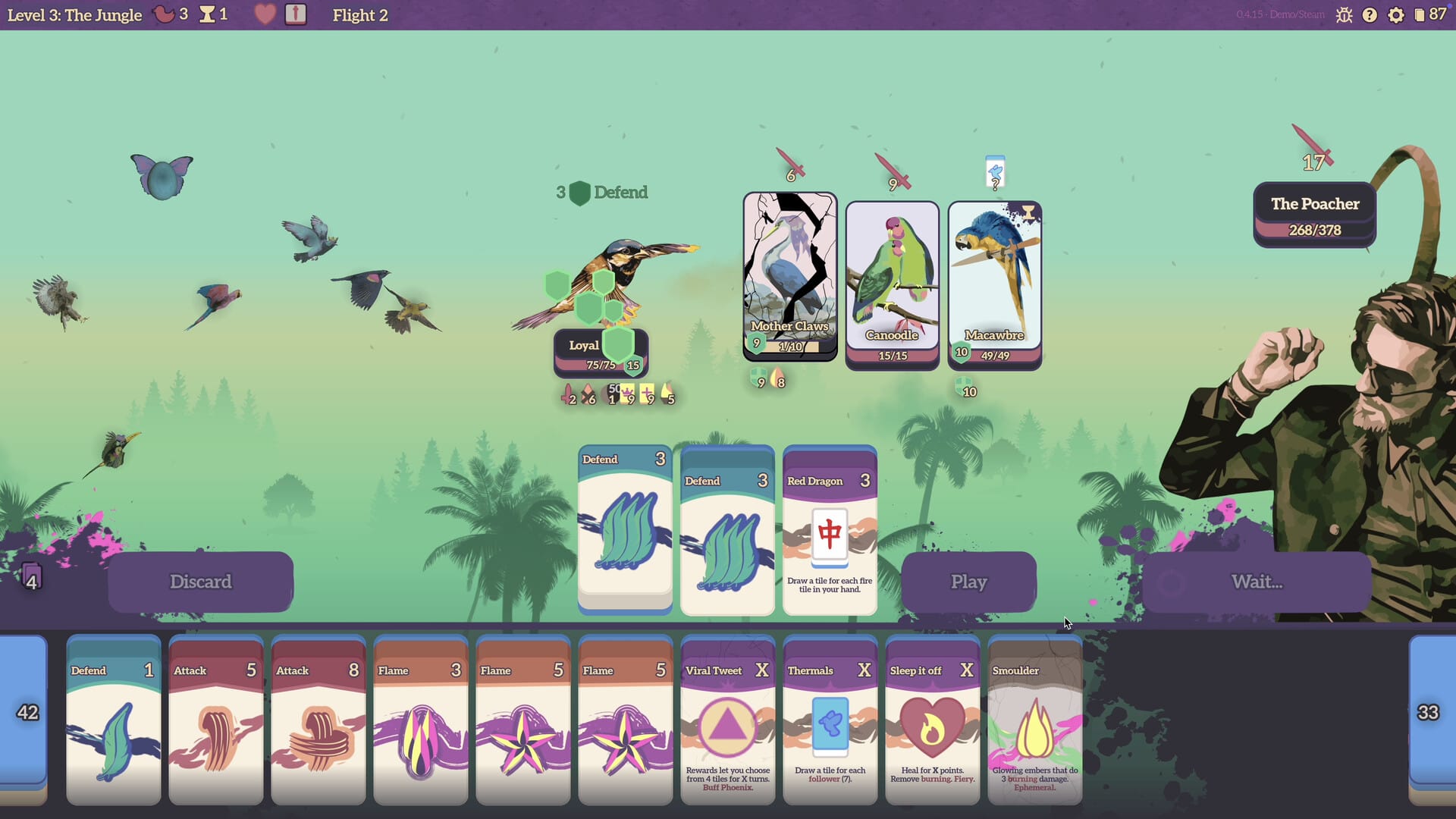
JV: Yeah, that’s a good question. There is a game I want to play today called Sparrow Warfare that is like birds fighting with cards, with deck-builder mechanics, but it’s sort of about class struggle. That’s made by some wonderful people in a company called Neon Aurelius.
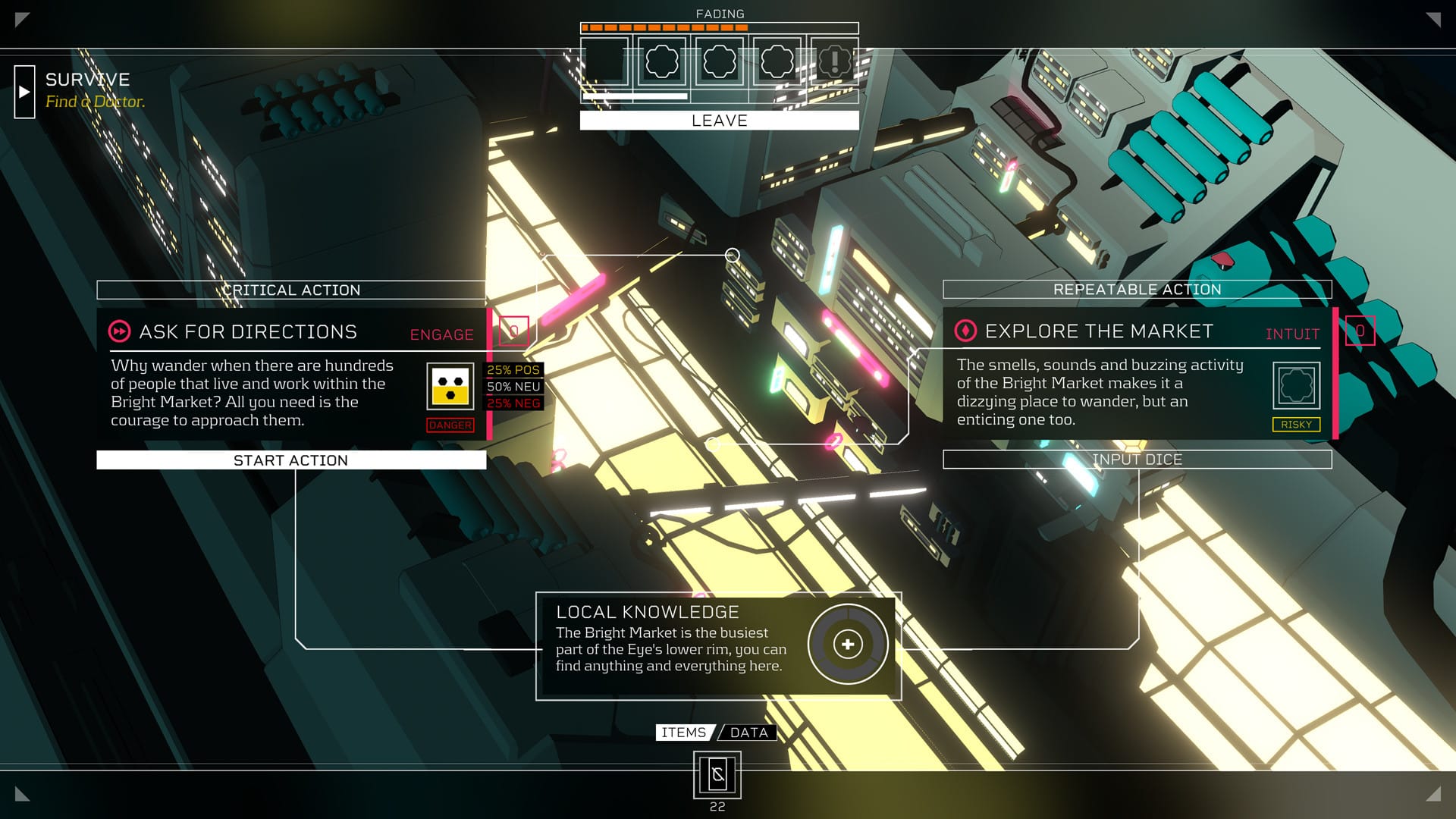
I really enjoy the Citizen Sleeper games. Citizen Sleeper, especially the first game, is based on The Mushroom at the End of the World, the book by Anna Tsing about the Matsutake pickers. It’s a really cool game about trying to build community resilience in the face of a crumbling capitalist society, essentially.
[Tsing’s Mushroom is a very important book here at Worldbuilding Agency, folks; strongly recommended. – PGR]
PGR: One more? Doesn’t have to be a game!
JV: There’s a game about stealing back colonial museum artifacts. It’s called ReLooted; a game where you reclaim African artifacts from Western museums, which is a very fun game idea. It’s an African-futurist heist game.
PGR: Nice, okay. I’m really glad to hear the shout out for Citizen Sleeper. I can’t even remember how I found it, I kind of blundered into it on Steam and thought, oh, this looks affordable and interesting. A lot of sci-fi games these days seem to be very first-person-shooter, which doesn’t interest me at all. So I gave Citizen Sleeper a go on the off chance, I thought, I’ll try it for an hour. And I played it all through the first time, I think it took me eight hours, just non-stop. Because the writing is so good! The writing is amazing.
This is a bias, obviously, coming from the literature side—but sometimes writing, especially dialogue and narrative, is sometimes actually the weakest point in a lot of games. I thought, this is so good, so unusually good. And so I looked it up, and of course, the developer has a PhD in experimental fiction from Goldsmiths. So I was like, oh, right—that makes sense!
JV: That makes sense, right?
PGR: Yeah, yeah. I wasn’t as impressed by the second one. I felt it was broader mechanically, but the story didn’t grab me in the same way as the first one.
JV: It’s a little bit less ecological as well; I like the ecological entanglement kind of vibes with the mushrooms and so on in the first game.
PGR: I think that’s part of it, but I think the closeness of focus... the second one is still first person, but then you have the team. And I think the closeness and the kind of the focus on the loneliness in the first one is really important.
JV: If you know Citizen Sleeper already, I can replace that recommendation with another one, a game I really love called The Cosmic Wheel Sisterhood. It’s set loosely in a climate-changed future, but it’s about a cult of witches who live in space, and you’re making tarot cards for your friends while being exiled in a sort of cosmic prison. It’s an amazing game.
PGR: That’s quite a setup!
JV: Yeah. I like it.
PGR: Going back to what you were saying about procedural rhetorics as well, one of the first things that really woke me up to the possibilities of this stuff was how in Citizen Sleeper, the way the entire gameplay is based on, like, you’re waiting for stuff, but having to do tedious things in order to be able to do other things. I wrote a piece about this for Vector, the British Science Fiction Association’s magazine: the mechanics are just like late stage capitalism, right?
Like, OK: you have shitty part-time jobs that you have to hustle to find, and they’re tedious, and you might get paid, and you might get hurt. And the affect of the experience, it comes with that same sort of sense of anxiety and waiting and rolling the dice to see what happens, right? It really captures... I mean, obviously it’s set in a far future, but it’s so now in that sense. I think that’s really a part of what chimed with people about it.
JV: I agree.
PGR: Yeah, special stuff. Brilliant. Thank you so much for making the time, man. It’s really appreciated.
JV: I’m glad we finally got to talk!
Thanks for dropping by and reading this interview. There's a bunch of others already on Worldbuilding Agency, and I'm arranging more to come. Subscribing is free, gives you good stuff to read, and helps me feel that I'm not just throwing my words and thoughts into an AI-despoiled digital wasteland!



Comments ()